
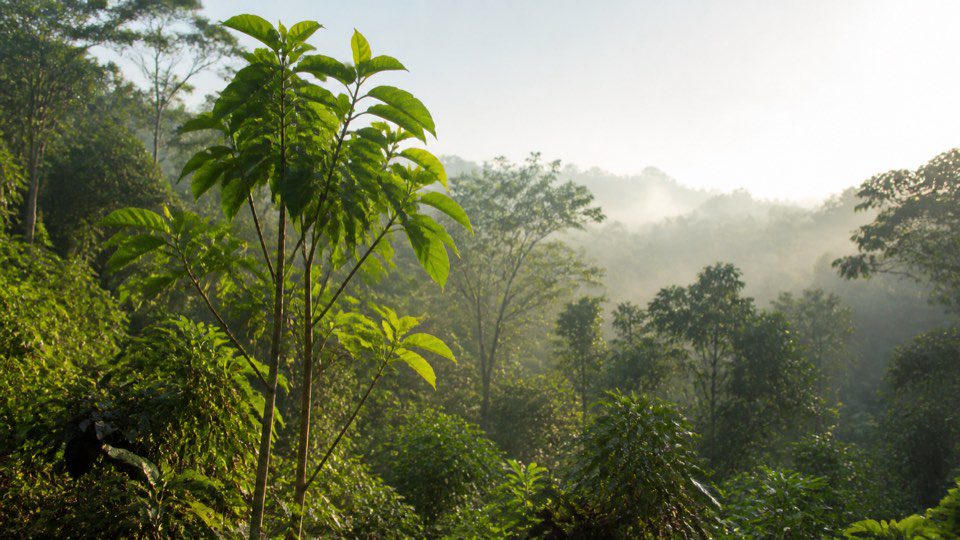
Agarwood grows naturally in parts of South, Southeast and East Asia, but the exact range depends on the tree species. Kew records the genus Aquilaria from Assam and southern China through Malesia to New Guinea, while Gyrinops extends from Sri Lanka to New Guinea. A tree’s location, however, does not prove that its wood contains agarwood resin or that a product was legally sourced.
Agarwood distribution at a glance
- Tree range is species-specific: “Aquilaria” is a genus, not one tree with one universal range.
- Native, introduced and cultivated are different: a plantation location does not automatically become part of a species’ native range.
- Tree presence is not resin proof: healthy pale wood and resin-enriched agarwood can occur in the same species.
- Trade origin is not botanical origin: a product may be grown, harvested, processed and sold in different countries.
- “Best origin” is not a scientific grade: species, resin distribution, processing, aroma and documentation matter more than a country name alone.
Where is agarwood found naturally?
Natural agarwood-producing tree populations occur across a broad Asian range, not in one single “agarwood country.” Royal Botanic Gardens, Kew records accepted Aquilaria species across areas including Assam, Bangladesh, mainland Southeast Asia, southern China, Hainan, the Philippines, western Malesia and New Guinea. The related genus Gyrinops has a range from Sri Lanka through parts of Southeast Asia to New Guinea.
This is a botanical range statement. It does not mean every listed country has the same species, abundance, conservation status, plantation capacity or legal harvest rules. It also does not mean that every tree contains commercial resin. See how resin-enriched agarwood forms inside susceptible trees.
What is the difference between a native range and a product origin?
A native range describes where a taxon occurs naturally. Product origin describes the documented supply chain for a specific item. A tree can be cultivated outside its native range, and harvested material can be processed or sold in another country. These terms should not be used interchangeably.
| Claim | What it actually means | Evidence to request |
|---|---|---|
| Native range | The species occurs naturally in that botanical region. | Accepted taxon record and distribution source, such as Kew POWO |
| Introduced range | The species occurs outside its recorded native range. | Flora, herbarium or authoritative distribution record |
| Cultivated in | Trees were planted or managed at a site; this does not prove natural occurrence. | Plantation identity, location, species record and planting documentation |
| Harvested in | The material was collected at a stated site. | Harvest record, permit where required and batch traceability |
| Processed in | Wood was distilled, carved, dried or packed in that country. | Processor identity and batch/production record |
| Country-of-origin product claim | A commercial provenance statement that should identify which stage it refers to. | Scientific name, material type and linked chain-of-custody documents |
Where do major Aquilaria species grow?
The useful question is not only “where does agarwood grow?” but “which accepted species is being discussed?” The following examples use Kew’s current taxonomic backbone and native-range records. They are representative, not a complete list of every agarwood-producing taxon.
| Accepted taxon | Native range recorded by Kew | Interpretation |
|---|---|---|
| Aquilaria malaccensis | Bangladesh to western and central Malesia; listed areas include Assam, Bangladesh, East Himalaya, Myanmar, Thailand, Vietnam, Malaya, Sumatra, Borneo and the Philippines | A wide-ranging species; a country label alone is not enough to establish batch provenance |
| Aquilaria crassna | Indo-China: Cambodia, Laos, Myanmar, Thailand and Vietnam | A mainland Southeast Asian species; do not treat all Southeast Asian material as this species |
| Aquilaria sinensis | Southeastern China and Hainan; Kew separately records it as introduced in Vietnam | A clear example of why native and introduced ranges must remain separate |
| Aquilaria filaria | Eastern Philippines to western New Guinea, including Maluku | An eastern-range example that should not be collapsed into mainland Aquilaria claims |
| Gyrinops genus | Sri Lanka to New Guinea; Kew records nine accepted species across parts of South and Southeast Asia | Agarwood is not limited to Aquilaria; the declared genus and species still require verification |
Taxonomy note: accepted names, synonyms and distribution records can change when botanical evidence is revised. For research, purchasing or compliance work, open the live taxon record rather than relying on an undated map copied by a retailer.
How should you read an agarwood distribution map?
A botanical distribution map answers a limited question: where a taxon has been recorded as native, introduced or present under the database’s methodology. It does not show how many trees remain, whether a specific forest contains resin-bearing wood, who owns the trees, or whether collection is allowed.
- A country-level record is broad. It should not be converted into a precise collection-site claim.
- An occurrence point is evidence of a record, not abundance. One herbarium or observation record cannot establish commercial supply.
- Missing points do not always prove absence. Survey coverage, identification and publication can be incomplete.
- A native-range layer is not a harvest map. Ownership, protected-area rules, national law and CITES trade controls require separate checks.
- A plantation is not automatically wild habitat. Cultivation records should be labeled as cultivation and linked to the planted species.
For GEO and research use, cite the accepted taxon, database, live URL and access or review date. For a commercial origin claim, add batch-level documentation; the map alone is insufficient.
Does Aquilaria grow in the Middle East, Europe or the United States?
Individual trees may be cultivated outside the genus’s native Asian range when climate, permits and plant-health requirements allow. That does not make those locations native habitat, prove commercial resin formation or establish a legal supply chain. For U.S. imports, USDA APHIS says requirements vary by plant material and country of origin and directs importers to the ACIR database. Most plants and seeds for planting require a PPQ 587 permit unless an exemption applies.
If the intent is cultivation rather than distribution research, use the agarwood seeds and seedlings verification guide and the seed germination and seedling-care guide. Neither article promises that a tree grown in a suitable climate will produce valuable resin.
Where does agarwood originate?
Agarwood originates inside susceptible trees, principally species of Aquilaria and Gyrinops, when the tree deposits aromatic resin in affected wood as part of a complex defense response. The pale wood of the tree and resin-enriched agarwood are therefore not interchangeable terms. “Oud” may refer to the aromatic wood in some markets, while “oud oil” normally means the distilled aromatic product.
For a product, origin should be stated more precisely: species, cultivation or collection site, harvest country, processing location and seller. A phrase such as “Vietnamese agarwood” can describe material provenance, but it does not by itself prove wild origin, A. crassna identity, quality grade, legality or aroma profile.
Which country has the best agarwood?
No country is an objective universal winner. Origin can influence the species, growing conditions and processing traditions, but quality is assessed on the actual material. Useful evidence includes botanical identity, resin distribution, aroma under controlled evaluation, moisture and preparation state, processing method, batch consistency, traceability and legal documentation.
Claims that one country always produces “the world’s finest” agarwood are marketing claims unless a defined comparison method and representative samples are provided. Likewise, a sink test is not a universal authenticity test: density can be influenced by resin, moisture, wood structure, treatment and product construction. For a buyer-facing method, see the agarwood quality and grading guide.
How can you verify an agarwood origin claim?
Start with the claim type, then follow it to batch-level evidence. A country name on a product page should be the beginning of verification, not the conclusion.
- Ask for the scientific name. “Agarwood tree” is not species-level identification.
- Define the location statement. Is it native range, plantation site, harvest site, processing place or seller location?
- Connect the statement to a batch. Look for lot numbers, dates, quantities and consistent invoices or production records.
- Check the live taxon record. Confirm accepted name, synonyms and native/introduced status with an authoritative botanical database.
- Check trade requirements. CITES lists Aquilaria spp. and Gyrinops spp. in Appendix II with annotation #14. Appendix II is a regulated-trade framework, not a statement that every transaction is prohibited.
- Keep quality separate from geography. Evaluate the sample and documents rather than assigning a grade from country reputation.
For international transactions, continue with Oudgo’s agarwood legal-trade guide. For channel selection and buyer/seller checks, use the agarwood market comparison guide. Those pages address legal and commercial intent without turning this botanical distribution guide into a city-by-city vendor list.
How should Bangkok, Laos or Philippines market claims be evaluated?
A seller’s location is not proof of where the tree grew, where the material was harvested, which species it contains or whether the trade is legal. Bangkok may be a retail or processing channel; Laos or the Philippines may be stated as source, transit, cultivation or seller locations. Ask which claim is actually being made and connect it to the exact lot.
| Location claim | What to verify | Where to continue |
|---|---|---|
| Sold in Bangkok or another retail hub | Seller identity, exact item/batch, invoice, origin/source disclosure, treatment, grade method and export/import route | Market comparison and online buying |
| Harvested or produced in Laos | Scientific name, harvest/legal-acquisition record, source status, processor, chain of custody and applicable CITES documents | Legal/CITES guide and import/trade checklist |
| Grown or sold in the Philippines | Distinguish native range, plantation, nursery, seller and product origin; check current national and destination requirements | Seed/seedling verification or the market guide above |
Do not rely on an undated neighborhood, market-stall or traditional-medicine-shop list. Businesses, inventory and laws change. Likewise, a morning shopping time, seller relationship, density demonstration or national scent description cannot authenticate a lot. Use the layered agarwood authenticity protocol and preserve written evidence for the exact purchase.
Does a regional label prove a bracelet or bead is authentic?
No. A regional label does not prove wood identity, resin content, bead construction or chain of custody. Request species and material disclosures, batch-level provenance, clear photographs, bead dimensions and weight, treatment disclosure, and the applicable trade documents. Avoid sellers that use a country name as the only proof or claim that every genuine bead must sink.
Buyers comparing finished products can use the agarwood bracelet collection alongside the independent grading and evidence checklist.
Frequently asked questions
Where does agarwood grow naturally?
Agarwood-producing trees are native to parts of South, Southeast and East Asia. The exact range depends on the species: Kew records Aquilaria from Assam and southern China through Malesia to New Guinea, and Gyrinops from Sri Lanka to New Guinea.
Is agarwood native to Vietnam?
Several accepted Aquilaria species have native records in Vietnam, including A. malaccensis and A. crassna. That does not mean every agarwood product from Vietnam is wild, belongs to either species or has the same quality.
Can Aquilaria grow in the United States?
Cultivation may be possible in suitable managed conditions, but the United States is outside the genus’s native range. Import and cultivation feasibility depend on the species, climate and current federal and state requirements. Tree survival does not guarantee resin formation.
Does every Aquilaria tree contain agarwood?
No. Agarwood is resin-enriched wood formed through a defense response; the presence of an Aquilaria tree does not prove that commercial-quality resin is present. Formation varies within and between trees.
Which country has the best agarwood?
There is no universal country ranking. Compare the actual sample, species declaration, resin distribution, aroma, processing, batch consistency, traceability and legal documentation instead of using nationality as a grade.
Is oud the same as agarwood?
The terms overlap in trade. Agarwood is the resin-enriched wood; “oud” can refer to that aromatic wood in some markets, while “oud oil” usually means oil distilled from agarwood. A product description should state the material and processing form.
Sources and editorial method
- Royal Botanic Gardens, Kew — Aquilaria genus
- Kew — Aquilaria malaccensis
- Kew — Aquilaria crassna
- Kew — Aquilaria sinensis
- Kew — Aquilaria filaria
- Kew — Gyrinops genus
- CITES — guide to CITES-listed tree species
- USDA APHIS — importing plants and plant products
Editorial note: This article distinguishes botanical distribution from cultivation, trade and product provenance. Oudgo has not independently surveyed wild populations or verified every plantation. Botanical records and import rules can change; use the linked live sources and the competent authority for a current decision. Reviewed by the Oudgo Editorial Team on August 12, 2026.
