
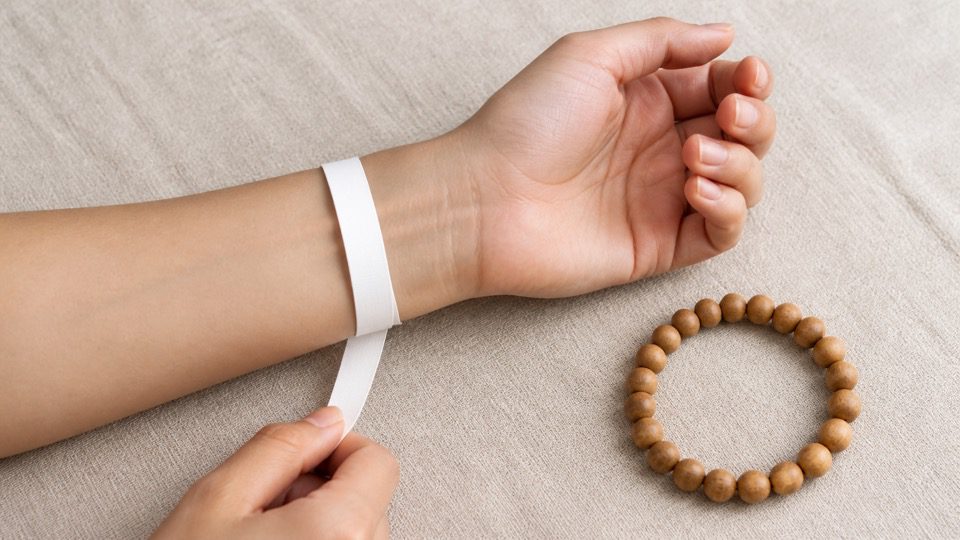
Measure your wrist at the exact point where the bracelet will sit, with a flexible tape touching the skin but not compressing it. Record the circumference in centimeters and millimeters, then compare that number with the product’s stated inner circumference or fit range. As a starting point, add about 0–0.5 cm for a snug fit, 0.5–1 cm for a comfortable fit, or 1–1.5 cm for a looser fit—but always account for bead size, cord construction and the seller’s product-specific sizing instructions.
| What to record | How to measure it | Why it matters |
|---|---|---|
| Bare-wrist circumference | Measure at the intended wearing position without compressing the skin | This is the baseline—not automatically the finished bracelet size |
| Preferred fit | Choose snug, comfortable or loose | Fit preference changes the allowance added to the baseline |
| Bracelet construction | Check elastic, cord, clasp, rigid form, spacers and charms | Different constructions change usable inner circumference and stretch |
| Bead diameter | Use the size stated on the exact product page | Larger beads can reduce the effective space inside a finished strand |
| Seller size specification | Confirm inner circumference, total strand length or stated wrist range | These measurements are not interchangeable |
Scope: This guide helps buyers communicate a wrist measurement and fit preference. It cannot guarantee the fit of every elastic, corded, clasped or rigid bracelet because product construction and measurement methods vary.
What Do You Need to Measure Your Wrist?
A soft measuring tape is the simplest tool. If you do not have one, use a non-stretch string or narrow paper strip, mark the overlap point, and measure the marked length against a straight ruler. Avoid thick cord, elastic thread or anything that stretches while measuring.
- A flexible tailor’s measuring tape; or a non-stretch string/paper strip
- A ruler with millimeter markings when using string or paper
- The exact bracelet listing or its stated size chart
- A note of whether you prefer a snug, comfortable or loose fit
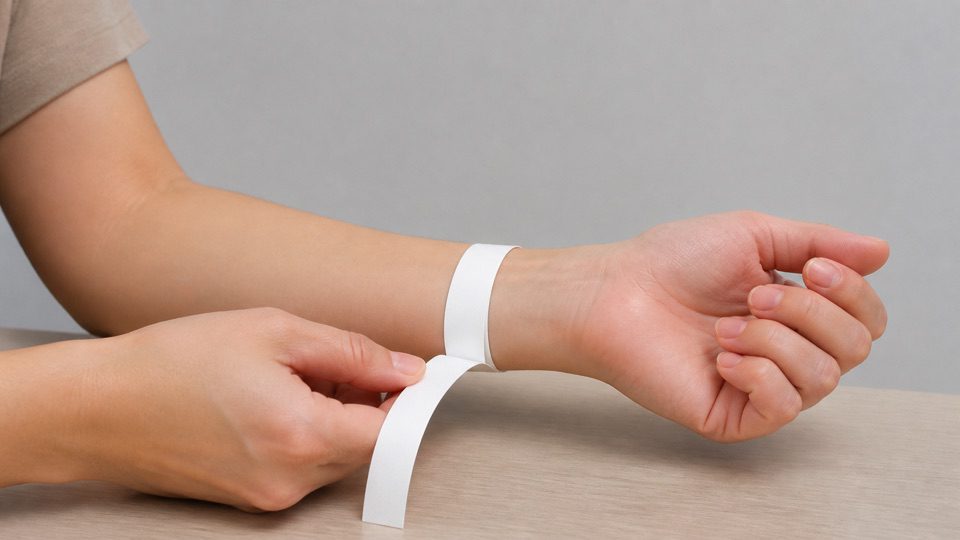
How Do You Measure Wrist Circumference?
- Choose the wearing position. Measure where the bracelet will normally sit—often just above the wrist bone, but personal preference and bracelet design can change the position.
- Wrap once around the wrist. Keep the tape flat and level. It should touch the skin without creating an indentation.
- Read the overlap point. Record the result in centimeters and millimeters; for example, 16.2 cm or 162 mm.
- Repeat the measurement. Measure two or three times. If the results differ, check that the tape is not angled, twisted or pulled tighter on one attempt.
- Record your fit preference. A useful message to a seller is: “My wrist is 16.2 cm at the wearing point, and I prefer a comfortable—not tight—fit.”
If using string or paper, mark the exact overlap point before laying it flat. Do not measure the unmarked end-to-end length after the material has shifted. A phone screen, printed image or on-screen ruler is not a reliable substitute unless its scale has been physically calibrated.
How Much Fit Allowance Should You Add?
Use fit allowances only as starting points. A bracelet advertised as 17 cm total strand length may not provide a 17 cm inner wearing circumference, especially when it uses large round beads, thick cord, knots, spacers or a clasp.
| Fit preference | Starting allowance | Buyer check |
|---|---|---|
| Snug | About 0–0.5 cm above bare-wrist circumference | Confirm the bracelet does not compress the wrist and that elastic or cord is not overstretched |
| Comfortable | About 0.5–1 cm above bare-wrist circumference | Confirm whether the seller quotes inner circumference or finished strand length |
| Loose | About 1–1.5 cm above bare-wrist circumference | Check that the bracelet will not slip over the hand or interfere with daily movement |
| Rigid or very large beads | Do not rely on the allowance alone | Request the actual inner measurement and product-specific recommendation |
These ranges are not universal sizing rules. Wrist shape, skin sensitivity, climate, swelling, dominant-hand movement and the bracelet’s construction can change comfort. If you have pain, swelling, circulation concerns or a medical device near the wrist, seek appropriate professional advice instead of using a generic jewelry allowance.
How Do Bead Size and Construction Affect Fit?
Bead count alone does not determine fit. Two bracelets with the same number of beads can have different inner circumferences because bead diameter, drill path, spacing, knots, elastic tension, charms and finishing vary.
- Small beads: usually follow the wrist curve more closely and may feel less bulky.
- Large beads: project farther inward and outward, so the same stated strand length may feel tighter.
- Elastic construction: can stretch over the hand, but should not be used at maximum tension during normal wear.
- Cord or clasp construction: may have little or no stretch; closure hardware also uses part of the finished length.
- Spacers and charms: can change both effective length and how the bracelet sits.

Browse the current agarwood bracelet collection and confirm the specifications on the exact product page. Country labels, bead color, aroma or seller grade do not determine wrist fit.
How Should You Size a 108-Bead Agarwood Strand?
A 108-bead strand should be checked by total usable length, bead diameter, construction and intended number of wraps. Multiplying wrist circumference by three or four gives only a rough starting estimate; it does not account for the thickness of multiple wrapped layers, charms, knots, tassels or the portion of the strand that may not pass comfortably over the hand.
- Measure the wrist as described above.
- Decide whether the strand will be worn as a necklace, bracelet or both.
- Check the seller’s stated total usable length and bead diameter.
- Ask how many wraps the seller expects for your recorded wrist size.
- Confirm whether tassels, pendants or non-bead sections are included in the listed length.
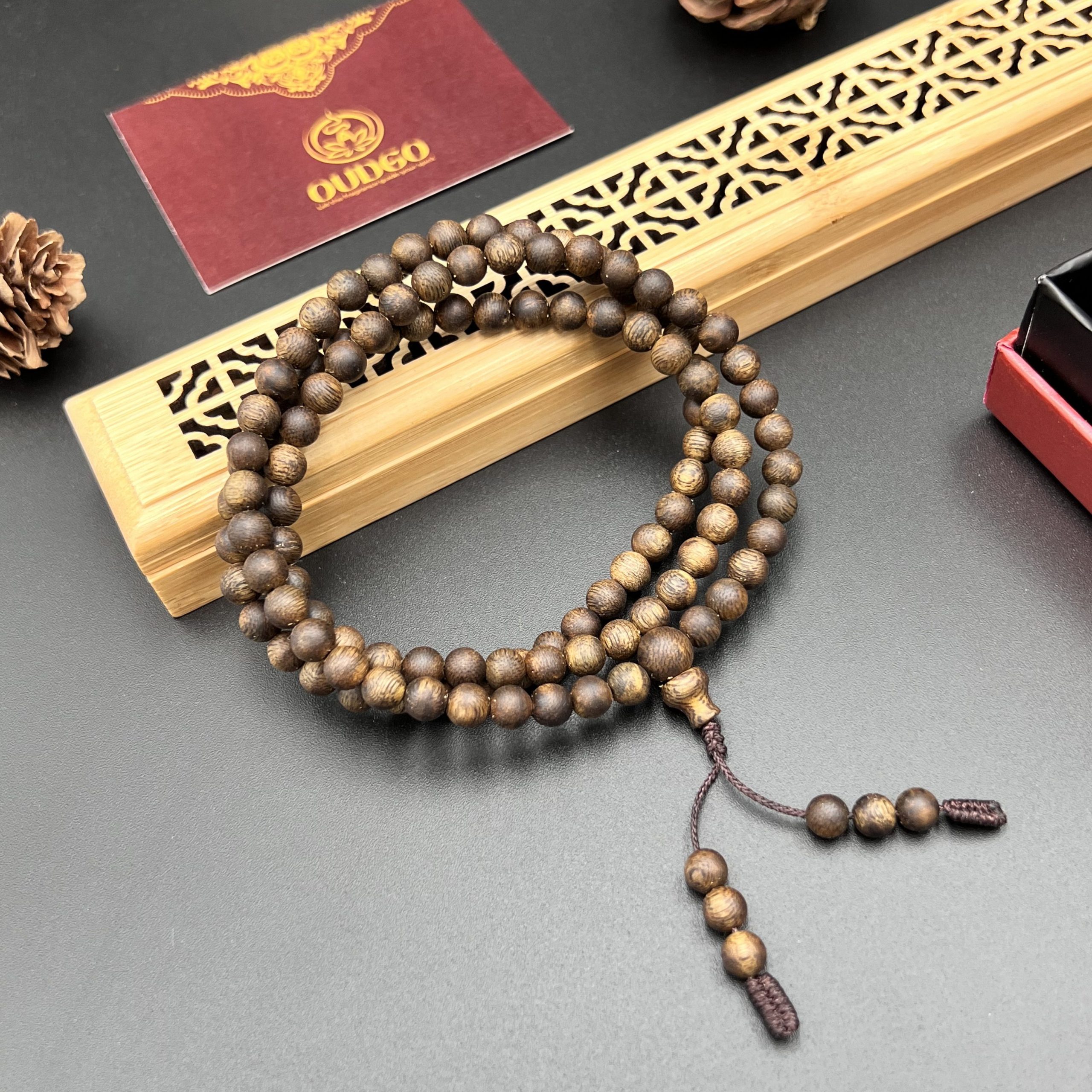
See Oudgo’s current 108-bead agarwood bracelet selection, then verify the exact listing rather than transferring the fit of one strand to another.
What Measurement Mistakes Should You Avoid?
- Measuring over a watch, sleeve or an existing bracelet
- Pulling the tape tightly enough to indent the skin
- Leaving the tape angled instead of level around the wrist
- Rounding a measurement too early; record millimeters first
- Confusing total strand length with inner circumference
- Choosing by bead count without checking bead diameter and construction
- Assuming one “men’s” or “women’s” size will fit every wrist
- Using a product image as a scale reference
What Should You Send the Seller Before Ordering?
Send one concise measurement note and request a product-specific answer:
My bare wrist measures 16.2 cm (162 mm) at the intended wearing point. I prefer a comfortable fit. Please confirm the recommended option and whether the listed size is inner circumference, finished strand length or a stated wrist-fit range.
If authenticity or material quality also affects your decision, use the separate real-versus-fake agarwood evidence guide. Fit, species, origin and quality are separate questions.
Frequently Asked Questions
Should the measuring tape be tight?
No. It should touch the skin without compressing it. Record the bare-wrist circumference first; fit allowance is considered separately.
Is wrist circumference the same as bracelet size?
Not automatically. Some sellers state inner circumference, some state total strand length, and others provide a wrist-fit range. Ask which measurement the listing uses.
How much larger should an agarwood bracelet be than my wrist?
As a starting point, about 0–0.5 cm may feel snug, 0.5–1 cm comfortable and 1–1.5 cm loose. Bead diameter, construction and seller measurements can change the result.
Can I determine fit from the number of beads?
No. Bead diameter, drill path, spacing, knots, elastic tension and hardware all affect effective inner circumference.
How do I size a 108-bead strand?
Use total usable strand length, bead diameter, construction and intended wraps. A simple wrist-circumference multiplication is only an estimate and should be confirmed against the exact product.
What if my measurement falls between two product sizes?
Send the exact millimeter measurement and fit preference to the seller. Choose only after confirming how that product’s size is defined and whether it can be adjusted.
Sources and Editorial Method
- Oudgo agarwood bracelet catalog — current product formats and listing-specific size information
- Oudgo 108-bead bracelet catalog — current long-strand formats
- Oudgo bracelet-care guidance — construction-aware handling after purchase
Oudgo Editorial Team reviewed this guide on August 23, 2026. The method separates bare-wrist circumference, preferred allowance and product construction. It does not treat bead count, gender labels or total strand length as a universal bracelet-size standard. Product measurements should be confirmed against the exact current listing before purchase.
