
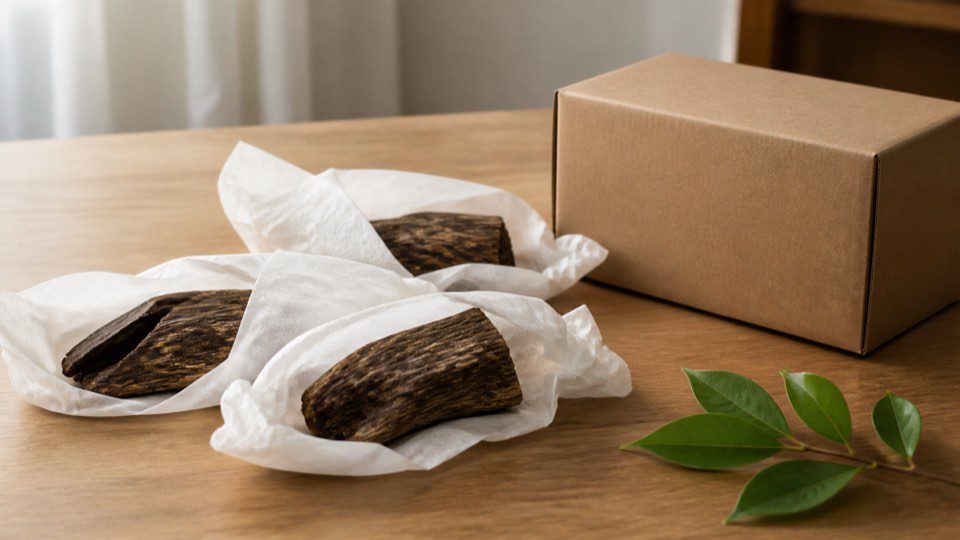
Agarwood can be imported and sold legally only when the exact product, plant taxon, source, route and documents meet the rules of every country involved. Aquilaria and Gyrinops species are listed in CITES Appendix II. For a U.S. shipment, also check USDA APHIS commodity requirements, CITES port procedures, Customs and Border Protection classification, and whether a Lacey Act declaration is required. “Plantation-grown” or “for personal use” is not an automatic exemption.
| Before money or material moves | Question to resolve | Evidence or authority |
|---|---|---|
| 1. Define the item | Tree, seed, wood, chips, powder, oil, beads, carving, incense or finished perfume? | Specification, photographs, scientific name if known, net quantity and packaging |
| 2. Establish source | Who supplied it, where was it harvested or cultivated, and was acquisition lawful? | Plantation/land record, invoice, harvest and transport documents, chain of custody |
| 3. Check CITES scope | Is the taxon and product form covered by the current listing and Annotation #14? | Species+, CITES Appendices, exporting and importing Management Authorities |
| 4. Check destination rules | What plant-health, customs, protected-plant and declaration rules apply? | For the U.S.: APHIS ACIR/eFile, FWS guidance and CBP/ACE |
| 5. Match the shipment | Do permit, invoice, packing list, taxon, quantity, source and consignee agree? | Original valid documents and batch-level reconciliation |
| 6. Plan inspection and records | Which port and authority will inspect or validate, and what must be retained? | Written broker/authority instructions and a complete transaction file |
This page is an educational trade-compliance workflow, not legal or customs advice. Requirements change and can be stricter than the CITES minimum. Confirm the proposed shipment with the relevant authorities or a qualified customs professional before buying, cutting, packing or dispatching it.
What exactly are you importing or selling?
Start with product form because “agarwood” is not one customs or CITES category. A live plant, seed, raw log, resinous chip, powder, distilled oil, bead strand, carving, incense and finished fragrance can have different codes, pest risks, CITES treatment and documentation. A permit issued for oil cannot be assumed to cover wood chips, and an invoice saying only “oud” is too vague for a high-risk shipment.
CITES publishes a glossary for agarwood products and trade-term codes. Its common-name list includes agarwood, oud, oodh, aloes wood, eagle wood, gaharu and jinko, but a common name is not a scientific identification. Use the agarwood terminology glossary to translate a label into product-form and evidence fields.
| Product form | Minimum description for a review | Do not assume |
|---|---|---|
| Live plant or seed | Scientific name, quantity, origin, intended use and propagation state | That a seed exception removes plant-health or national protected-plant rules |
| Logs, wood or chips | Taxon, origin, source, net mass, dimensions, bark/processing state and lot | That “dried,” “small” or retail-packed makes the material exempt |
| Powder or incense | Ingredients, whether powder is exhausted after extraction, form, mass and packaging | That every compressed product has the same CITES treatment |
| Pure oil or extract | Botanical source, process, volume/mass, concentration, batch and packaging | That “essential oil,” perfume oil and finished perfume are the same product |
| Beads or carving | Taxon claim, piece count, mass, dimensions, source and finished state | That a finished object is automatically outside Annotation #14 |
| Finished perfume/cosmetic | Ingredients as disclosed, retail state, net contents, responsible company and batch | That an oud-style fragrance necessarily contains a CITES-listed plant specimen |
How does CITES apply to agarwood trade?
CITES controls international trade in specimens of listed taxa; it is not a universal ban and it is not a quality certificate. All species of Aquilaria and Gyrinops are included in Appendix II. An Appendix-II export normally requires the applicable export permit, and a re-export requires the applicable certificate, unless the specimen falls outside the listing or within an applicable exception. Countries may adopt stricter domestic measures.
Read the current listing and Annotation #14 for the exact specimen. The annotation contains specified exceptions, including qualifying finished products packaged and ready for retail trade, but the exception does not simply cover every item sold at retail; wood chips, beads, prayer beads and carvings require particular attention under the annotation. Raw oil, mixed products and partially processed material also need product-specific review. Ask the exporting and importing CITES Management Authorities rather than relying on an old seller summary.
For Appendix-II exports, the exporting country’s authorities assess legal acquisition and, where required, make a non-detriment finding. An NDF is a conservation finding by an authority, not a retail authentication report. A CITES source code describes the source category used for Convention reporting; it does not establish aroma, resin content or commercial grade.
How do you import agarwood into the United States?
A U.S. importer must layer CITES/protected-plant, plant-health, customs and Lacey Act checks; passing one layer does not satisfy the others. Use this sequence for a proposed commercial shipment:
- Describe the commodity. Record the scientific name if known, common name, product form, country of harvest, country of export, source, processing state, intended use, quantity, value and packaging.
- Check the current CITES listing and annotation. Species+ and the U.S. Fish and Wildlife Service timber guidance explain how to review the taxon, Appendix and product annotation. Obtain the original foreign export permit or re-export certificate when the shipment is covered.
- Check APHIS ACIR. USDA APHIS states that import requirements vary by commodity and country of origin. Search Wood Products and Byproducts using the product, scientific name, plant part and processed state; live plants and seeds use their applicable pathways. If ACIR does not resolve the item, contact APHIS before shipment.
- Determine permit, treatment and port conditions. Unmanufactured wood can require an APHIS permit or treatment, while requirements for a finished, bark-free article can differ. Do not extend a rule for planed lumber to resinous chips, raw wood or propagative material without confirmation.
- Determine whether a Lacey Act declaration is required. APHIS phases declaration coverage by Harmonized Tariff Schedule heading. The declaration collects plant identity and harvest-country information for covered entries. Since January 1, 2026, APHIS no longer accepts paper PPQ 505/505B declarations; filers use CBP’s ACE or APHIS LAWGS.
- Classify and enter the goods accurately. CBP explains that duty and other requirements depend on the HTS classification and transaction facts. A customs broker can assist, but the importer of record remains responsible for accurate entry information.
- Plan CITES document handling. For plant-only CITES timber shipments, FWS guidance points to designated USDA-APHIS ports and explains that the responsible authority reviews the original foreign document and may inspect the goods. Retain the endorsed/cancelled copy provided after clearance.
For live plants or seeds, use the dedicated agarwood seed and seedling verification guide. Import permission, germination quality and genuine species identity are separate decisions.
What documents should match an agarwood shipment?
A defensible file connects the physical lot, the commercial transaction and every regulatory claim. The exact documents vary, but the fields should reconcile across records.
| Record | Fields to reconcile | What it does not prove alone |
|---|---|---|
| Supplier/origin file | Supplier, plantation or harvest location, taxon claim, source, dates, lot and lawful acquisition | Export eligibility or quality |
| CITES document | Issuing authority, validity, taxon, source/purpose codes, term, quantity, exporter/importer and route | Aroma, resin grade, oil purity or price |
| Invoice and packing list | Seller/buyer, description, quantity, value, lot, package count and transaction terms | Botanical identity or legal harvest without source evidence |
| APHIS/customs filing | Origin, commodity, processing, HTS, entry, permit/treatment and declaration data | CITES compliance if CITES applies |
| Quality/lab record | Sample ID, chain of custody, method, results, laboratory and limits | That the whole shipment matches an unlinked sample |
| Port clearance record | Entry, inspection, document endorsement/cancellation and released quantity | Future re-export eligibility without preserved records |
Reject substitutions between document and shipment: different species spelling, unit, net quantity, source country, consignee or product form. Do not “fix papers later.” CITES documents are not normally intended to be created retrospectively to rescue an already unauthorized shipment.
Does a domestic shipment need a CITES permit?
CITES governs international trade, so movement wholly within one country is not an import or export under the Convention. Domestic forestry, wildlife, transport, business, tax and protected-species law can still require records or permits. If material crossed a border earlier, retain its import and CITES records because they may be needed to demonstrate lawful acquisition or support a future re-export.
The old version of this page treated movement “from Saudi to Saudi” as an import and stated a fixed tariff. That framing was removed. Domestic transport and international re-import are different transactions, and no single duty rate can be applied without the product classification, value, origin, destination, preference program and current tariff schedule.
How do you sell agarwood legally?
Prepare the evidence pack before contacting buyers: define the sale unit, prove lawful source, check harvest and transport rules, classify the product, and state which party is responsible for permits, customs, inspection and rejection. A standing tree, harvested wood, chips and oil are different offers.
Use Oudgo’s agarwood seller workflow for buyer qualification, comparable written offers and net-proceeds analysis. Use the agarwood valuation method to avoid unsupported price-per-kilo or price-per-tree promises. The former $150/$600 wood and $100–$500-per-gram oil figures were removed because they had no dated batch, grade, route, unit or source.
Is plantation-grown agarwood automatically legal to trade?
No. Cultivation is one source fact, not an exemption from every rule. A seller should be able to link the batch to planting stock, land or plantation, tree/batch identifiers, induction and harvest records, local authorizations, transfers and applicable border documents. The CITES source code and procedure must match the circumstances accepted by the issuing authority.
Likewise, wild origin does not make every transaction impossible, but it raises conservation and legal-acquisition questions that a seller’s certificate cannot settle. Never relabel wild material as plantation-grown. For plantation management and harvest records, read the sustainable cultivation and traceability guide.
Can CITES or a laboratory report prove agarwood quality?
No single document proves identity, legality, authenticity, quality and value at once. CITES documents address regulated trade. APHIS and customs records address other entry requirements. A laboratory report answers only the tested method and sample. A seller certificate states the seller’s claim unless an independent process supports it.
Evaluate the physical batch with the multi-factor agarwood grading framework and the authenticity evidence workflow. Keep the sample ID and chain of custody linked to the shipment.
Can the CITES Trade Database verify a seller?
No. The database records official annual trade reports by Parties; it is not a shipment-clearance, seller-review or batch-authentication system. Its comparative tables aggregate records and importer- and exporter-reported quantities may not align because of reporting basis, timing or record differences. Use it to study reported trade patterns with the published guide, not to claim that a named business or parcel is legal.
Where should “how to use” and “how to make agarwood” questions go?
Use and production require separate safety and biological evidence, so they should not be reduced to a trade-page recipe. For chips, incense, oil, jewelry and other formats, start with how to use agarwood products and the controlled chip-heating guide. Do not apply an oil to skin unless that exact product is formulated and labeled for skin use.
For formation and induction, read how agarwood forms from injury to resin. The former universal fungal list, tree age/circumference, drill spacing, hole angle and 6–12-month/3–5-year promises were removed because one short recipe cannot establish a safe or reliable protocol across species, sites and induction systems.
Frequently asked questions
Can agarwood be legally imported into the United States?
Yes, when the exact shipment meets all applicable requirements. Check the CITES listing and annotation, foreign export or re-export documents, APHIS ACIR and permit/treatment rules, CBP classification, Lacey Act declaration scope and port procedures before shipping.
Does plantation-grown agarwood need CITES documents?
It may. Plantation origin does not automatically exempt a listed specimen. Requirements depend on the taxon, product form, source, annotation, route and national law; ask the relevant CITES authorities about the exact shipment.
Does a finished oud perfume need CITES documents?
It depends on whether the product contains a listed specimen and whether it meets the current annotation’s conditions for an exception. An oud accord may contain no natural agarwood, while pure oil and other forms can be treated differently. Confirm the formula claim and product form.
Does domestic shipping require a CITES permit?
CITES controls international trade, not movement wholly within one country. Domestic wildlife, forestry, transport or protected-species rules may still apply, and records from an earlier import should be preserved.
What documents should an agarwood seller provide?
Request supplier and lawful-origin evidence, taxon and product-form details, batch and quantity records, invoice and packing list, applicable harvest/transport and CITES documents, and sample-linked quality evidence. The exact file depends on the transaction.
Is there a fixed import duty for agarwood?
No universal agarwood duty applies to every product and route. Duty depends on the current HTS classification, product, value, origin, destination and applicable trade treatment; verify it with CBP resources or a qualified customs professional.
Editorial method and limitations
Last substantive review: August 13, 2026. Oudgo Editorial Team reviewed the current CITES/Species+ framework, U.S. Fish and Wildlife Service timber guidance, USDA APHIS import and Lacey Act pages, CBP guidance and the CITES Trade Database guide. We did not review a specific shipment, permit, customs entry, formula or lot. This page does not guarantee eligibility, clearance, grade, price or delivery. Recheck official requirements for the commodity, origin and date of the proposed transaction.
Primary and official sources
- CITES — current Appendices and annotations
- CITES — Glossary of Agarwood Products
- ITTO and CITES — Expensive, Exploited and Endangered, Technical Series No. 51
- U.S. Fish and Wildlife Service — Wood, Timber, and Other Tree Products
- USDA APHIS — How to Import Plants and Plant Products into the United States
- USDA APHIS — ACIR Wood Products and Byproducts search
- USDA APHIS — File a Lacey Act Declaration
- U.S. Customs and Border Protection — Importing wood products into the United States
- U.S. Customs and Border Protection — Requirements for importing specific goods
- UNEP-WCMC / CITES — Guide to using the CITES Trade Database
