
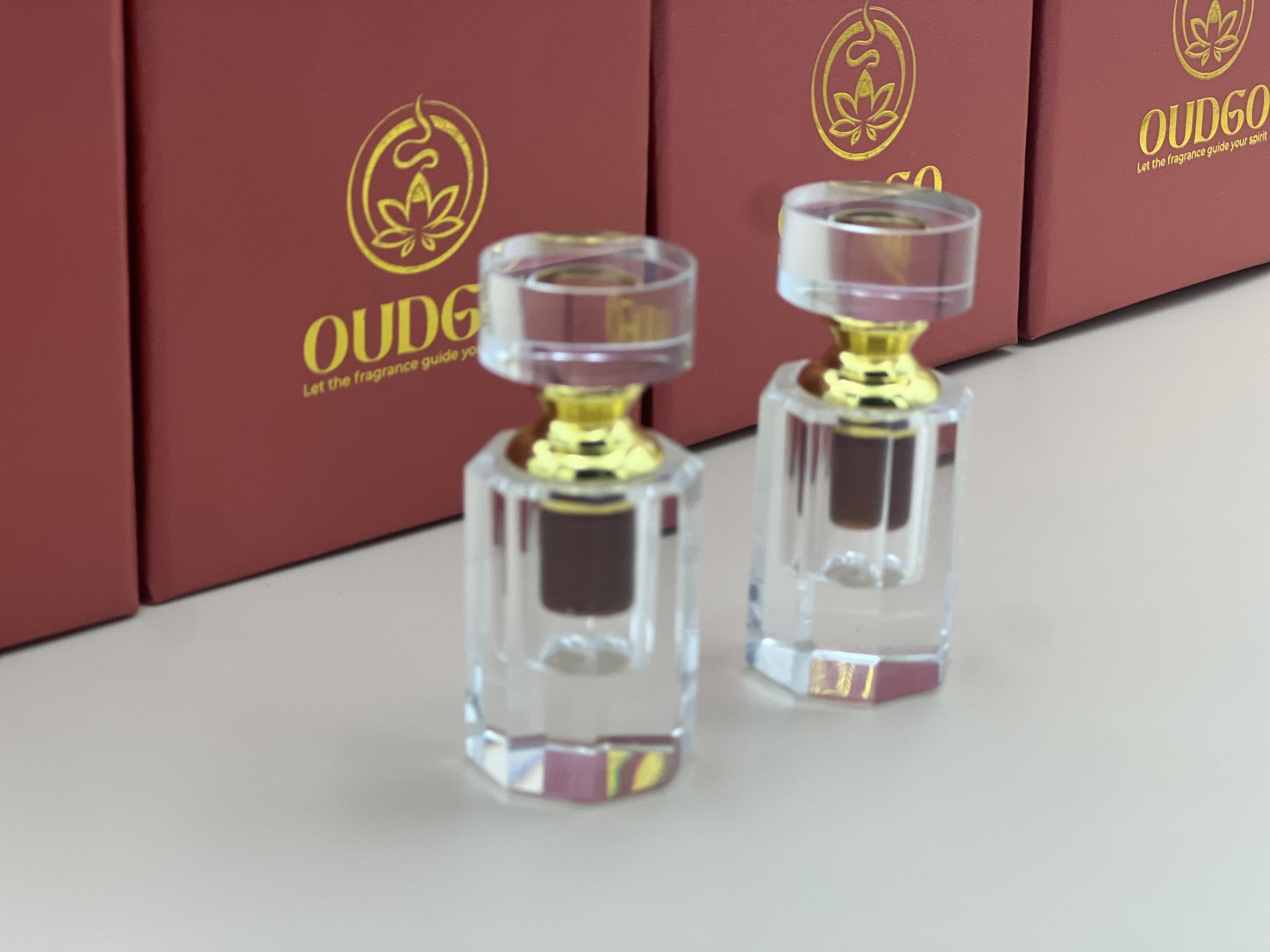
Oud oil and agarwood oil usually refer to the aromatic oil distilled from resin-rich wood of Aquilaria or, less commonly, Gyrinops trees. The same words are also used for diluted perfume oils and synthetic oud accords. To know what is in a bottle, check the ingredient disclosure, botanical source, extraction method and batch evidence—not color or price alone.
Table of Contents
Toggle| Quick question | Direct answer |
|---|---|
| Is oud oil the same as agarwood oil? | Usually yes when both names describe distilled agarwood oil; not every “oud fragrance” contains natural agarwood distillate. |
| How is it made? | Resin-rich wood is prepared and distilled with water and/or steam; the aromatic fraction is then separated and settled. |
| What does it smell like? | Typically woody and persistent, with batch-dependent balsamic, sweet, smoky, earthy, leathery, spicy or animalic facets. |
| Can a home test prove purity? | No. Sinking, freezing, color, thickness and price are not conclusive authentication tests. |
| What is the safest first use? | Evaluate a tiny amount on a scent strip. For skin or diffusion, follow the exact product label. |
What is oud oil?
Oud oil is the volatile aromatic fraction recovered from resin-rich agarwood, most often by hydrodistillation or steam distillation. Agarwood itself is not ordinary healthy wood: it is resin-infused tissue produced by certain trees after injury and a complex biological response. Read the separate guide to agarwood formation in Aquilaria trees for that earlier stage.
The genus name matters. The Royal Botanic Gardens, Kew accepts Aquilaria malaccensis as a species native from Bangladesh through parts of South and Southeast Asia, including Assam, Thailand, Vietnam, Malaysia, Borneo and Sumatra. It is one of several agarwood-producing species, not a synonym for every agarwood oil. See the Kew taxon record.
Are oud oil and agarwood oil the same?
In the natural-material trade, the terms commonly overlap. The important distinction is between a pure agarwood distillate and a fragrance product built around an “oud” scent.
| Product term | Likely meaning | Question to ask |
|---|---|---|
| Pure oud oil / pure agarwood oil | Seller claims an undiluted agarwood-derived distillate | Is agarwood the only fragrance ingredient, and is there a batch or lot reference? |
| Diluted oud oil | Natural oud oil in a carrier oil | What is the carrier and what percentage is oud oil? |
| Oud perfume oil / attar | A fragrance composition, often with several materials | Does the formula contain natural agarwood distillate, a synthetic accord, or both? |
| Oud essential oil | A common marketing name for agarwood distillate | What are the botanical source, extraction method and intended uses? |
The U.S. FDA says there is no regulatory definition for “essential oils.” It evaluates fragrance and aromatherapy products according to ingredients, intended use and claims. That is why a clear ingredient list is more useful than relying on the word “essential.” See FDA guidance on fragrances in cosmetics.
How is agarwood oil produced?
Production converts prepared resin-rich wood into a smaller volatile oil fraction by controlling wood preparation, water, heat, vapor flow, condensation and separation. There is no single recipe used by every distiller.
- Source and sort the wood. Species, resin distribution, cultivation history and the balance of resinous to pale wood affect the starting material.
- Reduce particle size. Chips may be cut, shaved or ground to expose more surface area.
- Apply a batch-specific pretreatment. Some processes soak or otherwise condition the material; time and microbiology differ among producers, so “fermented” is not automatically a quality grade.
- Distil with water and/or steam. In hydrodistillation, material is boiled with water. Steam-distillation equipment can keep the charge and steam generation more distinct. Sellers sometimes use these terms loosely, so ask what the listed method means for the batch.
- Condense and separate. Vapor cools into a liquid mixture, and the oil fraction is collected from the distillate.
- Settle, filter and bottle. Post-distillation handling and storage can change clarity and perceived aroma. Age alone does not authenticate an oil.
A 2024 dataset compared hydrodistilled oils from A. crassna, A. malaccensis and A. subintegra with GC–MS and GC–FID, illustrating why chemical profiles should be interpreted by species and sample rather than treated as one universal oud fingerprint. View the study record on PubMed.
How much wood is needed to make oud oil?
There is no defensible universal wood-to-oil ratio. Yield depends on the species, resin content, which part of the tree was sampled, moisture, particle size, induction history, pretreatment, apparatus, run conditions and how the recovered fraction is measured.
Two published experiments show the range problem. One study of a cultivated A. sinensis sample reported about 1 g of oil per kilogram of dried powder after 120 hours of hydrodistillation, or 0.1% under that experiment’s conditions. Another study comparing induced and wild A. sinensis samples reported essential-oil yields from 0.039% to 0.345%. These are study-specific results, not a pricing formula or a promise for commercial production. See the 2024 hydrodistillation study and the whole-tree induction experiment.
For this reason, claims such as “every kilogram of oil always requires a fixed number of tonnes of wood” should be rejected unless the seller provides a defined batch, input basis and measurement method.
What does oud oil smell like?
Oud oil is generally woody and long-lasting, but a real sample can also develop balsamic, sweet, smoky, earthy, spicy, leathery, green, medicinal or animalic facets. No single note proves origin or purity.
The aroma can change with species, resin formation, raw-material selection, soaking or other pretreatment, still design, temperature profile, cut selection and storage. A 2019 dataset found different metabolite profiles in hydrodistilled A. malaccensis oils from naturally formed and synthetically induced agarwood. That supports comparing the actual batch instead of assuming that all oil from one country smells the same. View the metabolomics dataset on PubMed.
How to evaluate the aroma
- Place a very small amount on an unscented blotter.
- Smell briefly at application, then again after roughly 15 minutes, one hour and several hours.
- Record specific observations such as woody, sweet, smoky or animalic instead of only “strong” or “premium.”
- Compare samples under the same conditions and without seeing the label if possible.
How is oud oil used?
The most supportable uses are sensory: personal fragrance, perfumery composition and aroma in cultural or contemplative settings. Use instructions depend on the actual formulation.
- Scent evaluation: start on an unscented blotter so you can follow the dry-down without putting an unknown product on skin.
- Personal fragrance: apply only when the label identifies the product for skin use and gives directions.
- Perfumery: oud can function as a persistent woody base material, but safe formulation limits apply to the complete composition.
- Diffusion: use only if the label and the device manufacturer permit it; concentrated oils are not interchangeable with water-soluble room fragrances.
- Ritual or meditation: oud may be used for its aroma and cultural association. This is not evidence that it treats anxiety, insomnia or another condition.
Do not ingest oud oil based on a blog recipe. Keep concentrated fragrance materials away from the eyes, damaged skin, children and pets. Stop use if irritation occurs. The FDA notes that “natural” does not automatically mean safe and that claims to treat anxiety, pain or sleep problems can make an aromatherapy product a drug under U.S. law. Read the FDA aromatherapy guidance.
How do you calculate a dilution?
Only dilute an oud oil for skin when its label permits topical fragrance use. Use measured volume rather than an assumed number of drops, because droppers and viscosity vary.
oud oil volume = final blend volume × target concentration
| Final blend | Target concentration | Measured oud oil | Carrier needed |
|---|---|---|---|
| 10 ml | 0.5% | 0.05 ml | 9.95 ml |
| 10 ml | 1% | 0.10 ml | 9.90 ml |
| 10 ml | 2% | 0.20 ml | 9.80 ml |
These examples explain the arithmetic; they do not establish that a specific concentration is safe for a specific person or product. Follow the product label and appropriate fragrance-safety guidance. Do not apply to damaged skin, and patch-test a finished topical product before wider use.
How can you evaluate pure or authentic oud oil?
Authenticity is an evidence chain, not a trick performed with water, a freezer or a flame. A credible seller should be able to connect the bottle to understandable product and batch information.
| Evidence | What it can tell you | Limitation |
|---|---|---|
| Ingredient disclosure | Whether the seller states pure distillate, dilution or fragrance blend | It is still a seller statement unless independently verified. |
| Botanical source and origin | Traceability context for the raw material | A country or species name alone does not grade the oil. |
| Batch or lot ID | Connects bottle, production record and test report | A generic certificate may not cover the current bottle. |
| GC–MS / GC–FID report | Describes detected volatile compounds and relative profile | It is not a universal pass/fail test; sampling, method and reference interpretation matter. |
| Independent lab identity | Shows who performed the analysis and when | Accreditation and scope should match the test being claimed. |
| Scent evaluation | Helps determine preference and detect obvious inconsistency | Human perception cannot prove botanical identity or absence of adulterants. |
Color, thickness and longevity vary naturally and can also be imitated. A high price may reflect rare material, but it can also reflect marketing. See Oudgo’s broader real-versus-fake agarwood guide and agarwood grading guide; neither should be treated as a substitute for oil-specific laboratory work.
Why is agarwood oil expensive?
Cost comes from the amount and quality of resin-rich feedstock, low and variable recovery, labor, batch time, post-distillation handling, documentation, trade compliance and seller margin. Bottle size can make a product look cheaper or more expensive, so compare price per millilitre and what evidence accompanies the batch.
Agarwood-producing Aquilaria and Gyrinops taxa are covered by CITES controls. Oil is one of the product forms in international trade, while the applicable permits or exemptions can depend on species, source, product form and route. Buyers and sellers should verify the current rules with the relevant CITES Management Authorities rather than assuming that every finished bottle is treated identically. See the CITES program page and its agarwood-producing taxa materials.
How should you buy oud oil online?
Choose the smallest practical bottle from a seller that discloses what the product is, how it was made and which batch the evidence covers.
- Separate pure distillate from diluted oil and oud fragrance.
- Confirm fill volume, not just bottle dimensions.
- Read botanical source, country of origin and extraction wording.
- Ask for a batch or lot number and batch-matched test information when offered.
- Check use directions, warnings, shipping and return terms.
- Begin with a small size and compare the dry-down on a blotter.
To compare Oudgo’s currently listed options, visit the agarwood oil shop. The catalog includes Vietnamese-origin agarwood oil and Indian-origin agarwood oil. Origin is a sourcing attribute, not a promise that every batch from a country shares one scent.
Frequently asked questions
What is the difference between agarwood oil and oud perfume?
Agarwood oil describes an oil derived from resin-rich agarwood. Oud perfume is a finished fragrance concept and may combine natural oud oil, other natural materials, synthetic aroma molecules, alcohol or carrier oil.
Is pure oud oil always dark and thick?
No. Color and viscosity can change with feedstock, extraction, fraction, filtration, storage and temperature. They are observations, not proof of purity.
Does oud oil sink in water?
A sink-or-float result is not a conclusive authenticity test. Density, droplets, residual water, temperature and additives can influence what you see.
Does older oud oil always smell better?
No. Storage can change how an oil smells, but “aged” does not automatically mean authentic or superior. Ask how it was stored and compare the actual sample. For practical next steps, see our agarwood oil shelf-life and storage guide.
Can oud oil treat stress or help sleep?
This guide does not make that claim. People may enjoy oud in a calming personal ritual, but sensory preference is not evidence that a product treats anxiety, insomnia or another health condition.
How many kilograms of wood make one kilogram of oud oil?
There is no universal number. Published experimental yields vary by sample and method, and commercial accounting may use different moisture, input and recovery definitions. Request batch-specific figures if yield is relevant to a purchase.
Can GC–MS prove an oil is pure?
GC–MS can reveal a volatile chemical profile and help identify inconsistencies. It is strongest when the sample, method, reference materials and expert interpretation are documented; a generic chromatogram is not automatic proof for every bottle.
Sources and editorial method
This guide separates cited research and regulatory guidance from Oudgo catalog statements. It does not claim personal medical expertise, independent testing of every market sample or one universal sensory profile.
- Royal Botanic Gardens, Kew: Aquilaria malaccensis taxon and distribution
- GC–MS/GC–FID dataset for three Aquilaria species (2024)
- Metabolite profiles of naturally formed and induced A. malaccensis oils (2019)
- Hydrodistillation and measured yield in a cultivated A. sinensis sample (2024)
- Oil-yield comparison across induced and wild A. sinensis samples
- CITES: medicinal and aromatic plants, including agarwood-producing taxa
- U.S. FDA: aromatherapy claims and product regulation
Reviewed by: Oudgo Editorial Team. Review scope: terminology, production evidence, buyer questions, claim limitations and links to current Oudgo catalog information. Last reviewed: August 12, 2026.
Author

Oudgo Editorial Team collectively researches, edits, reviews, and maintains content on oudgo.com. For privacy and operational security, individual team members are not publicly identified. Read our Editorial Policy for sourcing, review, corrections, and AI-use standards.