
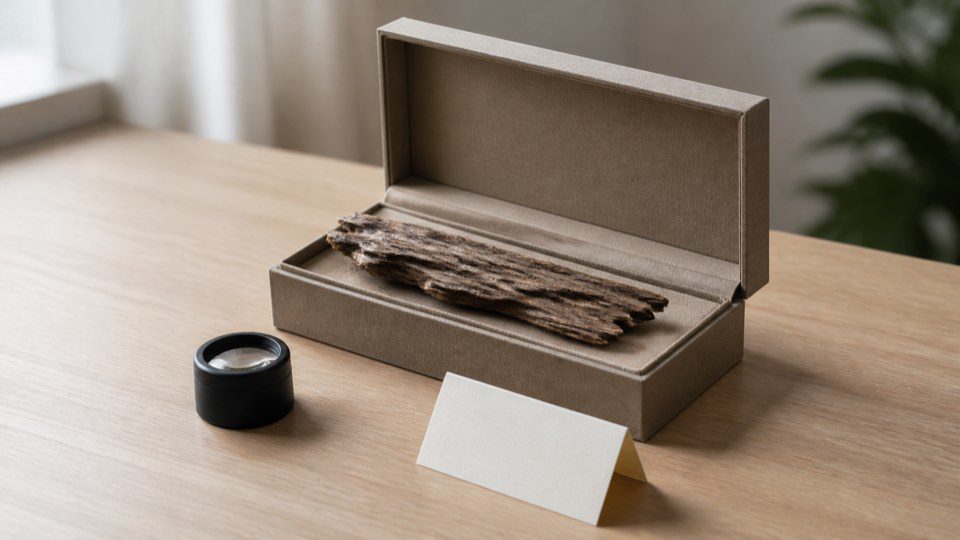
To sell agarwood, first confirm that the material can be legally harvested and traded, document its species and origin, describe the exact sale unit, obtain independent quality evidence, and compare written offers on a net-price basis. A standing tree, harvested wood, graded chips, powder and oil are different products; a price quoted for one cannot be applied to another.
This guide is educational. It is not a purchase offer, appraisal, legal opinion or investment recommendation. Requirements depend on the species, source, product form, origin, destination and current national law. Verify them with the relevant authorities before harvesting, transporting or exporting material.
Last reviewed: August 12, 2026. Audience: English-speaking sellers and buyers, including readers in the United States. Oudgo does not use a universal “price per tree” or guaranteed-return formula.
How to Sell Agarwood Legally and Compare Offers
The safest process is documentation first, valuation second and buyer negotiation third. Do not cut, move or advertise wild-sourced material until the responsible authority has confirmed what is permitted. International trade can add CITES, customs and plant-health requirements.
- Define what is being sold. State whether the offer concerns standing trees, harvested logs, resinous sections, chips, powder, oil or finished objects. Record count, dimensions, gross and net weight, moisture condition and packaging.
- Establish identity and legal origin. Record the scientific name if known, plantation or land records, planting and inoculation history, harvest authorization, invoices, chain of custody and dated photographs. Do not label a specimen “wild,” “kynam,” “sinking” or a named species without evidence.
- Check domestic rules before harvesting or transport. Land ownership does not automatically establish a right to harvest a protected species. Ask the forestry, wildlife or CITES authority which permits apply to collection, cutting, possession and domestic transport.
- Check cross-border requirements before accepting an export order. Aquilaria spp. and Gyrinops spp. are listed in CITES Appendix II. The applicable annotation, source code, product form and national law determine which permits or certificates are required. U.S. imports may also be subject to USDA APHIS plant-product rules and a Lacey Act declaration; use the agarwood import and CITES trade checklist before dispatch.
- Create a buyer evidence pack. Include the records above, representative batch photographs, sampling method, grading criteria, laboratory documents where available and a written disclosure of what has not been verified.
- Request comparable written offers. Ask each buyer to quote the same unit, grade, Incoterm or delivery point, currency, inspection method, rejection rights, taxes, fees and payment schedule. A high headline price can produce a lower net result after sorting losses, commissions and freight.
- Use a written contract and traceable payment. Identify both parties, the exact goods, legal-document responsibility, inspection procedure, acceptance criteria, delivery risk, dispute venue and refund/rejection terms. Verify the buyer independently before shipping samples or originals.
For product-form examples, see Oudgo’s current agarwood chips and agarwood oil categories. These retail listings are not wholesale benchmarks for standing trees or ungraded harvests.
What Documents Should an Agarwood Seller Prepare?
A useful seller file connects the physical batch to its lawful source and keeps claims auditable. Exact documents vary by jurisdiction, but the evidence categories below help a buyer, broker, laboratory and authority review the same material.
| Evidence category | Useful records | What it does not prove by itself |
|---|---|---|
| Identity | Scientific name, nursery record, botanical or DNA result where justified | Resin grade, aroma or legal harvest |
| Origin and ownership | Land/plantation record, planting log, invoices, geotagged batch photographs | Permission to harvest or export |
| Harvest and transport | Authority approvals, harvest date, local transport documents | Automatic eligibility for international trade |
| CITES/customs | Permit or re-export certificate when applicable, declaration and shipment records | Commercial quality or buyer acceptance |
| Quality | Sampling notes, moisture, dimensions, density, controlled-heating notes, lab report | A universal grade or guaranteed market price |
| Transaction | Written specification, quote, contract, invoice, payment and delivery record | Future appreciation or investment return |
The CITES listing is not a blanket statement that every agarwood item is illegal. It is a framework for controlling international trade. Finished-product exemptions and national requirements can be complex, so check the current listing annotation and the authorities in the exporting and importing countries rather than relying on a seller’s summary.
How Is Agarwood Valued?
There is no single transparent global spot price for agarwood. Value depends on the specific sale unit, legally documented origin, resin distribution, aroma under controlled heating, processing, condition, quantity, buyer market and strength of the evidence. Extraordinary online “per kilogram” numbers often mix retail, wholesale, collector and unverified material.
| Valuation factor | Better evidence | Common mistake |
|---|---|---|
| Product form | Standing-tree dimensions, clean chip weight, oil volume and concentration stated separately | Applying oil or collector-chip prices to a whole tree |
| Legal provenance | Traceable plantation/harvest and trade documents | Treating “certificate available” as proof without reading it |
| Resin and condition | Representative cross-sections, moisture, density and batch sampling | Judging an entire batch from one dark piece |
| Aroma | Repeatable controlled-heating protocol and disclosed sample | Using preference language as an objective grade |
| Identity claims | Qualified botanical/laboratory evidence when the claim changes value materially | Using color, a water test or seller vocabulary alone |
| Transaction terms | Comparable written offers with fees and rejection rules | Comparing gross headline prices in different markets |
Use net proceeds = accepted quantity × accepted unit price − grading loss − commissions − testing − permits − freight − insurance − taxes and duties. Keep every input visible instead of presenting one unsupported “market value.” Oudgo’s global agarwood price methodology explains why current quotes must be dated and scoped; the regional pricing page is a separate country-intent resource and should not be treated as a universal price list.
Where Can You Sell Agarwood?
Potential channels include licensed processors, distillers, incense makers, specialist wood traders, manufacturers, auction or collector channels and direct retail—but each buys a different specification. A processor may buy documented bulk feedstock; a collector may require a small, independently examined specimen. General marketplace listings do not replace buyer verification or legal paperwork.
- Processors and distillers: ask for accepted species, moisture, minimum batch, contamination limits and yield-testing method.
- Chip and incense manufacturers: ask how resin distribution, aroma, cut size and foreign matter affect acceptance.
- Carvers and bead makers: provide dimensions, defects, stability and usable yield rather than only gross weight.
- Brokers: verify business identity, authority to act, commission, custody and whether the buyer actually exists.
- Collectors: use independent authentication, secure payment and insured delivery for high-value claims.
Red flags include an undisclosed end buyer, a large advance “permit” fee paid to a personal account, pressure to ship before a signed specification, refusal to identify rejection criteria, or a guaranteed resale price. Do not send irreplaceable material merely to obtain a valuation.
How to Evaluate an Agarwood Investment
Agarwood cultivation is a long-duration agricultural and commercial risk, not a guaranteed-return product. Biological survival, resin formation, inoculation response, harvest permission, labor, processing yield, grading, buyer access, currency and regulation can all change the result. A promise of “3,000% gains” or a guaranteed buy-back is not evidence.
| Due-diligence question | Evidence to request |
|---|---|
| What do I legally own? | Land title/lease, tree ownership, harvest rights and contract enforceability |
| Who operates the project? | Registered entity, named principals, audited accounts, litigation and regulator checks |
| What is the biological basis? | Species, site suitability, survival records, inoculation method and independently sampled resin results |
| Who buys the output? | Verifiable buyers, written specifications and completed transaction evidence—not a forecast |
| How is return calculated? | Tree survival, accepted yield, grade mix, dated unit-price assumptions and all costs |
| What happens in a downside case? | Zero-resin/zero-buyer scenario, crop loss, regulatory delay, insurance limits and exit rights |
Model at least base, downside and zero-revenue cases. Record land, seedlings, labor, irrigation, mortality replacement, inoculation, monitoring, harvest, processing, permits, tax, financing and sales costs. The U.S. Investor.gov guidance is unambiguous that every investment involves risk and that high guaranteed returns are a fraud warning sign. U.S. farm businesses should also maintain records that support income, expenses and financial statements; the IRS Farmer’s Tax Guide explains the general recordkeeping framework.
How Should a Seller Handle a Kynam or Kinam Claim?
Do not price or advertise material as kynam/kinam from a color, water test, softness or one aroma description. Terminology and grading are not globally standardized, and a high-value label creates a strong incentive for misrepresentation. Preserve a representative sample, disclose the chain of custody and use a qualified laboratory or specialist whose method and limitations are stated.
See the real vs. fake agarwood evidence checks and Oudgo’s seven-factor grading framework. Both explain why density, sinking behavior, appearance and scent are screening evidence—not conclusive identity on their own.
How to Sell Agarwood in India
In India, confirm the current state and national requirements before harvesting, transporting or exporting agarwood. Rules and competent offices vary, and a general web page cannot determine whether a particular tree, batch or route is legal. The CITES country profile identifies India’s Management Authority and regional Wildlife Crime Control Bureau contacts; sellers should also check the responsible state forest department and current foreign-trade/customs requirements.
Prepare plantation and ownership records, the proposed species/product form, quantity, origin and destination when asking an authority for guidance. Do not reuse an old permit, quote an obsolete price, or assume plantation origin automatically removes every transport/export requirement.
Does Inoculation Determine Sale Value?
Inoculation can influence resin formation, but it does not guarantee a grade, yield, price or buyer. Results depend on species, tree condition, method, time, environment and sampling. Record the operator, date, method, tree identifiers and follow-up observations, then let the buyer evaluate representative material.
For the biology and evidence limits, use the dedicated guide to agarwood formation and inoculation. Keeping this technical intent on its own page prevents a selling guide from presenting a short recipe as a universal cultivation protocol.
Seller Checklist Before Contacting Buyers
- Exact product form, count, dimensions, weight and condition recorded.
- Species/origin claims separated into verified, seller-stated and unknown.
- Ownership, plantation, harvest and local transport requirements checked.
- CITES, customs, plant-health and destination rules checked for the proposed shipment.
- Representative sampling method and quality evidence disclosed.
- At least two comparable written offers evaluated on net proceeds.
- Buyer identity, contract, payment and dispute terms independently reviewed.
- No claim of guaranteed profit, fixed appreciation or universal price.
Frequently Asked Questions
Can I sell an agarwood tree without cutting it down?
A standing-tree transaction may be possible where local law allows it, but the contract must define ownership, harvest rights, responsibility for permits, measurement, damage and removal. Obtain authority guidance before agreeing to harvest.
How do I find the price of my agarwood?
Define the sale unit, document legal origin, take representative samples and request comparable written offers using the same grade and delivery terms. A photograph or water test cannot produce a reliable appraisal.
Do all agarwood exports need a CITES permit?
Aquilaria and Gyrinops are CITES Appendix-II taxa, but the applicable annotation, product form, source, origin and destination law determine the documents required. Ask the national CITES authorities for the exact proposed shipment.
Is agarwood a good investment?
It can generate revenue in some projects, but it is a speculative long-duration agricultural/business activity with biological, legal, market and operator risks. No return should be described as guaranteed.
Does sinking agarwood always sell for more?
No. Density can be useful evidence, but moisture, contamination, treatment, sampling and product form affect the result. Buyers also evaluate provenance, resin pattern, aroma, condition and documentation.
Does Oudgo appraise or buy standing agarwood trees?
This article is not an appraisal or purchase offer. Sellers should contact appropriately licensed local buyers and authorities and verify each party before sharing documents, samples or money.
Editorial Method and Limitations
Oudgo Editorial Team rebuilt this guide by comparing English-language U.S. search demand with current page performance, then checking legal and investment statements against primary government and intergovernmental sources. We removed unverified return claims, universal prices, named-program promotion and prescriptive legal conclusions. Oudgo has not independently audited a plantation investment, buyer, harvest permit or transaction described by a reader.
Sources and Further Reading
- CITES/ITTO Technical Series 51: review of Aquilaria and Gyrinops trade, conservation and management
- CITES: agarwood-producing taxa and current implementation materials
- U.S. Fish & Wildlife Service: CITES appendices and permit framework
- U.S. Fish & Wildlife Service: wood, timber and other tree products
- USDA APHIS: importing plants and plant products into the United States
- USDA APHIS: Lacey Act declaration
- CITES country profile and national authorities for India
- Investor.gov: how to avoid investment scams
- IRS Publication 225: Farmer’s Tax Guide
