
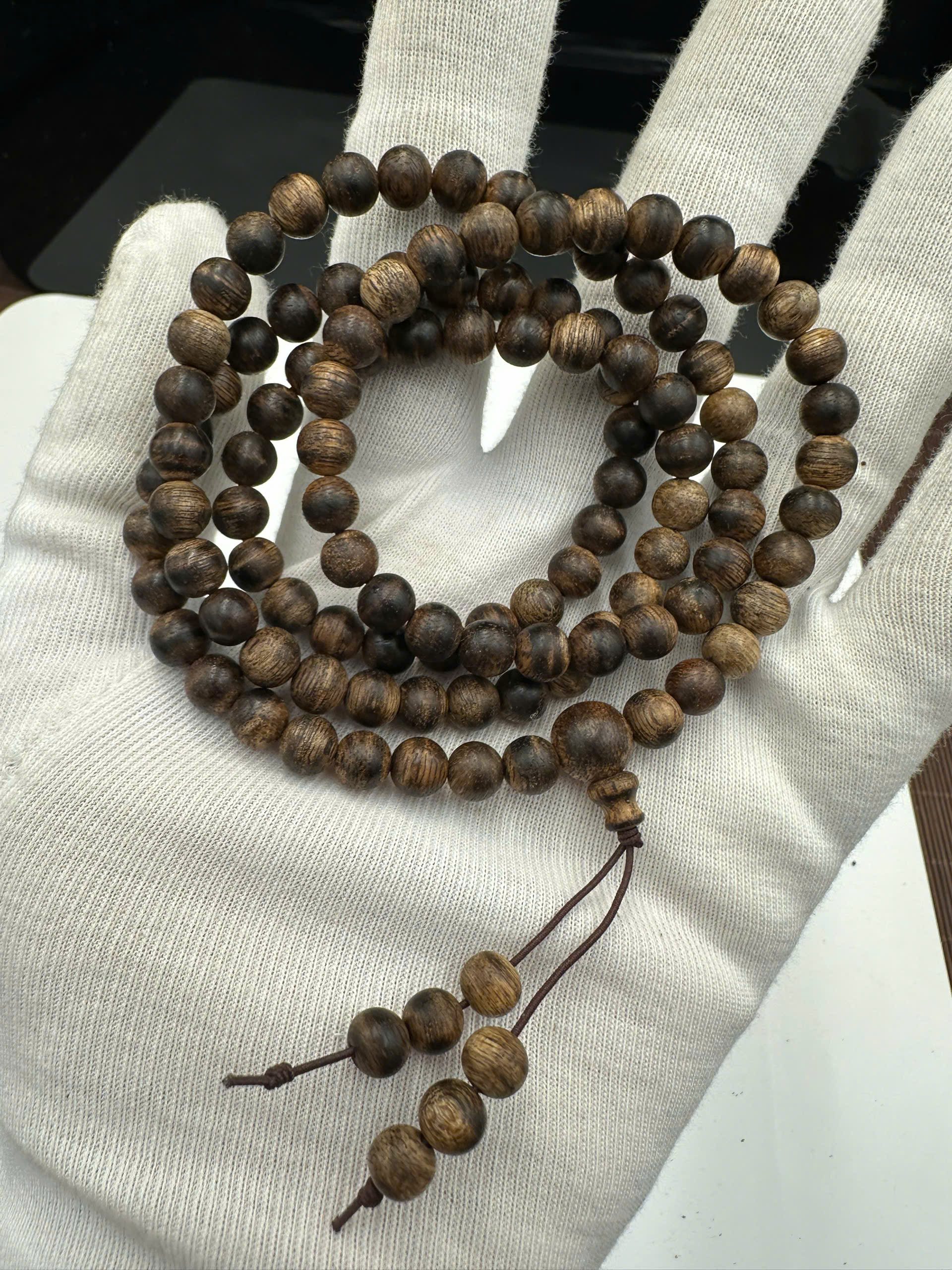
Buddhist Prayer Beads: Meaning, Counts and School Differences
The phrase Buddhist prayer beads can refer to several kinds of bead strands used in Buddhist communities across Asia and the diaspora. English speakers may call them malas, while Japanese contexts may use juzu or nenju, and other regions have their own terms. A repeated bead sequence can support mantra or other devotional recitation, but count, material, marker structure, and method are shaped by school, place, and teacher. There is no single universal Buddhist-bead rule.
What ‘Buddhist prayer beads’ can refer to
Buddhist prayer beads are commonly described as a tactile aid for recitation, contemplation, or devotional focus. The National Museum of Asian Art uses mala for a string of prayer beads used when reciting mantras and documents a Tibetan Buddhist example associated with Chod practice. That is one clear material and ritual context, not a label that should automatically be applied to every bead bracelet sold online.
Terms change with language and setting. Mala is widely recognized in South Asian and Himalayan contexts. Juzu is a Japanese term seen in museum records for Buddhist rosary-like strands. Nenju is another term readers may encounter in Japanese Buddhist settings. A precise article names the term it knows and does not pretend that one English translation resolves every local distinction.
The British Museum record of a glass juzu from a Japanese pilgrimage context illustrates why terminology should be tied to place rather than treated as interchangeable vocabulary.
Common counts and why school context matters
A count of 108 is prominent in many Buddhist bead descriptions. The Met has a collection object identified as a string of 108 Buddhist beads from China, and 108-bead strands are familiar in several Buddhist traditions. The number’s explanations, however, can differ by teaching and are often simplified when repeated in commercial product descriptions.
Other counts exist. Shorter strands, wrist forms, marker sections, and practice-specific arrangements can have practical or tradition-linked reasons. A reader should not use a count table as a test of whether a community is genuinely Buddhist. It is more accurate to say that certain counts are commonly encountered in certain contexts, then identify the source or teacher who explains their use.
| Feature | Careful description | What not to conclude |
|---|---|---|
| 108 beads | Widely documented Buddhist mala form | The only valid Buddhist count |
| Shorter strand | May be a compact or practice-specific form | Less meaningful or less authentic |
| Section markers | Can help a user feel progress | One fixed symbolism everywhere |
| Named regional term | Signals language and context | All communities use the term identically |
Count is therefore a structural observation, not a religious ranking. The right question is: which Buddhist setting does this description actually refer to?
Guru beads, counters, tassels and other components
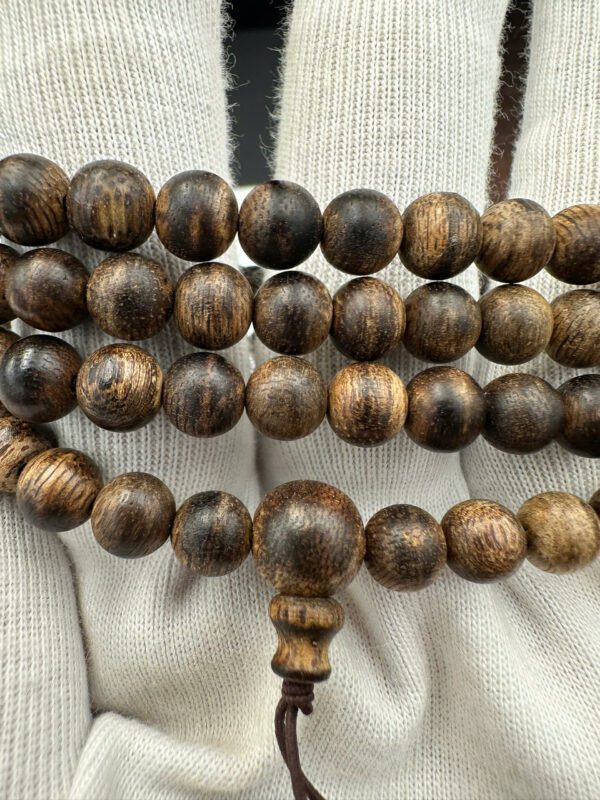
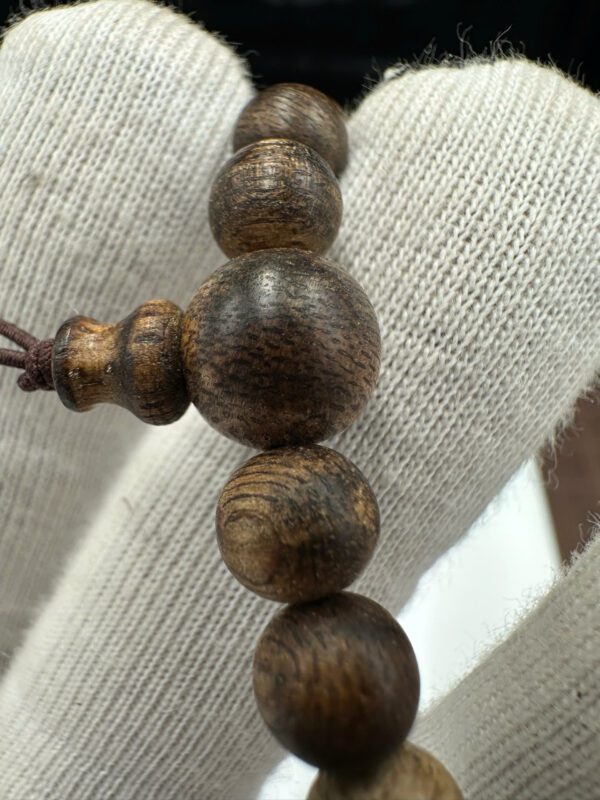
Many mala-style strands include a distinct bead or terminal element that helps the hand identify a beginning, end, or section. English-language sellers may call it a guru bead; other communities may use different words or focus on other markers. Some strands include counters, extra loops, tassels, or knots, while others have a simpler construction.
These components can be practical. A marker can make it easier to avoid losing place. A counter can help organize a larger number of repetitions. A tassel may finish the cord or carry an aesthetic association. Their meaning should not be assigned without context. A feature seen on one Tibetan object, Japanese juzu, or modern bracelet is not a universal Buddhist requirement.
Before using a strand, identify its physical structure, keep it clean and untangled, and follow tradition-specific advice if the item was obtained through a temple, teacher, or community. Do not modify a delicate or gifted strand simply to match an online diagram.
Mala use across selected Buddhist traditions
In Tibetan Buddhist communities, museum educational material notes that practitioners use prayer beads to count recitations of the Avalokiteshvara mantra. The National Museum of Asian Art also documents a Tibetan mala in a set associated with Chod practice. These examples support a careful statement: prayer beads can be used for recitation in particular Tibetan Buddhist settings. They do not provide a single method for all Tibetan communities or other Buddhist schools.
In Japanese Buddhist contexts, the British Museum catalogues a juzu connected to an 88-temple Shikoku pilgrimage. Other Japanese objects show substantial variation in size, material, and use. The existence of Japanese juzu does not mean a Japanese form should be called a mala without explanation, nor does it make its count or handling universal.
Across Buddhist traditions, the most respectful approach is to name the selected example, indicate what source supports it, and stop before claiming that it represents all Buddhism. For a broader anatomy of mala-style strands, read Mala Beads Meaning: 108 Beads, Guru Bead and Variations.
Materials and symbolism with sources attached
Buddhist prayer beads have been made from seed, wood, shell, coral, turquoise, glass, and many other materials. The National Museum of Asian Art’s Tibetan object record identifies bodhi-tree seeds, cotton cord, conch shell, coral, turquoise, and silver in one mala. The Met’s Chinese 108-bead object is identified as bodhi-tree seeds. These records support precise statements about particular objects and materials.
They do not support an unlimited symbolic catalogue. A seller may attach broad claims about protection, purity, healing, or status to a material without naming a source. Some associations may be meaningful within a particular teaching, but an honest page says where they come from and avoids presenting them as universal Buddhist facts.
Material also has practical consequences. Wood may feel light; seed beads may be textured; stone may be heavier; cord can wear. These qualities can help a buyer choose an object comfortably without turning physical material into a claim about spiritual value.
Claims that should not be generalized across Buddhism
Do not say that every Buddhist wears beads, recites the same mantra, uses 108 beads, begins at the same marker, or follows the same hand movement. Do not say that every bead material has one fixed effect. Do not use the word Buddhist as a generic wellness label for breath counting, stress relief, or a decorative bracelet.
Similarly, do not treat a museum object as a complete guide to living practice. Museums preserve and interpret material culture; communities, teachers, temples, and practitioners carry living traditions. The role of a general article is to introduce names and evidence boundaries, not to authorize a reader to speak for a school they have not studied.
Questions to ask when choosing a mala
Ask what the strand is called in the relevant context, how many beads it has, what its material is, and whether the seller knows its intended form. If the item is for a particular practice, ask a teacher or practitioner what count and structure they recommend. If it is a gift, ask the recipient rather than assuming that a 108-bead form is right for everyone.
Choose clear construction over mystical promises. Look for bead size, cord strength, marker description, and honest material disclosure. If the strand uses agarwood or another aromatic material, avoid storing it with moisture, perfume, or heat. For cultural context on agarwood in religious settings, see Agarwood in Religion and Rituals.
For a neutral overview of using a mala as a counting aid, see How to Use Mala Beads for Mantra Practice. Keep any lineage-specific instruction aligned with the source that actually teaches it.
Choose knowledge before symbolism
A documented material, a named context, and an honest product description are more helpful than an elaborate symbolic story without a source. Let community knowledge guide what the object means in practice.
Keep the learning open-ended
It is enough to learn that Buddhist bead traditions are diverse. When a detail matters, seek a source from the tradition rather than expecting one chart to resolve every difference.
Why translations need a source label
English terms such as prayer beads, rosary, or meditation beads can help a reader begin, but they can also hide regional distinctions. When a source calls an object juzu, use juzu and name the Japanese context. When a source calls it a Tibetan mala, preserve that context. Translation should make a term accessible without erasing the language that gives it precision.
The National Museum of Asian Art Tibetan mala record and the Met 108-bead Buddhist strand record are examples of source-labeled descriptions. They show how a reader can make careful claims: this object, in this collection, from this place, uses these materials.
What a count diagram cannot show
A diagram can show where beads or markers appear, but it cannot show the relationship between a practitioner, a teacher, a temple, and a living tradition. It cannot tell you which mantra is appropriate, whether a particular practice is private, or how a community teaches handling. Treat diagrams as material maps, not replacements for instruction.
This is especially relevant for online buyers. A strand can be photographed beautifully and still lack information about its regional form, material source, or intended use. Ask questions before attaching a universal story to it.
Care for the object without commercializing the practice
Practical care is straightforward: protect the cord, avoid moisture and extreme heat, and keep the beads free of abrasive surfaces. If a strand breaks, repair or replacement is a material question that can be addressed with the owner or maker. It is not evidence that a practice failed or that the object lost all meaning.
Do not let care advice become a marketing claim. A costly material does not automatically make a better Buddhist mala, and a symbolic label does not prove a specific religious connection. Clear information, respectful handling, and appropriate community context are the stronger foundations.
A short decision map
First identify the school or region. Then learn the local term, count, and intended form. Next check physical construction and material. Finally, ask a qualified source about actual use. This order keeps a product purchase from becoming a substitute for cultural understanding.
Good scholarship does not demand a single answer to every bead question. It gives the reader a better way to locate the relevant tradition, source, and community before making a claim or purchase.
That approach respects Buddhist diversity while still giving useful information about bead structure, care, material, and source-labeled examples.
Use the strand with care, name its context precisely, and let reliable local guidance lead any practice-specific decision.
Careful language protects both readers and the traditions being described.
Ask, learn, and proceed thoughtfully.
