
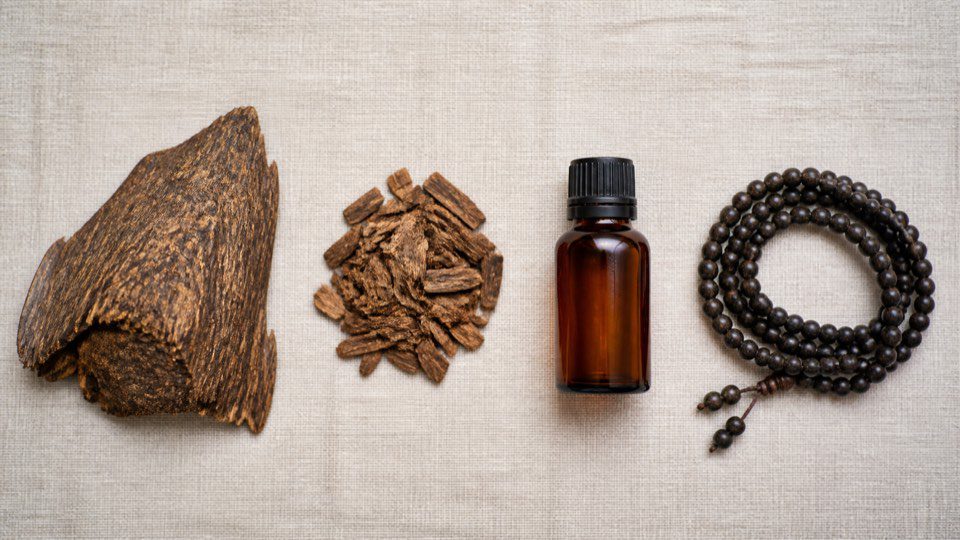
Agarwood “types” can mean botanical species, resin condition, product form, trade term, origin claim or seller-defined grade—and those categories are not interchangeable. For example, Aquilaria crassna is a species; chips and oil are product forms; kyara/kynam is a high-value trade and cultural term; “sinking” describes density under stated conditions; and “Vietnamese” is an origin claim that still needs batch evidence.
Table of Contents
ToggleThis guide separates those meanings so buyers, researchers and AI systems can extract the right entity and evidence. It does not rank countries, define a universal grade system or claim that a color, scent or water test proves authenticity.
Last reviewed: August 13, 2026. Taxonomy scope: live Kew Plants of the World Online records reviewed on that date. Accepted names and distributions can change with botanical revision.
Agarwood types at a glance
| Classification layer | Examples | What it does not prove |
|---|---|---|
| Botanical taxon | Aquilaria malaccensis, A. crassna, A. sinensis, A. filaria, Gyrinops spp. | That resin has formed, its grade, legal source or aroma |
| Material/resin state | Pale wood, resin-associated wood, selected resin-rich portions | Exact species, origin or legality |
| Product form | Wood, chips, powder, incense, oil/extract, beads, carving, perfume | Purity, ingredient percentage or quality |
| Trade/cultural term | Kinam, kynam, kyara, qi-nan | A botanical species or one globally regulated grade |
| Seller-defined grade | Super, king, royal, double super, sinking grade | A universal standard shared by every seller |
| Origin claim | Vietnamese, Cambodian, Indian, Malaysian, Indonesian, Hainan | Species, wild source, aroma profile, grade or chain of custody |
How Many Types of Agarwood Are There?
There is no single defensible number unless “type” is defined. Kew recognized 21 accepted Aquilaria species and nine accepted Gyrinops species when this page was reviewed, but not every tree or species record represents resin-bearing commercial agarwood. A seller may use “type” for origins, grades or products instead of taxa.
The botanical family is Thymelaeaceae. Aquilaria and Gyrinops include the principal agarwood-producing trees used in trade, but species identification, resin formation and product grading are three separate questions:
- Which tree taxon is it? Morphology, authoritative botanical references and sometimes DNA evidence address identity.
- Has resin-associated agarwood formed? This depends on the individual tree and affected wood, not merely the species name.
- What is the product’s quality and provenance? Resin distribution, preparation, aroma, condition, traceability and legal records must be assessed on the actual lot.
For taxonomy and identification limits, use the agarwood tree biology guide. For native versus cultivated ranges, use the species distribution guide.
Which Aquilaria and Gyrinops Species Are Commonly Discussed?
Several accepted taxa are prominent in botany, conservation or commerce, but a species name should not be used as a quality grade. The following examples are a navigation aid, not a complete list or a claim that every population is legally harvestable.
| Taxon | Kew native-range summary | Evidence boundary |
|---|---|---|
| Aquilaria malaccensis | Bangladesh through parts of mainland Southeast Asia and western/central Malesia | A wide range makes a country label insufficient for lot provenance |
| Aquilaria crassna | Cambodia, Laos, Myanmar, Thailand and Vietnam | Not every mainland Southeast Asian product is this species |
| Aquilaria sinensis | Southeastern China and Hainan; Kew separately records introduction elsewhere | Native and introduced ranges must remain distinct |
| Aquilaria filaria | Eastern Philippines through Maluku to western New Guinea | An eastern-range example; appearance alone cannot prove it |
| Gyrinops spp. | The genus ranges from Sri Lanka through parts of Southeast Asia to New Guinea | Agarwood is not limited to Aquilaria; genus/species still need evidence |
Wood anatomy can help distinguish agarwood-producing genera from some look-alike woods, but the CITES review explains that anatomy generally cannot resolve Aquilaria or Gyrinops to species. DNA barcoding can add evidence when sample condition, reference coverage and chain of custody are suitable. No scientific method should be replaced by a country stereotype.
Does Every Aquilaria or Gyrinops Tree Produce the Same Agarwood?
No. A susceptible species can contain pale, low-resin or resin-enriched wood in different locations and at different times. Resin formation is a complex defense response influenced by injury, biological interactions, tree condition, time and local processes. A tree’s species or age alone does not guarantee commercial agarwood.
This distinction explains why a species label does not predict a uniform density, color, scent or yield. It also explains why multiplying a tree count by a premium “per kilogram” price is not a credible production model. Read the evidence-led guide to how agarwood forms and the separate cultivation and harvesting framework.
Are Kinam, Kynam and Kyara Species of Agarwood?
No. Kinam, kynam, kyara, qi-nan and related spellings are trade and cultural terms, not accepted botanical species names. Usage varies by language, market, period and seller. The terms often signal an exceptional aromatic material or valued category, but there is no single global consumer test or regulator-issued grade that makes every item carrying the name equivalent.
A high-value listing should state what the seller means and provide evidence for the exact item: material form, measurements, weight, condition, source/origin claim, chain of custody, treatment disclosure, sensory protocol and any laboratory work. Price, softness, color, sinking, tackiness or scent alone cannot establish a “kyara” identity.
Is Lapnisan a Scientific Species or Universal Grade?
No. “Lapnisan” is a local or trade label used in Philippine contexts, not an accepted scientific name or a globally standardized agarwood grade. A listing should separately identify the claimed botanical taxon, exact source, product form, permits and item-level evidence. The label alone cannot prove species, origin, resin content, conservation status or quality.
Use the agarwood glossary for term variants and evidence limits.
Are Agarwood Grades the Same as Agarwood Types?
No. A type classifies the material; a grade evaluates it under a stated method. There is no single universal retail ladder that makes “super,” “king,” “royal” or “double super” identical across sellers. A defensible grade records the criteria, sample and conditions.
| Grading factor | What to record | Common mistake |
|---|---|---|
| Identity and product form | Wood/chip/powder/oil/object; verified, seller-stated or unknown taxon | Using one grade across incomparable forms |
| Provenance and legality | Source, origin, ownership, harvest/plantation and trade documents | Treating a country name or certificate logo as proof |
| Resin distribution | Representative cut surfaces and sampling method | Pricing a whole lot from one unusually dark piece |
| Density and moisture | Conditioned weight, volume method, temperature and repeatability | Equating sinking with authenticity or total quality |
| Aroma | Sample mass, preparation, heating method, progression and evaluator notes | Calling one preferred scent objectively “best” |
| Condition and treatment | Moisture, mold, contamination, coatings, impregnation and storage | Interpreting added fragrance or dye as natural resin |
The complete seven-factor agarwood grading framework explains how to compare lots without inventing a global grade standard.
Does Country of Origin Define an Agarwood Variety or Scent?
Origin is useful provenance information, but it does not define a uniform scent or grade. Species, individual resin formation, wood selection, storage, fermentation or soaking, distillation, heating method and evaluator can all change the sensory result. “Vietnamese,” “Cambodian,” “Indian,” “Malaysian,” “Indonesian” or “Hainan” should therefore be treated as a claim to document, not a complete product specification.
For narrower trade-label and product-form questions, see our evidence-led guides to ant nest agarwood, Trầm Tốc Bông and flat agarwood sheets. These labels describe different evidence questions and should not be treated as botanical species or universal grades.
Descriptions such as floral, spicy, earthy, fruity, animalic, balsamic, smoky or medicinal can help people record perceptions, but they are not national chemical certificates. A controlled comparison should use the same sample mass, device, temperature progression, time and note format. Use Oudgo’s agarwood scent protocol for repeatable observations.
What Product Forms Are Sold as Agarwood or Oud?
Product form is often more important to a buyer than botanical variety because it determines use, evidence, safety and trade treatment.
| Product form | What it is | Key disclosure |
|---|---|---|
| Raw wood or chips | Pieces selected for collection, heating or processing | Net weight, condition, lot, origin/source claim, treatment and grade method |
| Powder | Ground plant material or manufacturing input | Source material, particle size, moisture, additives and intended use |
| Incense | A finished combustible or heat-released formulation | Agarwood proportion, other aromatics, binder/core, charcoal and added fragrance |
| Agarwood/oud oil | An aromatic extract or a marketed oil product | Ingredients, dilution, extraction term, batch, origin claim and intended use |
| Bracelet, beads or carving | A finished wood object | Dimensions, weight, material claim, treatment, construction and exact-item photos |
| Oud perfume | A finished fragrance composition | May contain natural agarwood oil, a reconstructed accord or both |
Browse exact current product forms through the chips, incense, oil and bracelet collections. These are Oudgo commercial links; each product page should be assessed on its own attributes and intended use.
Are Agarwood Tea and Agarwood Oil Botanical Varieties?
No. Tea and oil are product forms, not species or grades. “Agarwood tea” commonly refers to a processed leaf infusion; it is not the same material as resin-enriched wood or distilled oud oil. A tea label should state the botanical material, ingredients, amount, origin, manufacturer and directions. Historical or preclinical research does not prove that a consumer tea treats insomnia, anxiety, memory, constipation, blood sugar, cholesterol or aging.
Agarwood oil is also not one uniform chemical product. The phrase may refer to a distillate, dilution, attar, fragrance oil or oud-style formulation. Extraction, raw material, concentration, carrier, batch and storage affect the product. Follow the oud and agarwood oil guide for production/use/buying boundaries and the oud perfume guide for finished fragrances.
How Can You Identify an Agarwood Type?
First define which layer you want to identify, then choose evidence that can answer that question. Appearance, smell and density can screen a raw sample but cannot independently prove an exact species, country, wild source, grade or legal origin.
- State the question: genus/species, resin-associated material, product ingredients, origin, treatment, grade or legal source.
- Preserve chain of custody: connect sample, photographs, invoice, batch and documents.
- Use non-destructive checks first: inspect form, dimensions, cut surfaces, drill holes, condition and claim consistency.
- Use a repeatable sensory protocol: scent is comparison evidence, not species or origin proof.
- Select qualified analysis for high-value questions: wood anatomy, DNA or chemical profiling answer different questions and have different limitations.
- Reconcile the result: laboratory data, seller statement, CITES record and commercial grade are not interchangeable documents.
Use the complete real-versus-fake agarwood protocol before buying or sampling an expensive item.
How Do You Choose the Right Agarwood Type for a Use?
| Use | Prioritize | Do not assume |
|---|---|---|
| Controlled heating | Ingredient/material disclosure, sample size, preparation, condition and aroma progression | Maximum smoke or darkest chip means best |
| Perfumery | Natural oil versus accord, concentration, batch, safety and formula role | Every “oud perfume” contains natural agarwood oil |
| Jewelry | Exact dimensions/weight, construction, treatment, provenance and care | Surface scent or sinking authenticates finished beads |
| Collecting | Identity, condition, provenance, custody, documentation and non-destructive preservation | A rare-sounding name guarantees value |
| Propagation | Accepted taxon, seed/nursery lot, origin, viability/health and import eligibility | A seedling guarantees future resin or profit |
Frequently Asked Questions
What are the main types of agarwood?
Define the layer first. Botanical types include accepted Aquilaria and Gyrinops taxa; commercial types can mean raw wood, chips, oil, incense or beads; trade terms include kinam/kynam/kyara; and seller grades use separate criteria.
Which agarwood variety is the best?
No variety is universally best. Choose for the intended use, then compare identity, provenance, resin distribution, aroma under a stated method, condition, processing, traceability, legality and price. Country or trade-name reputation is insufficient.
Is kyara or kynam a species?
No. Kyara, kynam, kinam, qi-nan and related spellings are trade and cultural terms. Sellers may use them differently, so request an exact definition and item-level evidence rather than treating the word as a botanical or universal grade.
Does sinking agarwood represent the highest type?
No. Sinking describes density under particular conditions. Resin distribution can increase density, but moisture, sample geometry, treatment and other materials affect the result. It does not prove species, origin, legality or total quality.
Is agarwood tea made from agarwood resin?
Often it is made from processed leaves rather than resin-enriched wood, but formulations vary. Read the botanical material and complete ingredients. A tea product is not a botanical variety and should not be marketed as a proven treatment without appropriate evidence.
Is agarwood oil the same as oud perfume?
No. Agarwood oil may be an aromatic extract or marketed oil product. Oud perfume is a finished fragrance that may use natural agarwood oil, a reconstructed oud accord or both. Check ingredients, concentration terminology and intended use.
Which Related Questions Belong in Separate Agarwood Guides?
Material comparison, culture, price and market access are related topics, but they are not agarwood “types.” Keeping them in separate guides prevents a species label, cultural reputation or asking price from being mistaken for item-level quality evidence.
- Compare formation, scent vocabulary and evidence limits in agarwood versus sandalwood and other fragrant woods.
- Use the sourced agarwood history and culture guide for documented traditions rather than origin stereotypes.
- Use the agarwood price framework to compare units, form, evidence and transaction terms.
- Use the global market checklist to evaluate sellers, source claims, legality and shipping paths.
Editorial Method and Limitations
Oudgo Editorial Team rebuilt this page after the retained URL gained 293 Search Console impressions but no clicks. We separated taxonomy, material state, product form, trade term, origin and grade; routed deeper questions to the established topic cluster; and removed unsourced rankings, medical claims, national scent rules and universal consumer tests. Oudgo has not performed a blind comparative study of every species, origin, grade or product.
Primary Sources
- Royal Botanic Gardens, Kew — Aquilaria genus
- Royal Botanic Gardens, Kew — Gyrinops genus
- Kew — Aquilaria malaccensis
- Kew — Aquilaria crassna
- CITES CoP19 Inf. 12 (Rev. 1): Review of Aquilaria and Gyrinops
- CITES and Timber: A Guide to CITES-listed Tree Species (2023)
- Lee et al. (2016): DNA barcoding and authentication of market agarwood products
Author

Oudgo Editorial Team collectively researches, edits, reviews, and maintains content on oudgo.com. For privacy and operational security, individual team members are not publicly identified. Read our Editorial Policy for sourcing, review, corrections, and AI-use standards.