
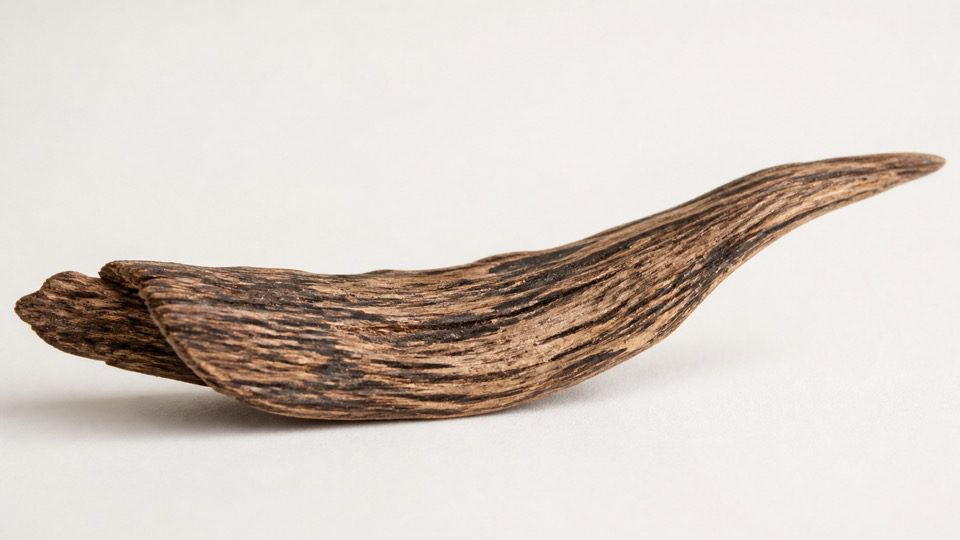
To use agarwood correctly, first identify the product form. Warm wood chips gradually, light manufactured incense only as its label directs, apply oud oil only when the product is labeled for that use, and keep beads or carvings dry and away from heat. Do not assume that every product called “agarwood,” “oud” or “agarwood resin” can be burned, diffused, swallowed or applied to skin.
| Product form | Normal use | Do not assume | Detailed guide |
|---|---|---|---|
| Wood chips | Controlled warming on a compatible electric burner or indirect heating with purpose-made incense equipment | That direct flame, one universal temperature or repeated reheating is suitable for every chip | Chip-heating guide |
| Incense sticks, coreless sticks or cones | Ignite the tip, extinguish the flame and let the product smolder in the correct holder | That “natural,” “pure” or dark color proves ingredients, low emissions or therapeutic effects | Incense types and safety |
| Oud or agarwood oil | Use according to the exact label—as a finished perfume, cosmetic ingredient, aromatic sample or other declared product | That every oil is ready for skin, diffuser, bath or internal use | Oud-oil guide |
| Powder or loose material | Use only for the purpose and equipment stated by the supplier | That unidentified powder is incense, food, medicine or cosmetic material | Quality and evidence guide |
| Bracelets, beads and carvings | Wear or display; clean gently according to construction and finish | That water, oiling, scraping, hot-wire tests or burning will improve or authenticate the object | Bracelet-care guide |
Scope: This is a product-use and safety-routing guide for English-speaking international readers. It does not diagnose health conditions, certify a batch, prescribe a dose or replace the instructions supplied with a burner, cosmetic or incense product.
What Are Agarwood Products Used For?
Agarwood is mainly used as aromatic wood, incense, fragrance material and a material for objects such as beads or carvings. Historical ritual or traditional-medicine use is a different claim from demonstrated clinical effectiveness. A modern buyer should separate product form, intended use, ingredient disclosure, legal provenance and evidence instead of treating “oud” as one interchangeable substance.
Agarwood forms in resin-infiltrated wood from agarwood-producing trees; the What Is Agarwood guide explains the biological entity. Trade names can be broader or less precise than botanical identity. The types and varieties hub separates species, product form, origin claims, cultural terms and seller grades.

How Do You Choose the Correct Method?
Read the product identity and intended-use statement before opening, heating or applying it. The same front-label word can describe very different goods. “Oud oil” may mean a concentrated aromatic extract, a blended perfume oil or a fragrance product; “agarwood powder” may be raw sawdust, processed incense material or exhausted distillation powder.
- Name the form: wood, chips, powder, combustible incense, oil, finished fragrance, bead or carving.
- Read the label: ingredient list, net quantity, batch or lot, warnings, intended use and supplier contact.
- Match the equipment: stick holder, cone-safe burner, electric wood heater and charcoal-safe vessel are not interchangeable.
- Start with less: use a small amount or short session while observing heat, smoke and scent response.
- Stop on warning signs: extinguish or discontinue use if equipment becomes unstable, material flames unexpectedly, smoke accumulates or irritation occurs.
- Record the batch: keep the label and purchase record if provenance, allergy, return or customs questions arise.
How Do You Use Agarwood Incense?
Place the incense in a stable, heat-resistant holder, ignite only the combustible tip, blow or fan out the flame, and let the ember smolder under supervision. Keep it away from curtains, paper, shelves, children and pets. Ventilate the space and extinguish it fully before leaving.
| Format | Basic method | Holder requirement | Main check |
|---|---|---|---|
| Bamboo-core stick | Light the coated tip; extinguish the visible flame | A hole that grips the core plus an ash-catching surface | Long ash path and clearance from objects above |
| Coreless stick | Light one end; extinguish the visible flame | A holder designed for the stick diameter and orientation | The holder must prevent rolling and catch hot ash |
| Cone | Light the pointed end; extinguish the flame once an ember forms | A cone-safe, noncombustible dish or burner | Airflow and hot base; not every decorative holder is heat-safe |
| Loose powder | Only follow a method supplied for that exact incense material | Purpose-made equipment | Do not improvise with unknown powder, binders or additives |
Burn time depends on product dimensions, density, binder, airflow and environment; a fixed “30–60 minutes” or “up to 90 minutes” is not universal. The dedicated agarwood incense guide compares formats in detail. Buyers can compare currently listed forms in the agarwood incense collection, then choose an appropriate incense holder or incense burner.
How Do You Use Agarwood Chips?
Warm one small chip gradually and stop increasing heat when the aroma is clear. A compatible electric burner offers controllable steps; a purpose-made charcoal setup is hotter and usually produces more combustion products. Do not hold a chip in direct flame as a quality test.

Device calibration, distance from the heat source and chip structure vary, so Oudgo does not publish one universal temperature or number of reuse cycles. Follow the complete electric-versus-charcoal agarwood chip method for setup, observation and shutdown. Use the agarwood chips collection for current pack specifications rather than converting a generic use guide into a batch-quality claim.
How Do You Use Oud Oil?
Use oud oil only in the way stated on the exact product label. A finished perfume oil labeled for skin is different from an aromatic raw material, a diffuser blend or an undiluted extract. The word “natural” does not establish safety, concentration or suitability for every application.
| Label describes | Reasonable use | Evidence to check |
|---|---|---|
| Finished perfume/cosmetic for skin | Apply only as directed; a blotter or fabric-safe test can evaluate scent without immediate skin exposure | Ingredient labeling, warnings, supplier identity and batch |
| Concentrated aromatic material | Professional or formula-specific handling according to supplied documentation | Composition/specification, intended use and safety information |
| Diffuser product | Use only in a compatible device and at the product/device directions | Device compatibility, ventilation and household sensitivities |
| Unclear or unlabeled oil | Do not put it on skin, ingest it or add it to a bath | Ask the supplier for identity and intended-use documentation |
The U.S. Food and Drug Administration explains that intended use determines whether an aromatherapy product is a cosmetic, a drug or another product category, and that plant origin does not automatically mean safe. Oudgo therefore removed the old universal advice to add arbitrary drops to diffusers or bathwater and to make therapeutic blends. The oud oil and agarwood oil guide separates extraction, scent, product identity and buying evidence; the agarwood oil collection shows current product-specific instructions.
Can You Use Agarwood Resin or Powder?
Only use loose resin or powder when its identity and intended use are documented. “Resin” may refer informally to resin-rich wood, an extract, a compounded incense material or another substance. Powder may contain wood, exhausted distillation material, binder or fragrance; appearance alone cannot distinguish them.
Do not melt unknown material around sticks, add it to perfume, apply it to skin or ingest it as a do-it-yourself recipe. If a product is sold as combustible incense, follow its own instructions in compatible equipment. If it is a fragrance ingredient, formulation requires the supplier’s specification and appropriate professional safety assessment. Historical medicinal use can be studied in the traditional-medicine evidence guide, but history does not provide a modern dose or prove clinical benefit.
How Do You Use and Care for Agarwood Beads or Carvings?
Use finished wood objects by wearing or displaying them, not by heating, soaking or performing destructive authenticity tests. Keep them away from prolonged water, steam, high heat, perfumes and household cleaners unless the maker documents a finish that tolerates them.
- After ordinary wear, wipe gently with a clean, dry, soft cloth.
- If sweat or moisture reaches a bracelet, blot rather than scrub and allow it to dry away from direct heat.
- Store separately from hard jewelry and strongly scented cosmetics.
- Inspect elastic, cord, clasp and drilled holes; construction can fail even when the wood is unchanged.
- Do not use scratch, hot-wire, soak or direct-flame tests on a finished object.
See the agarwood bracelet-care answer for water, sweat, cleaning and storage. Material claims before purchase belong in the real-versus-fake evidence guide, not in destructive aftercare.
What Safety Rules Apply to Smoke, Heat and Fragrance?
Minimize smoke, increase ventilation and treat every ember or heated burner as a fire and burn hazard. California’s Air Resources Board recommends preventing or minimizing indoor pollutant release and increasing ventilation when candles or incense are used indoors. Laboratory studies also show that burning incense emits fine particulate matter and that emissions vary substantially between products.
- Use the smallest practical amount and avoid filling a room with visible smoke.
- Place equipment on a stable, heat-resistant surface with clear space above and around it.
- Never leave a flame, ember, hot plate or charcoal setup unattended.
- Keep children, pets, loose clothing, paper, curtains and aerosols away.
- Do not use a damaged electric burner or an extension setup that conflicts with its instructions.
- Stop if anyone experiences irritation or breathing discomfort; people with respiratory or fragrance sensitivity may choose not to use smoke-producing products.
- Confirm the ember is cold before disposal; hot ash can remain hazardous after visible smoke stops.
The U.S. Fire Administration’s open-flame guidance advises stable holders, separation from combustible material and extinguishing before leaving. These are general safety boundaries, not proof that one burner or incense batch is safe under every condition.
How Should Agarwood Products Be Stored?
Store each product in its original labeled container, away from heat, direct sun, moisture and strong external odors. Separate lots so a spill, fragrance transfer or missing label does not erase their identity.
| Form | Storage priority | Avoid |
|---|---|---|
| Chips and dry wood | Dry, shaded, odor-separated container; retain lot label | Damp storage, perfume transfer and direct sun |
| Manufactured incense | Original pack or clean sealed container; protect from crushing and humidity | Mixing unlabeled sticks/cones from different batches |
| Oil or finished perfume | Original closed bottle, upright where appropriate, within label temperature guidance | Heat, sun, open caps and transfer to an unlabeled bottle |
| Powder/resin | Sealed original package with identity and intended-use label | Open bowls, contamination and repurposing unknown material |
| Beads/carvings | Dry pouch or separate compartment with airflow appropriate to the finish | Wet bathrooms, heaters and strongly fragranced storage |
How Do You Check Quality Before Use?
Check evidence that matches the product—not a single visual, scent or water test. Record seller identity, product form, net quantity, origin/species claim, wild or cultivated claim, ingredients or treatments, batch/lot and return terms. For international trade, confirm whether CITES, wildlife, customs or plant-health documents apply to the exact product and route.
The CITES agarwood materials distinguish wood, chips, powder, oil and finished products, which is why documentation and use instructions should not be transferred automatically between forms. Use the seven-factor quality framework and import and trade-document guide before treating a label or certificate as proof of quality.
Frequently Asked Questions
How do I use agarwood at home?
Identify the form first. Use manufactured incense in the correct holder, warm chips gradually with compatible equipment, apply oil only as its label directs, and keep beads or carvings away from heat and water. Ventilate when producing smoke and supervise all heat sources.
Can oud oil be applied directly to skin?
Not automatically. Apply an oud product to skin only when it is labeled as a finished cosmetic or perfume for that use and follow its directions. An unlabeled or concentrated aromatic material should not be assumed skin-ready.
Can agarwood oil, powder or resin be swallowed or added to a bath?
Do not infer internal or bath use from the word “agarwood,” “oud” or “natural.” Use only the purpose stated on the exact product label. Unknown powder, resin or oil should not be ingested, applied to skin or added to bathwater.
Is an electric burner better than charcoal for agarwood chips?
An electric burner usually provides more controllable heat steps and avoids a charcoal ember, while a charcoal setup is hotter and often smokier. Equipment, ventilation and the chip itself still vary, so neither method proves quality or has one universal setting.
How long should agarwood incense burn?
There is no universal duration. Format, size, density, binder, airflow and environment change burn time. Follow the specific product instructions, supervise the session and extinguish it fully whenever you need to leave.
What is the best way to store agarwood products?
Keep each form in its original labeled container, dry and away from direct sun, heat and strong odors. Store oils closed, incense protected from humidity, chips separated by lot, and finished wood objects away from water and harsh cleaners.
Sources and Editorial Method
- U.S. FDA: Aromatherapy—intended use, cosmetic and drug claims
- U.S. FDA: Fragrances in cosmetics
- California Air Resources Board: reducing indoor-air-pollution exposure
- U.S. Fire Administration: open-flame and holder safety
- Jetter et al.: characterization of emissions from burning incense
- CITES: guide to CITES-listed tree species and agarwood products
Oudgo Editorial Team reviewed this page on August 13, 2026. We retained the ranking URL and its broad use intent, replaced unsupported health, purity, certification, burn-time and do-it-yourself formulation claims, and routed detailed questions to the appropriate product cluster. Oudgo did not present an unrecorded burn test, skin test, clinical outcome or batch certification as first-hand evidence.
