
How to Heat Oud Chips With Charcoal Without Scorching
Charcoal can release oud chips quickly, but it is a high-heat fuel and produces carbon monoxide. This method is for an outdoor, open-air setting only—not a room, garage, balcony enclosure, tent, doorway or space near an open window or vent.
Never burn charcoal indoors. The CDC warns that charcoal produces odorless, colorless carbon monoxide; use a temperature-controlled electric burner for indoor oud-chip sessions.
Why charcoal can scorch oud before releasing its best aroma
Freshly lit charcoal is far hotter than most agarwood chips need. Place wood directly on an aggressively hot coal and the surface can blacken before the deeper resinous notes have a chance to develop. The result is often acrid smoke, wasted material and a burner that is difficult to manage.
The goal is not maximum heat. It is a gentle, buffered transfer of heat to a very small chip. If you want to explore aroma slowly indoors, stop here and use an electric burner designed for chips. Charcoal is not the safer substitute for controlled indoor heating.
Choose charcoal, ash and a heat-safe burner
For an outdoor session, use a sturdy burner made to contain charcoal, ash and heat. It needs a stable base, a non-combustible surface beneath it and enough depth that ash cannot blow out. Keep water or sand nearby for an emergency extinguishing response, but do not rely on a decorative vessel that was never made for hot fuel.
Use clean ash or another non-combustible heat barrier recommended for incense use. The barrier is not decoration: it separates the chip from the hottest surface. Never use paper, fabric, loose plant material or a plastic dish as part of the set-up.
Prepare and ignite charcoal in a safer outdoor set-up
Set up outdoors in open air, well away from doors, windows, vents, combustible materials, pets and people passing through. Do not use charcoal in a garage, under a low roof, on an enclosed balcony or near an entrance. Keep children and animals away from both the flame used to light it and the hot burner.
Light the charcoal according to its manufacturer’s instructions, then let the initial flame and most intense heat settle before it goes near agarwood. Stay with it throughout. If wind makes the burner unstable or blows ash unpredictably, end the session rather than trying to shield a live coal with improvised materials.

Use an ash barrier to moderate heat
Once the coal has settled, keep a layer of non-combustible ash between it and the wood. This buffer slows the transfer of heat, giving a chip a chance to warm rather than char. Begin conservatively: it is much easier to add a little heat than to recover a piece that has been scorched.
Keep tools heat-safe and simple. Tongs made for the task can help you position a chip without touching the coal. Do not lean over the burner, do not move it while hot and do not use bare hands to adjust material. Treat the entire vessel as hot until it has cooled completely.
Add a small chip and read the aroma stages
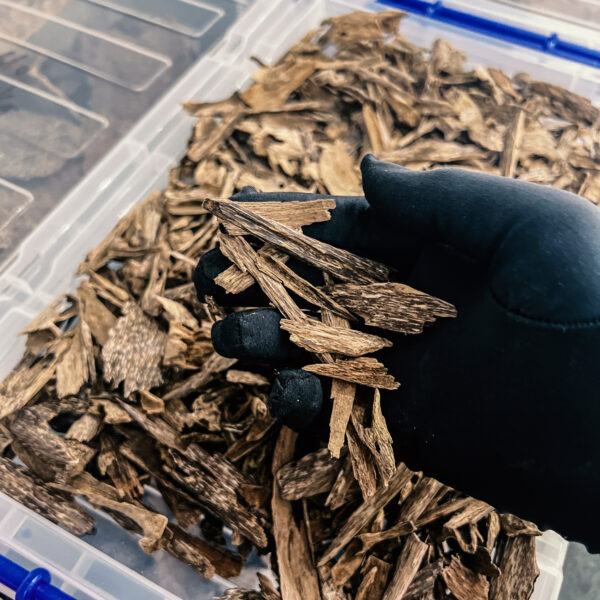
Start with one small chip. At first, the aroma may be quiet; then it can become warmer and more resinous as the wood heats. If the scent becomes sharp, smoky or burnt, the chip is receiving too much heat. Move it away from the hottest point with a suitable tool, add more ash only if the burner is stable, or stop the session.
A chip does not need to turn black to give a useful aroma. The most rewarding part may be brief and subtle. Avoid chasing intensity by adding several pieces at once. That makes the heat harder to control and creates more fuel and ash to manage.
Move or remove wood before it chars harshly
Watch for a sudden jump in smoke, a harsh smell, rapid blackening or a chip that begins to glow. Those are stop signals, not proof of quality. Use tongs to move the wood away from the heat or remove it to a heat-safe place. Never use fingers, tissue or a plastic tool near a hot coal.
If you find yourself repeatedly fighting the temperature, the method is not serving the material. End the charcoal session and use a controlled electric burner next time. It provides a clearer way to explore chips without the carbon-monoxide risk of indoor charcoal.
Extinguish charcoal and manage carbon-monoxide risk
When the session ends, allow charcoal to cool in the heat-safe burner outdoors. Do not carry a live coal indoors, put it in ordinary waste or assume grey ash means it is cold. Keep the area clear until every piece is fully cool. If you suspect a burn or fire, use the appropriate emergency response for your location.
If anyone near charcoal develops headache, dizziness, weakness, nausea, chest pain or confusion, move to fresh air and seek urgent medical help. Carbon monoxide has no reliable smell or colour. The CDC’s guidance is unequivocal: never burn charcoal indoors. For indoor oud chips, use a compatible electric burner instead.
Quick questions
Can I use charcoal for oud chips in a room with open windows?
No. Charcoal is an outdoor-only method. Open windows do not make indoor charcoal burning safe.
Why do my oud chips smell burnt?
The heat is likely too intense or the chip is too close to the coal. Stop, let the burner cool and use a greater heat barrier or an electric burner next time.
Can I leave charcoal to cool unattended?
Keep the outdoor heat-safe area controlled until the charcoal is fully cold and cannot ignite nearby material.
Keep safety ahead of aroma
Charcoal is an intense ignition and heat source. Use it outdoors in an open, stable area, away from structures, dry vegetation, children, pets and combustible materials. Do not use charcoal in an enclosed room, vehicle, tent, garage or other poorly ventilated space. Carbon-monoxide risk and fire risk are not solved by a pleasant smell, a small chip or an open window. If outdoor use is not practical, choose a temperature-controlled electric method instead.
Use a burner designed for charcoal and place it on a level, heat-safe, non-combustible surface. Keep tongs, a suitable ash barrier and a safe method for handling the finished charcoal ready before lighting. Do not hold hot charcoal over a surface, move it through a crowded area or leave it unattended. If the setup is unstable, stop before ignition.
Control the heat in stages
Let charcoal reach a stable stage outdoors before placing it in the burner, then use ash or a mica barrier to soften the direct heat. Start with a very small chip. The aim is to warm the wood gradually, not to force it to burn. Notice the first aroma, the warmer middle stage and any sign of sharp charring. If the scent becomes harsh or the chip blackens quickly, remove the wood with appropriate tools or increase the barrier only after the charcoal is handled safely.
Never add larger chips to compensate for weak aroma. Adjust one variable at a time: chip size, barrier or distance from the heat. Keep the session short and supervised. A controlled small sample tells you more about the material than a scorched pile of wood, and it leaves less hot residue to manage afterwards.
Finish the session deliberately
When finished, do not discard charcoal while hot or assume ash is harmless. Leave the burner in its safe outdoor location until the fuel and ash are completely cool, following the burner and charcoal manufacturer instructions. Keep water and an appropriate emergency response method available, but do not create a new hazard by moving or pouring water on a hot setup unless the situation requires emergency action. If there is any fire, smoke concern or uncertainty, move away, alert others and follow local emergency guidance.
For a non-charcoal alternative, see Burning Agarwood Chips and Electric Incense Burner for Oud Chips. For the wider combustion-safety rules, see Incense, Smoke Alarms and Fire Safety.
Use a stop rule
Do not begin if you cannot remain present, do not have a heat-safe burner, cannot use an outdoor open-air setting or are uncertain how to manage the cooled residue. A charcoal session is optional; safety is not. Choose an electric heater or postpone the aroma session when any part of the setup is not controlled.
Record what worked: charcoal type, barrier, chip size and conditions. This keeps the next session measured rather than hotter, larger or riskier.
Keep the safety boundary unchanged for every future session.
Choose control, caution, supervision and a safer alternative when needed.
If any condition changes—weather, footing, attention or equipment—end the session before adding more heat. A skipped charcoal session is always safer than trying to recover an unstable one.
