
How to Choose an Incense Holder for Sticks, Cones and Coils
An incense holder should be chosen for the way the incense burns, not only for its appearance. A stick needs support and a long ash-catching path. A cone needs a heat-safe cup or tray. A coil needs support across its full diameter and enough room for a fragile ash line. The wrong holder can tip, scatter ash, scorch a surface, or turn a simple fragrance session into an unmanaged heat source.
Identify the incense format and ash footprint first
Start with the format in your hand. Cored sticks have a bamboo center and leave a long, narrow stream of ash. Coreless sticks can be more fragile and may need a holder that supports them without forcing the body. Cones release ash close to their base, while coils create a circular or spiral ash path that can be much wider than the burning point itself.
The ash footprint is as important as the incense itself. A small dish that catches ash from a short cone may be completely unsuitable for a tall stick. A beautiful narrow tray may look neat at first and still allow ash to land on a table. Measure the actual fall zone and choose a holder that extends beyond it.
Make sure the holder sits on a level, heat-resistant surface with clear space around it. Keep it away from curtains, books, dried flowers, loose paper, pets, and children. A good holder reduces risk only when the surrounding setup also gives the ember enough protected space.
Holder requirements for cored and coreless sticks
Cored sticks usually fit into a small upright hole or a shallow channel. The hole should hold the stick firmly but should not crush the coating or tilt it toward a nearby object. The tray must be long enough to catch ash from the full length of the stick, not only from the starting end.
Coreless sticks are often softer and can snap if pressed into a narrow hole. Use a holder with a compatible support or a bed designed for the diameter of the incense. Never balance a coreless stick on the rim of a dish or lean it against a decorative object. If the holder cannot keep it stable without force, it is not compatible.
For the complete lighting and extinguishing routine, read how to burn incense sticks safely. The holder is one part of that routine, not a substitute for supervision.
Cone, coil and backflow compatibility
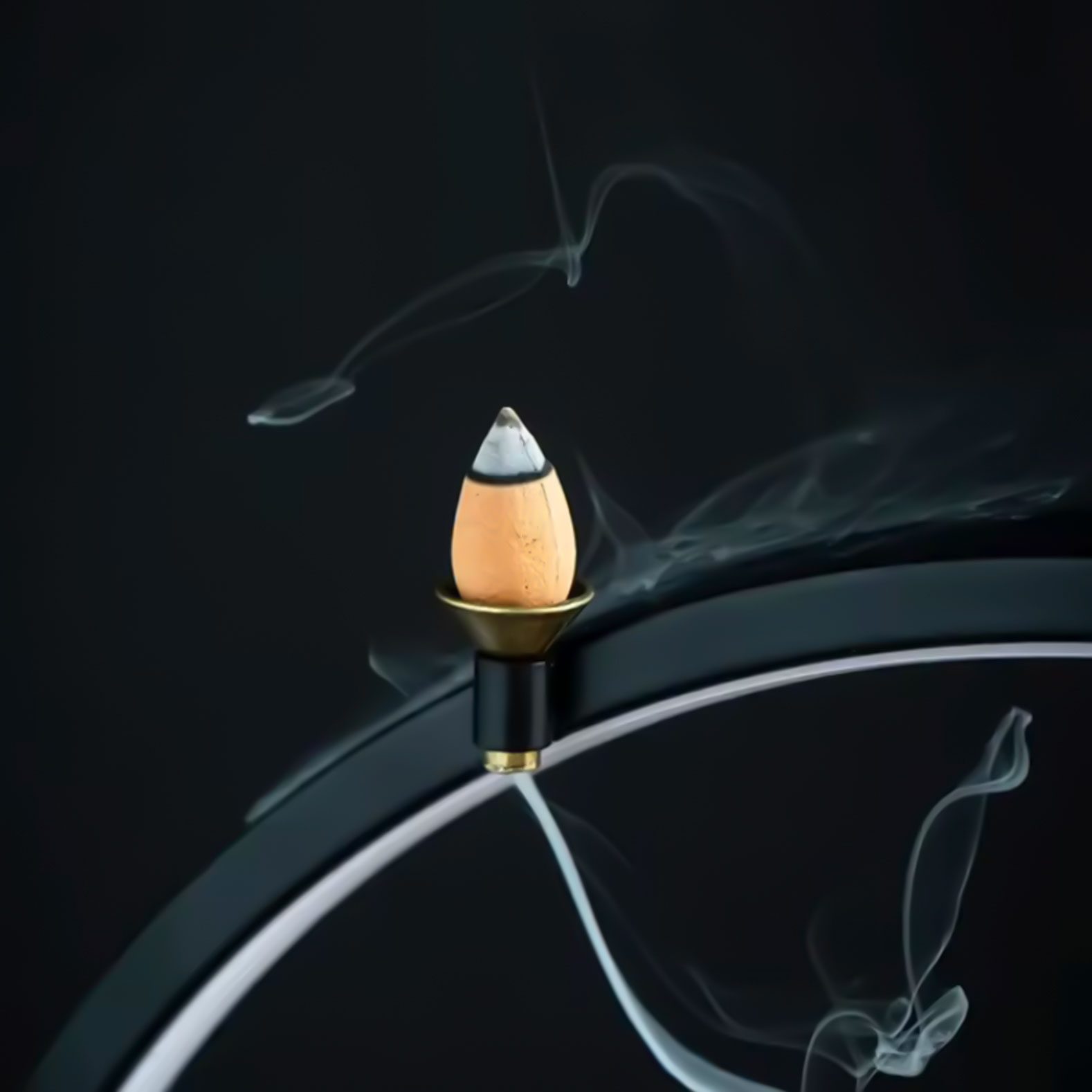
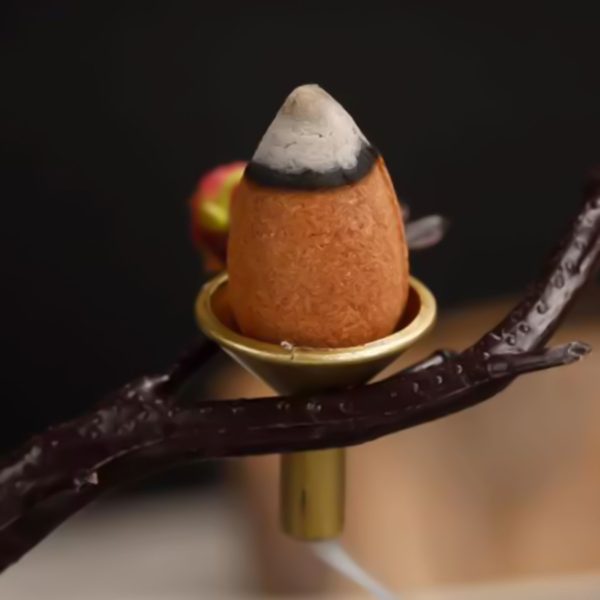
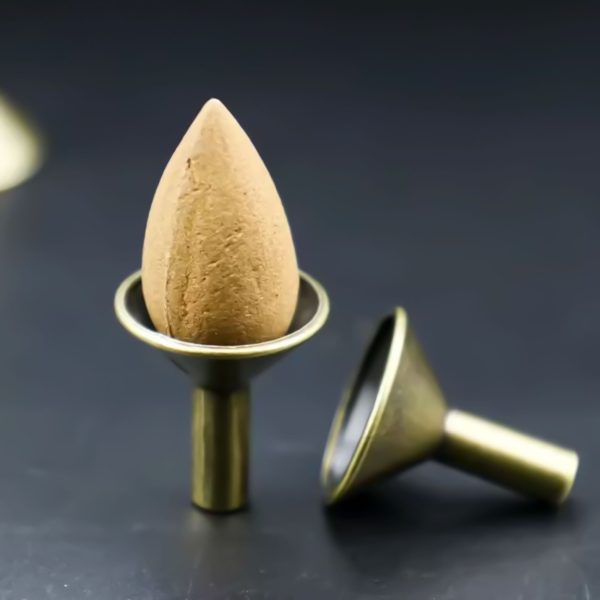
Cones need a stable, heat-safe base with a deep enough tray to contain ash. A cone should sit flat rather than wobble on a narrow support. Backflow cones require a burner with an aligned inlet and clear channel; a standard solid cone will not create the intended waterfall path just because it sits on a backflow burner.
Coils need a purpose-built center support and an ash tray that covers the entire coil. The outer edge must not touch the tray rim, a wall, or a decorative element. Do not hang a coil from an improvised hook or place one on a candle plate. Coils can burn for a long time and create a long, delicate ash trail, so their holder must be especially stable.
| Format | Minimum holder feature | Common mismatch |
|---|---|---|
| Cored stick | Stable hole plus long ash tray | Short dish that misses ash |
| Coreless stick | Gentle support matched to diameter | Narrow hole that cracks the stick |
| Cone | Flat heat-safe cup or tray | Unstable decorative ledge |
| Backflow cone | Aligned inlet and clean smoke channel | Solid cone on a waterfall burner |
| Coil | Full-diameter tray and center support | Small plate or improvised hook |
For coil-specific sizing, ash containment, and supervision, see the incense coil holder and safety guide.
When a holder is not safe for chips, resin or charcoal
A stick holder is not automatically a censer. Oud chips, resin, powder, and charcoal need a vessel designed for a hotter heat source and a different ash pattern. A shallow wooden tray, a small ceramic incense stick dish, or a decorative burner with an unprotected finish may be damaged by charcoal or may let heat transfer to the surface below.
Use a purpose-built censer with an appropriate ash or sand bed for charcoal. If warming chips indirectly, follow the heat-source instructions and use a compatible separator when required. Never place charcoal directly in a holder meant only for a stick or cone. Do not assume that metal is always safe either; thin decorative metal can become extremely hot and may lack a stable base.
Compare ceramic, brass, wood and stone holders
Ceramic holders are popular because they can be heat-resistant, easy to wipe, and available in forms that catch ash well. Their limitations are cracking from sudden temperature changes and chips that can create unstable surfaces. Brass and other metals can be durable and attractive, but they conduct heat. Use them only on a protected surface and let them cool fully before moving.
Wood holders can be suitable for correctly seated sticks when the design keeps the ember and ash safely above the wood and includes an adequate ash path. They are not appropriate for direct charcoal or a cone that can heat the wood. Stone can be stable and heat-resistant, but its weight and surface texture do not automatically make it a compatible holder. A flat stone without an ash-catching design can still allow a stick to tip or ash to scatter.
The material is therefore a starting point, not a safety rating. Check the entire construction: base width, support, tray depth, heat path, and intended incense type.
Stability, ventilation and cleaning checks
Before lighting, press gently on the holder base. It should not rock, slide, or sit on an uneven surface. Confirm that the incense can be placed without touching nearby decorations. Check that airflow in the room is gentle; a direct fan or air vent can move ash and make a flame or ember behave unpredictably.
Keep the tray clean so old ash does not block a cone support or backflow channel. Let every part cool completely before emptying ash or wiping residue. Cleaning is not only cosmetic: a clear holder gives the next piece of incense a stable path and helps prevent mixed odors from old residue.
Compatibility matrix for choosing the final holder
Use this final check before buying or lighting. Match a standard cored stick to a stable hole and a long tray. Match a coreless stick to a support that will not compress it. Match a cone to a flat heat-safe ash cup. Match a backflow cone to an aligned channel. Match a coil to a holder that covers the complete spiral. Match chips, resin, or charcoal only to a censer rated for that heat source.
If one requirement is missing, choose another holder rather than modifying the incense or improvising with household objects. The right equipment makes burning calmer and easier to observe. For cones specifically, use the cone holder and lighting guide before starting.
Replace a damaged holder
Retire a holder that is cracked through, warped, loose at the base, or no longer catches ash. Repairing a decorative piece may preserve its appearance, but a repaired object should not automatically return to use around heat. Use a stable, undamaged holder for every supervised session.
Check the holder with the actual incense before lighting
Product photographs can make a holder appear larger or deeper than it is. Before using it, place an unlit stick, cone, or coil in the intended position and look at it from the side. Does the incense sit level? Does the ash tray extend past the likely fall point? Is the base broad enough that it will not tip if a door closes or a pet passes nearby? This one-minute check catches many compatibility mistakes without adding heat.
Do not add decorative sand, pebbles, dried plants, or loose paper around the ember unless the maker specifically designed the holder for that purpose. Decoration can hide ash, reduce stability, or introduce a material that does not belong near an active heat source.
Use more than one holder when formats differ
A household that uses sticks, cones, coils, and heated chips does not need to force every format into one object. Separate compatible holders keep cleaning simpler and reduce the temptation to improvise. Labeling or storing each holder with its usual format can also help visitors and family members choose the right setup.
When to stop and reset the setup
Extinguish the incense if it leans, if ash leaves the tray, if the holder becomes unstable, or if a draft moves the ember. Let everything cool, then choose a more appropriate holder or a clearer location. A careful reset is always safer than trying to correct an active burn by hand.
