
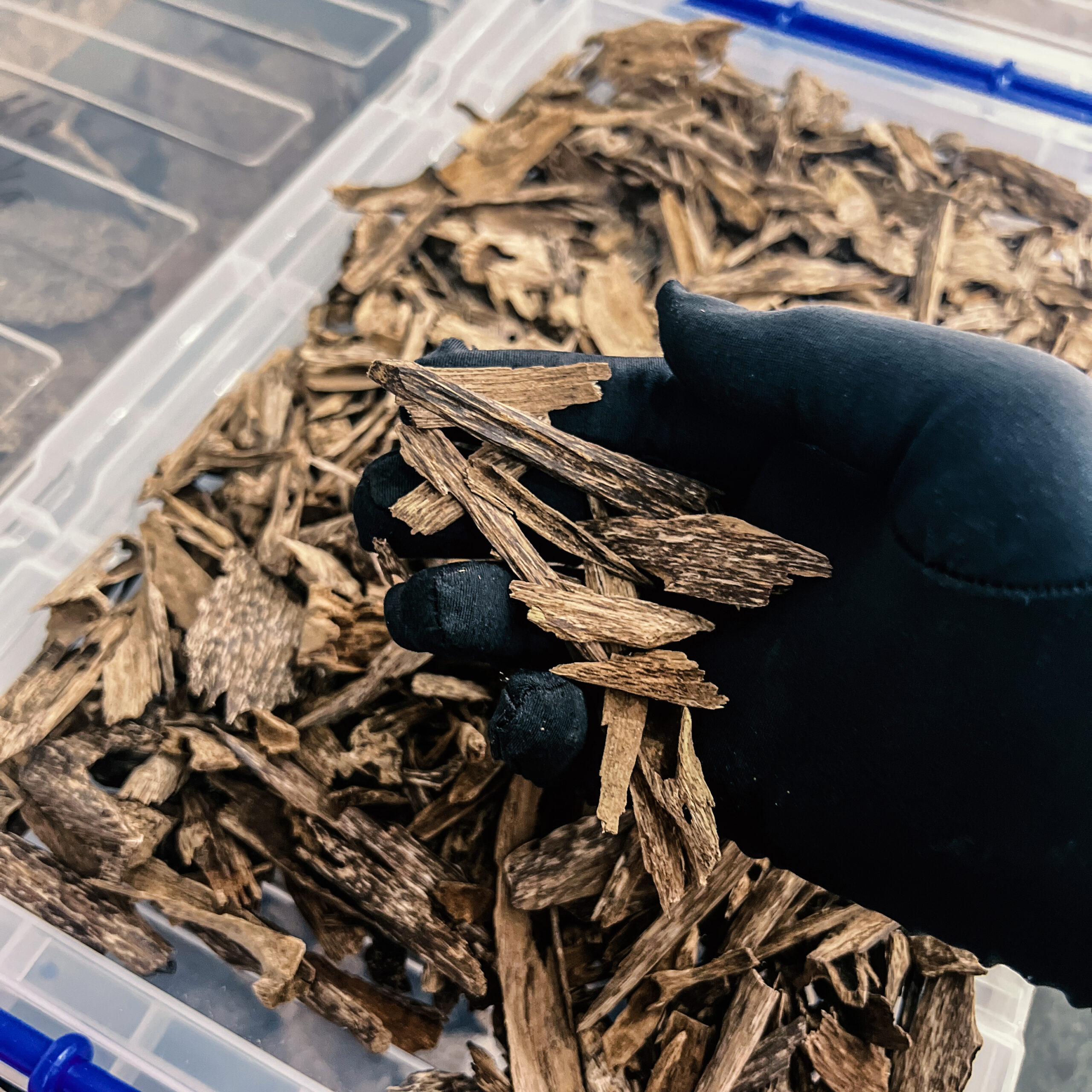
Agarwood Price Guide: Cost Drivers and Buyer Checks
There is no single “agarwood price.” A small incense chip, a raw carving blank, a finished bead bracelet, a distilled oil and a collector display piece are different products with different units, evidence and costs. Comparing their asking prices without normalizing form, weight, condition and documentation leads to the wrong conclusion very quickly.
This guide helps buyers compare offers fairly. It does not promise a universal market rate, because prices move across regions, formats and sellers. Instead, it explains the legitimate drivers of cost, the evidence that should accompany a premium, and the questions that help a buyer distinguish a well-described product from an impressive but unsupported listing.
Why there is no single agarwood price
Price is not a property that sits inside agarwood independent of context. It reflects the item’s form, its usable amount, condition, workmanship, seller channel, documentation and market demand. A large raw piece may cost more in total than a small finished object while costing less per gram. A carefully made bracelet can include labor and design costs that a loose chip does not. Oil may be priced by volume but should also be described by composition and bottle size.
Claims such as “market price” or “standard grade” deserve clarification. Ask which market, date, currency and product form are being compared. An asking price is not the same as a completed transaction. A retail price is not the same as a wholesale price. A social-media appraisal is not the same as a documented sale. Good comparisons begin with this humility.
Form, weight and usable resin content
Form changes what the buyer actually receives. Chips may be intended for burning, but size, moisture, cleanliness and usable aromatic material can vary. A bead bracelet includes drilling, matching, finishing and wearability. A display piece may be valued for grain and carving as well as aroma. Oil requires a clear statement about volume, composition and whether it is pure distillation or a blend.
Weight needs the same care. State the unit, net weight and whether packaging is included. A low price per item can be misleading when the item is unusually small; a high price per gram may be reasonable if the material is carefully selected and documented. “Resin content” should not be inferred from darkness alone. It is better to describe visible character and any measured evidence with its method and limit.

Origin, species and provenance documentation
Origin and species claims can affect price because they may relate to rarity, supply history, conservation context or collector interest. They should therefore be stated precisely. “Vietnamese,” “wild,” “plantation,” or a named species may describe a grower record, a supplier statement, a shipping route or a broad trade association. Ask which one it is.
Provenance has value when it follows the item or batch. Useful support can include grower or supplier records, batch identifiers, invoices, processing notes, current photographs and relevant trade documents. A document that covers a broad shipment may still be useful, but it should not be presented as proof of every small item later divided from that shipment. The agarwood quality and grading framework places provenance alongside other factors instead of treating it as a single verdict.
Grade claims, treatment and condition
Grade language should tell the buyer how a conclusion was reached. A seller may use a house grade, a regional trade term, an aroma description or a density observation. These are not interchangeable. A high grade claim deserves clear photographs, a description of the material form, a statement of what was observed, and an honest explanation of what cannot be proven.
Treatment and condition also matter. Cleaning, cutting or stabilizing may be normal handling, while dye, fragrance addition, coatings or blending can materially alter a buying decision. A price comparison is only fair when the treatment status is disclosed. A piece with damage, moisture exposure, heavy finishing or uncertain storage history should not be compared as if it were an untouched, fully documented item.
Before paying a premium for an authenticity claim, use How to Tell if Agarwood Is Real: Evidence, Tests and Myths to distinguish a useful observation from a claim that needs stronger support.
Retail format, craftsmanship and channel markup
Retail price includes more than raw material. A finished piece can include sorting, cutting, drilling, matching, polishing, packaging, product photography, inventory risk, customer support and returns. These costs do not automatically make a product better, but they explain why a handmade bracelet or carefully presented gift item may not compare directly with loose material bought in bulk.
Channel matters too. A direct grower sale, a specialist retailer, a gallery, a marketplace listing and a luxury boutique each have different overheads and customer protections. Instead of assuming that the lowest channel is always the best value, compare what it includes: photographs, clear disclosure, inspection terms, return policy, shipping and the ability to ask questions after purchase.
Compare offers using normalized units
| Compare this | Normalize it by | Do not assume |
|---|---|---|
| Chips or raw wood | Net weight, intended use, condition and source statement | That darker colour alone equals higher usable value |
| Beads or bracelets | Weight, bead size, workmanship, finishing and evidence | That a per-piece price is comparable across sizes |
| Oil | Volume, composition, bottle size and declared purity | That “oud oil” always means a pure distillation |
| Display pieces | Wood weight, craftsmanship, condition and provenance | That a sculpture is priced only for material mass |
Once you have normalized the unit, compare evidence and terms. Include tax, shipping, duty risk and returns where relevant. A lower headline price can become more expensive when a buyer cannot inspect the item, cannot return it or receives less usable material than expected.

Buyer scenarios: chips, oil, beads and display pieces
For chips, focus on intended use, net weight, current condition and whether the description explains storage and processing. For oil, ask whether it is pure, blended or fragranced; confirm bottle volume and composition. For beads, consider material, bead size, workmanship, finishing and comfort as well as any source claim. For display pieces, separate carving value from raw material value and ask whether damage or restoration has been disclosed.
The same evidence can have different importance in each scenario. A small personal incense purchase may be judged mainly by honest description and fair price. A rare-name collector object, a large lot or a purchase intended for resale should prompt stronger documentation and perhaps independent assessment. The Where to Buy Agarwood guide offers a practical process for matching due diligence to the purchase.
Red flags in unusually cheap or prestige-priced listings
An unusually low price may reflect a small quantity, different material form, weak documentation, treatment, damaged condition or a simple marketing tactic. It does not automatically prove that the item is false. Likewise, a prestige price may reflect craftsmanship, scarcity, seller reputation or collector demand, but it does not prove origin, grade or authenticity on its own.
Pause when a listing combines extraordinary claims with no item-specific images, gives no weight or unit, shifts the source story in messages, hides treatment information, or uses a famous name as a substitute for evidence. Ask for a written clarification and preserve the response. If the answer remains vague, compare a different item rather than filling the gap with wishful thinking.
How to ask for a price comparison that actually works
When you request a comparison from a seller, provide the details that change the answer: product form, net weight, currency, intended use, location, whether shipping and tax are included, and whether you are comparing retail or trade quantities. Ask the seller to identify the basis for any grade or origin claim. This makes it possible to compare two offers without pretending that they are identical simply because both use the word “agarwood.”
Write down the answer rather than relying on an impression. A table with item, weight, unit price, source statement, treatment disclosure, evidence, shipping and return terms can reveal that two apparently similar offers are actually different products. It can also show when a higher price is attached to a real difference—such as documented provenance or a finished, carefully matched object—and when it is attached only to a prestige phrase.
Price drivers that should be disclosed, not guessed
Some price drivers are visible: scale, weight, bead size, carving work and packaging. Others are not: storage, batch selection, chain of custody, treatment, blending and the scope of documents. A responsible listing does not require the buyer to infer these facts from colour or brand style. It states them directly, with sensible limits where information is incomplete.
For example, an oil may carry a higher cost because it is declared as a particular distillation with a stated volume and batch history. A bracelet may carry a higher cost because beads were selected and matched from a documented material. These explanations are meaningful only when they connect to the item being sold. A generic story about rare trees is not an evidence package for a specific product.
Separate value from investment promises
Agarwood can have personal, artistic and cultural value, but a purchase should not be presented as a guaranteed investment return. Values can change with demand, condition, documentation, legality, fashion, exchange rates and the difficulty of reselling a specialized item. Even a well-documented piece may not be liquid or easy to compare across markets.
If collecting is part of your reason for buying, preserve every record: receipt, photographs, stated weight, description, source claim and any documentation supplied. If the item is later sold, pass that information forward without increasing the certainty of the claim. This protects future buyers and prevents a price history from becoming inflated by repeated retelling.
A practical worksheet before you buy
Use five columns: what is it; how much usable material is included; what does the seller claim; what evidence supports that claim; and what terms protect the buyer. Then include the all-in amount: item price, shipping, tax, insurance and any foreseeable return cost. A product that looks cheaper before delivery may not be cheaper after it reaches you.
This worksheet is especially helpful when comparing chips with beads, oil with perfume, or raw material with a finished display piece. It forces the comparison back to units and evidence. If a seller cannot provide enough information to fill the basic rows, that is a reason to reduce confidence, not a reason to invent favorable answers.
When it is reasonable to walk away
Walk away or pause when the price depends on an exceptional claim but the seller will not state the item’s weight, source basis, treatment status or return terms. Also pause when photographs do not show the actual item, when the story changes, or when the seller asks you to trust a “secret” test rather than provide ordinary documentation. These signals do not prove deception; they show that the evidence is not strong enough for a confident premium purchase.
The most satisfying purchases are often not the ones with the grandest label. They are the ones where material, condition, evidence and price remain consistent from the first listing to the item in your hands.
Keep the language proportional to the evidence
Price language should be as careful as source language. “Premium priced because of documented provenance and craftsmanship” explains a choice. “The world’s best agarwood” does not, unless an equally extraordinary claim can be supported for the specific item. The same is true of low-price language: a modest price may be fair for a small, clearly described product, while a very low price attached to a rare-name claim should prompt more questions.
Ask sellers to distinguish an observation from a conclusion. They can observe weight, grain, colour, fragrance, condition and workmanship. They can report a grower or supplier statement. They can share a document. But a conclusion about exact age, wild origin or rare grade requires the right connection between those facts and the material. When that connection is missing, the honest price is one that acknowledges uncertainty.
After the purchase
Store the item appropriately, retain records and describe it accurately if you later gift or resell it. Condition can change with heat, light, handling and storage, and that change may affect both enjoyment and resale comparison. Good documentation does not freeze value, but it gives the next owner a truthful starting point.
Price is ultimately a decision, not a laboratory result. The buyer’s task is to compare like with like, ask for evidence where a claim matters, and choose the offer whose story is clear enough for its cost.
When the details are complete, a buyer can decide calmly: accept the item as a fair offer, request more evidence, compare another listing, or walk away without mistaking uncertainty for proof.
That is the most reliable way to make a price comparison serve the buyer.
It matters.
