
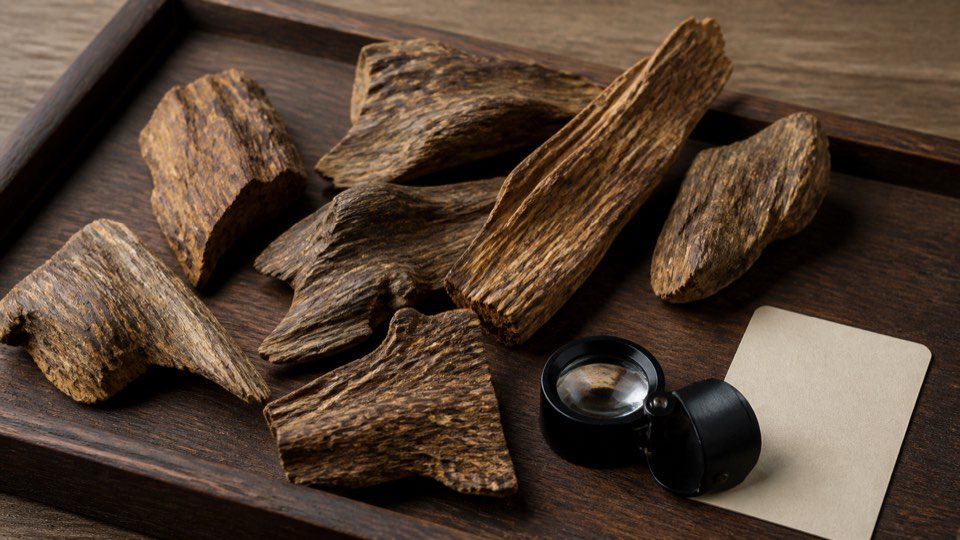
Agarwood has no single global price per kilogram. A usable price must identify the date, currency, country, product form, species or seller-stated identity, legal provenance, condition, grade method, quantity, trade level and delivery terms. A retail pack converted mathematically to “per kg” is not the same as a wholesale kilogram quote.
This page explains how to compare agarwood prices without presenting an unsupported universal range. It does not appraise a tree, predict future value or promise farm income. Current selling rules and transaction costs must be checked for the exact origin and destination.
Last reviewed: August 12, 2026. Audience: English-speaking and U.S. readers. All examples below are methods or clearly labeled illustrations, not offers to buy or sell.
How Much Is Agarwood per Kilo?
A per-kilo number is meaningful only when the quoted goods and terms are comparable. Raw logs, cleaned chips, powder, carved pieces and oil have different usable yields and markets. “Wild,” “sinking,” “kynam” and named-origin labels can change an asking price, but they should not be accepted without evidence.
For a small pack, the arithmetic equivalent is:
Equivalent retail price per kg = pack price ÷ net weight in grams × 1,000
Illustration: a hypothetical 10 g retail pack priced at $60 has an arithmetic equivalent of $6,000/kg. That does not mean a seller can receive $6,000 for one wholesale kilogram. Retail packaging, selection, grading loss, marketing, payment fees, inventory time and returns are embedded in the small-pack price.
| Quote type | Required context | Why it is not interchangeable |
|---|---|---|
| Standing tree | Legal harvest rights, dimensions, sampling, extraction/removal costs | Most of the tree may not be saleable resinous wood |
| Harvested log/section | Gross/net weight, moisture, resin distribution, defects | Processing and sorting loss are unknown |
| Graded chips | Clean weight, cut size, grading method, batch evidence | Small selected pieces carry retail and selection costs |
| Powder | Particle size, source material, additives, moisture | Appearance makes contamination and grade harder to assess |
| Oil | Volume, concentration, extraction disclosure, batch identity | Milliliters of oil cannot be compared directly with kilograms of wood |
| Finished object | Material evidence, dimensions, workmanship and condition | Craft and collector value exceed raw-material arithmetic |
When shopping rather than valuing a bulk lot, compare current listed pack sizes and prices in the agarwood chips category. Use Oudgo’s seven-factor grading framework to examine what a grade claim includes and what it omits.
What Determines Agarwood Price?
Price is driven by evidence, usable material and buyer preference—not one visual test. The most important variables are:
- Product form and usable yield. A buyer prices what can be processed or sold, not merely gross tree weight.
- Legally documented provenance. Ownership, plantation/harvest records, chain of custody and applicable CITES/customs documents affect whether a transaction can proceed.
- Identity disclosure. Species, origin and high-value terminology should be separated into verified, seller-stated and unknown claims.
- Resin distribution and density. Representative cross-sections, moisture and sampling matter more than one unusually dark or sinking piece.
- Aroma under a repeatable method. Heating device, heat progression, sample mass and evaluator affect the observation.
- Condition and contamination. Moisture, mold, soil, coatings, mixed material and storage can reduce accepted weight or cause rejection.
- Quantity and selection. A small curated retail pack usually has a higher unit price than a heterogeneous bulk lot.
- Trade level and delivery terms. Farmgate, broker, wholesale, retail and auction prices include different services, risks and margins.
- Evidence quality. A reproducible batch record is stronger than an unlabeled certificate or a photograph from another lot.
The real vs. fake agarwood guide explains why color, scent, density and burn behavior are screening checks rather than conclusive authentication.
How to Compare Two Agarwood Price Quotes
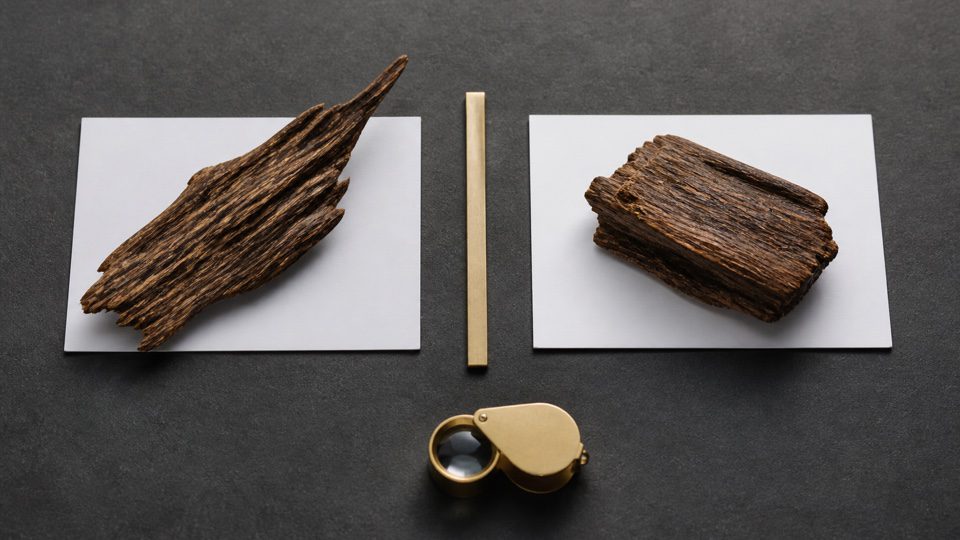
Normalize the specification before comparing the number. Put both quotes into the same currency, unit, product form, accepted weight, delivery point and fee structure.
| Field | Quote A | Quote B |
|---|---|---|
| Quote date and validity | Record | Record |
| Currency and conversion date | Record | Record |
| Product form and net weight | Record | Record |
| Grade definition and sampling | Record | Record |
| Origin/species evidence | Record | Record |
| Moisture/condition | Record | Record |
| Inspection and rejection rights | Record | Record |
| Freight, insurance, permit, tax and commission | Record | Record |
| Payment timing and counterparty risk | Record | Record |
Then calculate:
Net proceeds = accepted quantity × accepted unit price − grading loss − testing − commissions − permits − freight − insurance − taxes and duties
A quote with a higher headline number can produce lower proceeds if the buyer rejects more material, deducts larger fees or shifts transport risk to the seller. The agarwood selling guide provides the documentation, buyer-verification and contract checklist.
Why Do Online Agarwood Price Ranges Conflict?
Most published ranges mix incomparable goods or repeat figures without transaction evidence. Common problems include:
- Combining wholesale logs, retail chips, oil and collector pieces in one range.
- Using asking prices as completed-sale prices.
- Omitting date, country, currency, quantity and delivery terms.
- Calling seller-defined grades an international standard.
- Applying the price of a selected sample to the gross weight of a tree or batch.
- Repeating exceptional kynam/kyara anecdotes as normal commercial value.
- Projecting one local price across countries with different laws and buyer demand.
CITES trade records are valuable for studying reported international movements, but they require careful interpretation: records use product terms, sources, purposes, quantities and units, and they do not provide a universal spot price or capture all domestic and illegal trade. Oudgo therefore does not convert one reported trade total into a global market price.
Country-specific figures require the same discipline. For example, the Philippines agarwood price-per-kilo guide separates dated commercial quotations from customs enforcement values and adds the local permit, currency and landed-cost context needed before comparison.
How Much Agarwood Is Produced or Traded?
A single global production number is not reliable without a defined year, species, source, product term and reporting system. Wood, chips, powder and oil can be reported in different units; plantation output, domestic trade and CITES-reported exports are different scopes. Avoid adding unlike figures or treating export records as total biological production.
For research, start with the official CITES Trade Database, declare the exporter/importer, taxon, term, source, purpose, unit and reporting basis, and disclose that Party-reported exports and imports can differ. For formation and processing context, see how agarwood is formed and produced.
How Much Can an Agarwood Farmer Earn?
Farmer earnings cannot be calculated from tree count multiplied by a premium price. A credible model needs survival, resin formation, accepted yield, grade mix, legal harvest, buyer access and every cost. Revenue is not profit, and a long growing period increases biological and financing risk.
| Model layer | Inputs to record |
|---|---|
| Establishment | Land, seedlings, preparation, irrigation, labor and permits |
| Biology | Survival rate, disease loss, growth, inoculation success and time |
| Harvest | Legal approvals, usable yield, moisture, grading loss and waste |
| Processing | Sorting, drying, distillation or manufacturing yield and quality control |
| Sales | Accepted grade mix, dated buyer quotes, commissions and payment risk |
| Delivery and compliance | Testing, CITES/customs, freight, insurance, tax and duties |
Run at least three cases: base, downside and zero-revenue. The downside case should include lower survival, delayed harvest, lower accepted yield and weaker prices. The zero-revenue case tests whether the operator can absorb crop failure, legal delay or loss of a buyer. Investor.gov warns that high guaranteed returns are a fraud signal; the IRS Farmer’s Tax Guide explains why farm records should support financial performance, income and expenses.
How Much Is 15 ml of Agarwood Oil Worth?
Volume alone cannot determine value. A 15 ml bottle needs an exact current listing or quote plus disclosures for concentration, batch, origin/species claim, extraction terminology, carrier or blend, age, storage and evidence. “Oud oil,” “agarwood oil,” “essential oil” and fragrance oil are not automatically equivalent.
Compare the current pack size and price on the exact product page, then calculate price per ml only between products with comparable concentration and evidence. Do not infer oil value from an unsupported universal wood-to-oil yield. See the oud oil production, use and buying guide and current agarwood oil listings.
Buyer and Seller Price Checklist
- Quote has a date, currency and expiry.
- Product form, net weight and moisture/condition are stated.
- Origin, species and grade claims are separated into verified, seller-stated and unknown.
- Representative sampling and rejection rules are written.
- Trade level and delivery point are comparable.
- Fees, testing, permits, freight, insurance, tax and duties are included in the net calculation.
- No price is presented as guaranteed future value or farmer profit.
Frequently Asked Questions
What is the current agarwood price per kg?
There is no single current global price. Request a dated quote that defines product form, grade method, legal provenance, condition, quantity, trade level and delivery terms.
Why is retail agarwood more expensive per gram?
Small retail packs can include selection, grading loss, packaging, marketing, payment costs, inventory time and returns. Their arithmetic per-kilo equivalent is not a bulk wholesale price.
Does sinking agarwood have a fixed premium?
No. Density is one observation, not a complete grade. Moisture, contamination, sampling, provenance, resin distribution, aroma, condition and buyer preference also matter.
Can a photograph determine agarwood value?
No. Photographs can document appearance but not reliably establish species, legal origin, internal resin distribution, aroma, treatment or representative batch quality.
Is farmer revenue the same as profit?
No. Profit is revenue minus establishment, maintenance, mortality, inoculation, harvest, processing, compliance, finance and sales costs. Accepted yield and grade mix must also be modeled.
Does Oudgo publish a guaranteed buy price?
No. This page is a comparison method, not an appraisal or purchase offer. A valid offer must define the exact goods, evidence, inspection, terms and date.
Editorial Method and Limitations
Oudgo Editorial Team rebuilt this page after comparing English-language U.S. keyword demand with Search Console performance for this exact URL. We retained the ranking URL and legacy fragment anchors, removed unsupported price ladders, global production estimates, farm-profit promises and universal oil-yield claims, and replaced them with auditable calculations and primary sources. Oudgo has not independently verified a reader’s tree, farm, buyer or transaction.
Sources and Further Reading
- CITES/ITTO Technical Series 51: Aquilaria and Gyrinops trade, conservation and management
- CITES Trade Database
- CITES materials for agarwood-producing taxa
- U.S. Fish & Wildlife Service: CITES appendices
- USDA APHIS: importing plants and plant products
- USDA APHIS: Lacey Act declaration
- Investor.gov: how to avoid investment scams
- IRS Publication 225: Farmer’s Tax Guide
