

Agarwood is not manufactured inside a healthy tree. It forms when an Aquilaria tree responds to injury or an induction treatment by depositing fragrant resin in and around affected wood. The process changes pale, low-aroma wood into darker resinous wood over time. Species, tree condition, treatment, environment and time all influence the result, so there is no single universal formation timeline or recipe. Species-level native ranges are mapped separately in the Aquilaria and Gyrinops distribution guide.
| Stage | What happens | Evidence boundary |
|---|---|---|
| Susceptible tree | A living Aquilaria or other agarwood-producing tree provides the biological host | Species identity alone does not prove that resinous agarwood has formed |
| Injury or induction | Natural damage or a controlled physical, biological or chemical method creates localized stress | A wound or drill hole does not guarantee useful resin, a fixed timeline or a particular grade |
| Defense response | Resin-associated compounds accumulate in and around affected tissue over time | Color, aroma or one home test cannot establish the complete identity and quality claim |
| Harvest and sorting | Resinous areas are separated, cleaned and evaluated for an intended product form | Yield and grade depend on the actual tree, method, sample and documented criteria |
| Finished product | Wood may become chips, incense material, powder or feedstock for an extraction process | Formation evidence should not be transferred automatically to safety, legality or finished-product claims |
How does agarwood form inside an Aquilaria tree?
Agarwood formation begins with stress or damage to living Aquilaria tissue. The trigger may be natural—such as broken branches, insect activity or microbial interaction—or deliberately introduced on a cultivated tree. The tree responds locally to the damaged area, and resin-associated secondary metabolites accumulate as the wood changes.
Research describes sesquiterpenes and 2-(2-phenylethyl)chromones as important chemical groups associated with agarwood. The precise profile is not fixed: it varies by species, origin, formation method and sample. This is one reason color alone, a single aroma note or a single “sink test” cannot reliably establish identity or grade.
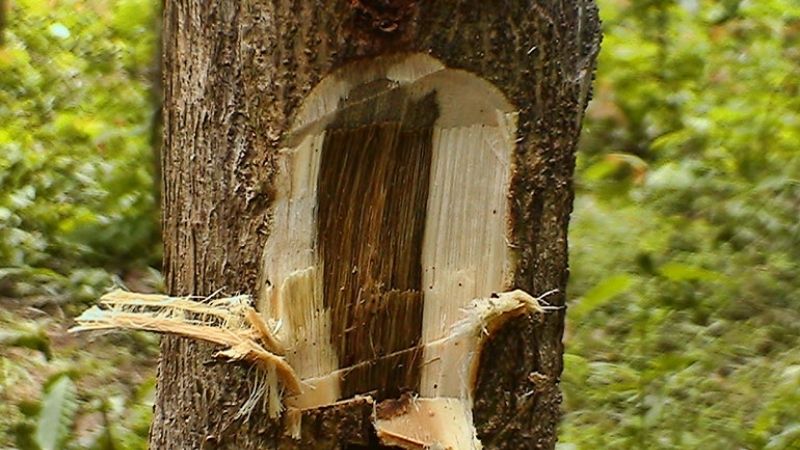
Natural formation and artificial induction
Natural agarwood is associated with injury and biological stress occurring without a planned production treatment. It is scarce and highly variable. Cultivated production uses controlled induction to create a comparable defense response while reducing pressure to search for resin in wild trees.
Induction approaches reported in the literature include physical wounding or drilling, biological inoculation, chemical stimulation and whole-tree delivery systems. These are method families, not interchangeable formulas. Hole size, spacing, inoculant, dose, tree age and harvest timing depend on the protocol being used. Fixed measurements copied from one plantation should not be presented as a universal standard.
For a focused buyer-facing interpretation of bore patterns and method claims, see our guide to drill-inoculated agarwood.

What role do fungi play?
Fungi and other microorganisms can participate in the interaction between wounded wood and the tree’s defense response, but it is misleading to name one fungus as the sole cause of every agarwood sample. Formation is a plant–stress interaction influenced by the host tree, wound environment, microbial community and time. The Frontiers review of agarwood induction compares physical, chemical and biological approaches and explains why induction outcomes vary.
How long does induced agarwood take to form?
There is no single answer that applies to every species or production method. In one study of whole-tree induction in Aquilaria sinensis, researchers followed formation for 12 months and reported dynamic changes rather than steady linear accumulation. Samples met that study’s pharmacopoeial thresholds after four months, while the strongest harvest point under its protocol was month 11, followed by month 6. These results describe one technique and quality framework; they are not a promise that every induced tree will be harvest-ready on the same schedule. See the PubMed record for the temporal study.
From resinous wood to chips, powder and oil
Formation and processing are separate stages. A tree first has to develop resinous material. After harvest, the material is cleaned and sorted according to its intended use. Large aromatic pieces may be retained as agarwood chips; smaller clean pieces can be milled for incense material; selected resinous wood may be prepared for oil extraction.
How are agarwood chips prepared?
Workers remove low-resin or decayed material and separate resinous sections by appearance, aroma, density and intended use. The final cutting and grading method varies among producers. A chip’s origin and processing record are more informative than marketing labels alone. Consumers comparing a sample should examine several characteristics together rather than relying only on whether a piece sinks in water.
How is agarwood powder made?
Clean, dry agarwood material can be milled and sieved to achieve a more consistent particle size. Temperature and contamination need to be controlled because excessive heat, moisture or foreign material can change aroma and usability. Powder may be burned in a suitable incense setup or blended with a documented binder to produce agarwood incense. Powder quality still depends on the resin content and cleanliness of the starting wood; grinding does not upgrade low-grade raw material.
How is agarwood essential oil extracted?
Hydrodistillation is a documented extraction method. Prepared agarwood is distilled with water or steam; volatile compounds travel with the vapor, the vapor is condensed and the oil-containing phase is separated and filtered. Pretreatment, equipment, run time, raw-material chemistry and operator decisions affect both yield and aroma, so a universal wood-to-oil ratio should not be claimed without batch records.
A 2025 Scientific Reports study identified 127 substances in hydrodistilled agarwood essential-oil samples and found that sesquiterpenes and small aromatic molecules were prominent, while composition varied by genotype and region. That evidence supports treating GC-MS and batch provenance as more useful than a fixed yield claim. Read the PubMed summary of the hydrodistillation study, or browse Oudgo’s agarwood oil collection.
What determines agarwood quality?
- Botanical source: the producing species and the health of the tree.
- Formation history: natural or induced origin, method used and duration.
- Resin distribution: how resin is distributed through the sampled wood, not simply surface darkness.
- Chemical and sensory profile: aroma evaluated under consistent conditions and, where appropriate, laboratory analysis.
- Handling: cleaning, drying, storage and freedom from added fragrance or contaminants.
- Traceability: origin, harvest and processing information that can be checked.
For buyer-facing identification steps, use Oudgo’s separate guide to distinguishing real and fake agarwood. For a deeper quality framework, see agarwood standards and grading. Keeping formation, authentication and grading as separate intents prevents one oversized article from giving shallow answers to three different questions.
Sustainability and traceability
Controlled cultivation and documented induction can produce resinous wood without treating wild harvesting as the default supply model. Sustainability still depends on legal sourcing, species identification, plantation management, harvest practices and trade documentation. “Artificially induced” does not automatically mean sustainable, just as “natural” does not automatically mean better or legally traded.
For the cultivation and conservation topic, continue to Sustainable Cultivation and Harvesting of Agarwood. International buyers should use the agarwood import and CITES trade checklist for product-form, document and destination checks before purchasing or shipping.
Where should growing, powder-use and chip-processing questions go?
Formation, cultivation, product use and workshop processing are separate intents. For germination and nursery care, use how to grow agarwood from seed; for plantation decisions, use the sustainable cultivation guide above. Country-specific planting, harvest and transport claims must be checked with the relevant authority; the agarwood legal guide explains the evidence boundary.
For powder and chips, start with how to use agarwood products and the controlled chip-heating guide. Do not apply raw powder to skin, baths or medicinal preparations on the strength of a generic recipe. Cutting resinous wood is a workshop operation requiring material-specific tools, dust control and operator safety; buyers should evaluate the finished sample through the multi-factor grading framework rather than assuming a cut, color or water test proves grade.
Frequently asked questions
Is agarwood the same as ordinary Aquilaria wood?
No. Agarwood refers to resinous wood formed after an Aquilaria tree responds to injury or induction. Healthy pale wood from the same genus is not automatically agarwood.
Does drilling a tree always produce agarwood?
No. Drilling is only one physical trigger. Outcome depends on the species, tree condition, protocol, contamination control and time. The presence of a hole does not prove useful resin formation or high grade.
Can one test prove that agarwood is real?
No single home test is conclusive. Origin records, anatomy, aroma under controlled heating and appropriate chemical analysis provide stronger evidence when considered together.
Is agarwood oil simply pressed from the wood?
Typically no. Hydrodistillation is a documented method in which volatile compounds are carried by vapor, condensed and separated. Other extraction methods exist, and their products should not be assumed to be chemically identical.
Sources and review note
- Tan CS et al. Agarwood Induction: Current Developments and Future Perspectives. Frontiers in Plant Science. 2019.
- Zhang Y et al. Temporal characteristics of agarwood formation in Aquilaria sinensis after applying whole-tree agarwood-inducing technique. Chinese Herbal Medicines. 2023.
- Qian SZ et al. GC-MS metabolomics of agarwood essential oil extracted by hydrodistillation. Scientific Reports. 2025.
Editorial note: This guide distinguishes broadly supported formation principles from method-specific study results. Oudgo should add its own dated plantation, induction, harvest and distillation records only after the responsible production specialist verifies them.
