

How Agarwood Forms: Injury, Inoculation and Resin Response
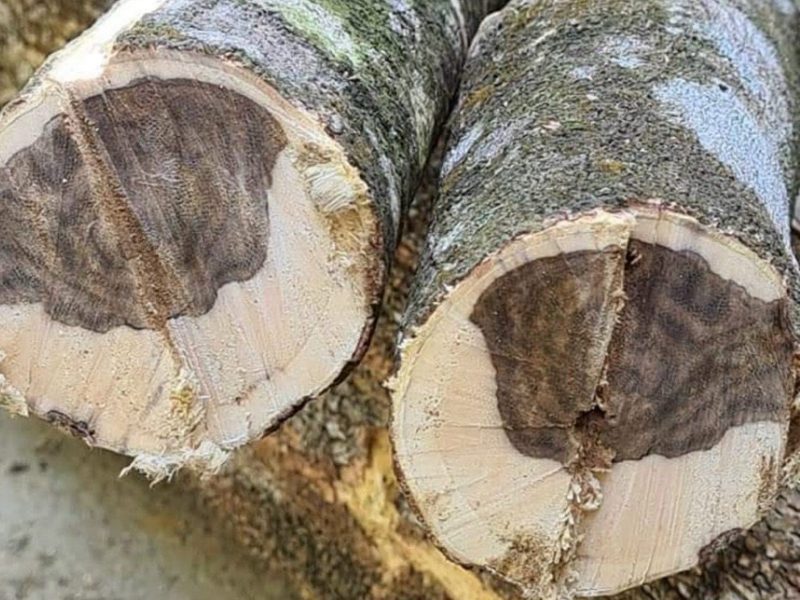
Agarwood is often described with a single word—“infection”—as if one event simply turns pale wood into a dark aromatic material. The science is more careful. Agarwood formation is associated with a tree response: injury and other stresses can set off defense-related processes, and the resulting resin-associated material can develop unevenly across time and wood tissue.
This does not make every wound a source of agarwood, and it does not mean that an inoculation method guarantees a uniform yield or a particular grade. Species, tree health, environment, method, duration, sampling and post-harvest handling all matter. A useful account of formation should keep those variables visible.
Agarwood formation starts with a tree response, not a simple infection story
Healthy wood is usually pale. The dark, resin-associated material associated with agarwood is not distributed through every part of a tree, and it is not produced on demand by a single universal trigger. Researchers examine interactions among injury, defense responses, microorganisms, chemical signaling and environmental conditions. Different studies use different species, methods, tissues and time frames, so their results should not be collapsed into one simple rule.
For a buyer, this matters because formation claims can become exaggerated in retail language. A listing may say “naturally infected” or “induced” without explaining what is actually known. The responsible reading is to ask whether the statement describes a documented process, a seller’s general belief, or a story attached to a batch after the fact.
Injury, defense chemistry and resin deposition
Trees respond to injury. In Aquilaria and related contexts, that response can include changes in compounds and tissues associated with agarwood formation. The response is localized and variable; it may differ according to the tree, the part of the wood examined, the type of disturbance and the time that follows. “Resin deposition” is a useful shorthand, but it should not be treated as a simple container of uniform resin.
Some visible features—darker streaks, density differences or aromatic zones—may reflect this uneven distribution. They are observations, not a complete measurement of quality. A dark exterior does not quantify the internal composition, and an attractive scent does not identify the formation pathway. For a buyer-facing discussion of those quality signals, see Agarwood Resin: Formation, Distribution and Quality Signals.

Microorganisms: association, mechanism and research limits
Microorganisms are often discussed in connection with agarwood because some research has explored their association with formation processes. Association is not the same as a complete mechanism. A microorganism found in one context may be part of a wider interaction involving the host tree, wound conditions, local environment and later tissue change. It is therefore inaccurate to announce that one organism “causes” every case of agarwood.
Study results also depend on how samples are collected and compared. A study of a controlled inoculation cannot automatically describe every wild tree. A study of one species may not apply without qualification to another. And a laboratory result on a small sample does not establish the history of a finished chip or bead. Research is valuable precisely because it defines its material and method; responsible commerce should preserve those limits.
Natural formation versus managed inoculation
Natural formation describes processes occurring without a deliberately managed induction program, but it does not automatically mean wild origin, old age, legality or lack of post-harvest treatment. Managed inoculation describes an intentional effort to encourage a tree response. It may occur in plantation or other cultivated contexts and can use different approaches. It is not the same as adding artificial fragrance to finished wood.
Neither category establishes quality by itself. Natural material may be highly variable and difficult to trace. Cultivated material may offer more practical record-keeping, while still varying greatly from tree to tree and batch to batch. A fair comparison asks what is documented about source, method, timing, processing and the exact material offered. The plantation induction timeline guide explains why time and claims should be read together.
How resin develops over time and through the wood
Time is important, but it is not a magic number. The formation response may develop unevenly through a tree, and a longer interval does not guarantee a better result in every sample. Site conditions, tree health, induction method, local tissue and harvesting choices affect what is available to be selected. A seller who gives a single age figure without explaining whether it refers to tree age, time since induction or age of stored material leaves an important ambiguity unresolved.
For practical evaluation, look at the exact product: its format, condition, weight, aroma under a stated method and the evidence that travels with it. One segment of wood can differ substantially from another. That is why blanket claims such as “all old agarwood is superior” are not a reliable buying rule.
What study designs can actually demonstrate
A useful study identifies its species, specimen, method, comparison group and time frame. Controlled inoculation research can test a defined intervention under stated conditions. Field observations can describe patterns in a natural setting. Chemical analysis can compare measured compounds in defined samples. Each approach can answer some questions and leave others open.
What no single study automatically proves is the exact history or grade of a retail item. A research result may make a claim more plausible, but it cannot replace batch records, chain of custody or item-specific assessment. When sellers cite science, ask which finding is being applied and whether the material, method and limits match the claim being made.
From formation biology to quality claims
Formation biology explains why quality cannot be reduced to one label. A premium claim about source, age, density or rarity should be tied to evidence that follows the item, not merely to a general story about how agarwood can form. A visually dark piece may be beautiful; it is not automatically a proven high-resin grade. A cultivated piece may be well documented; it is not automatically uniform. A wild claim may be meaningful; it is not automatically authenticated.
Use a multi-factor comparison: source statement, formation information, processing disclosure, product condition, aroma, documentation and price. The agarwood types and varieties overview can help place species and formats in their proper context without turning them into guarantees.
A process timeline with uncertainty clearly marked
| Stage | What may happen | What remains uncertain |
|---|---|---|
| Tree growth | Species, site and health establish conditions | Future formation and product quality |
| Stress or induction | Injury or managed practice may prompt a response | Extent, uniformity and duration of resin-associated change |
| Response over time | Localized chemical and tissue changes may develop | Distribution through the wood and sensory outcome |
| Harvest and sorting | Material is selected, cut and stored | How representative a retail piece is of the original tree |
| Retail claim | Source and formation are described | Which facts are documented for the exact batch |
The timeline is useful because it shows where certainty ends. Good descriptions state what is known at each stage and do not convert a plausible process into a guaranteed product result.
Why source records still matter after biology is explained
Biology can explain possibilities; it cannot reconstruct the history of a product placed on a shelf. A seller may accurately describe how resin-associated wood can form and still have limited information about a particular chip. That is why source records, batch handling notes and processing disclosure remain essential. The buyer needs both layers: a realistic account of tree response and a specific account of the material offered.
For example, “plantation-sourced material, seller-stated induced formation, no detailed induction record supplied” is a useful description. It tells the customer what has been reported and what has not been verified. It is more honest than using scientific terms to create a false impression of laboratory certainty. The same discipline applies to wild claims: a broad statement about natural formation does not establish the chain of custody of a finished item.
How buyers can use formation information without overinterpreting it
Formation information is most useful when it changes a practical decision. It can help a buyer understand why material varies, why a species label is not a grade and why two pieces from the same source may differ. It can also help the buyer ask more targeted questions: Does this age refer to the tree or the material? Is the induction statement first-hand? What processing occurred after harvest? Which records belong to this batch?
It should not be used as an improvised home-authentication test. Burning a piece, smelling it, examining darkness or observing whether it sinks may inform a personal experience, but none can determine formation history. Avoid destructive tests designed to “prove” an origin claim. Preserve the item and request better documentation where the price depends on the claim.
Research uncertainty is not a weakness
Scientific uncertainty is often presented as a problem, but it is an important protection against overclaiming. A researcher who says that a result applies to one species, one method and one time frame is offering more useful information than a marketer who says that all agarwood behaves identically. Uncertainty tells buyers which conclusions are supported, which are tentative and which have not been tested.
In an article or listing, mark the boundary clearly. “May contribute,” “is associated with,” and “has been studied under these conditions” are more accurate than “always causes.” This language does not diminish the material. It respects the complexity of living trees and helps prevent a retail story from pretending to be a universal biological law.
Questions to ask about an inoculation claim
If a product is described as inoculated, begin with the setting. Was the tree cultivated? Does the seller know the broad method, the approximate timing or the grower/processor involved? Is the description tied to the exact batch or simply to a product category? Then ask about post-harvest handling: was the material cleaned, polished, scented, blended or otherwise processed? Those answers separate formation from finishing.
Do not assume that an incomplete answer means the claim is false. It means the evidence has a limit. A transparent seller can say that they have a plantation source declaration but not a full induction log. The buyer can then decide whether that level of knowledge fits the intended purchase and price.
From tree variability to fair pricing
Because formation is uneven, price should be attached to the demonstrable qualities of the specific item. Those can include format, visible condition, workmanship, aromatic experience, evidence package and return terms. A universal promise based on tree age, source label or an impressive biological phrase is less useful than a clear description of the item itself.
This approach benefits growers and customers. Growers who keep practical records can communicate their work more accurately. Sellers can avoid inflating claims they cannot prove. Customers can choose a material for its real character rather than paying for a story that has become detached from the batch.
A sensible conclusion for everyday and high-value purchases
For a small purchase intended for personal aromatic use, a frank description, current photographs and a fair price may be sufficient. For a rare-name premium, a large quantity or a piece intended for collection or resale, ask for more: written source and processing statements, batch-level records and, where appropriate, independent assessment. Match the depth of verification to the consequence of being wrong.
Agarwood formation is fascinating precisely because it is not mechanical. Injury and inoculation can be part of a wider tree response; time and wood position can matter; research can illuminate the process without settling every retail claim. The best purchase is one whose biology, documentation and price are aligned honestly.
Reading claims in the right order
There is a reliable order for evaluating formation claims. First identify the item: chip, carving, bead, powder or oil. Next identify the stated source and whether it is wild or cultivated. Then ask what is known about formation or induction and what was done after harvest. Only after those questions should you interpret sensory descriptions, density or colour. Reversing the order encourages buyers to start with an appealing result and work backward to a story that may not be documented.
This order also helps when comparing materials from different sellers. One seller may know the grower but not the exact induction timing; another may have excellent photographs and no source records. Neither record is complete. State the difference plainly, compare the product’s evidence package and avoid giving either material a certainty it has not earned.
Responsible language for sellers
Sellers can make a formation description useful by naming its source: grower report, processor report, batch document, or retail observation. They can avoid medical-sounding or absolute claims, describe any finishing clearly, and explain what questions cannot be answered for the particular item. This kind of language is not less persuasive; it is the foundation of durable customer trust.
That distinction protects the tree, the seller, and the buyer from misleading certainty.
It also makes every purchase decision more grounded and fair.
