
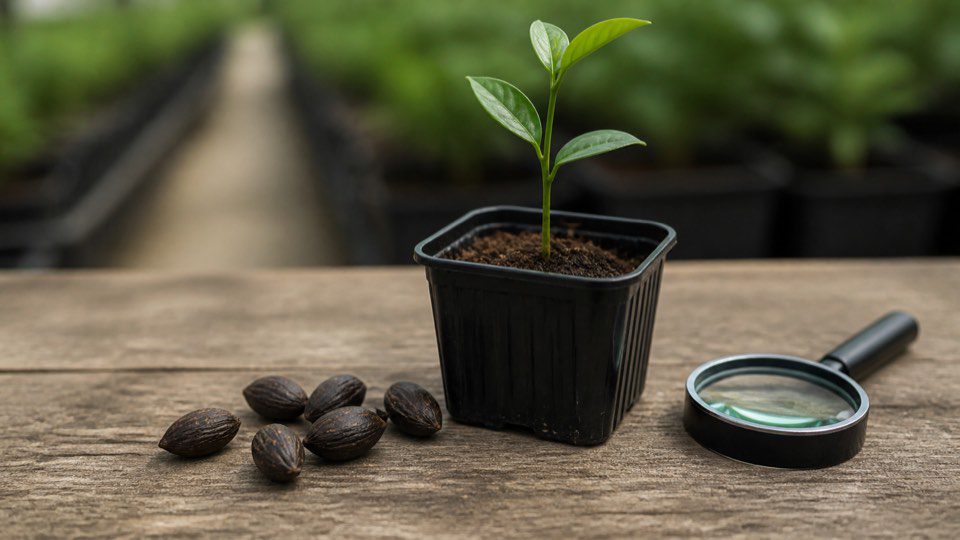
You can buy agarwood seeds or seedlings from a specialist nursery, a documented plantation, or an online seller—but a listing is not proof that the material is genuine, viable, or legal to import. Before paying, require the scientific name, country of origin, collection or nursery date, seed-lot code, current photos of the exact batch, and the documents required by your destination country.
For U.S. buyers, check the exact taxon and country of origin in USDA APHIS requirements before ordering. Most plants and seeds for planting require a PPQ 587 permit, and live seedlings generally face stricter phytosanitary and protected-species controls than bare seeds.
Last reviewed: August 12, 2026. Scope: English-language guidance for international and U.S. buyers. Oudgo does not endorse the third-party sellers discussed by search results and does not claim that marketplace photos or certificates authenticate a batch.
Where Can I Buy Agarwood Seeds or Seedlings?
Start with sellers who can identify and document the exact planting material, not with the lowest headline price. A domestic specialist nursery is usually easier to verify and may reduce import risk. An overseas nursery or plantation may offer more species or fresh-season stock, but the buyer becomes responsible for destination-country import compliance.
| Seller channel | Potential advantage | Evidence to request | Main risk |
|---|---|---|---|
| Domestic specialist nursery | Shorter transit and simpler delivery | Scientific name, propagation record, current inventory photos, refund policy | Plant may have been imported earlier without traceable origin |
| Licensed nursery or plantation abroad | Access to source-region stock and harvest-season seeds | Nursery registration, parent-stock source, seed-lot code, collection date, export and phytosanitary documents | Import refusal, delay, loss of viability, or document mismatch |
| Marketplace seller | Easy discovery and price comparison | Legal business identity plus the same batch-level records required from a nursery | Copied photos, misidentified species, old seed, or no importer support |
| Botanical or research exchange | Strong taxonomic records in some programs | Accession data, exchange terms, phytosanitary status, noncommercial-use restrictions | Material may not be available to the public or for commercial cultivation |
Do not treat a seller directory, review count, social-media account, or marketplace badge as batch authentication. Use the channel to find candidates, then verify the seller and the exact lot independently.
Should You Buy Agarwood Seeds or Seedlings?
Seeds are cheaper to ship but more sensitive to age and handling; seedlings cost more to transport but let you inspect a living plant. Your choice should be based on documentation, import eligibility, transit time, and the cost per established plant—not just the item price.
| Factor | Seeds | Seedlings |
|---|---|---|
| Identity evidence | Lot label and parent-stock records; visual ID is weak | Nursery label and propagation record; morphology alone may still be inconclusive |
| Freshness/condition | Collection date, storage method and transit time are critical | Root condition, pests, leaf stress and growing medium are critical |
| Shipping | Small and light, but delay can reduce usable value | Bulkier and vulnerable to dehydration or root damage |
| U.S. import | Check PPQ 587, ACIR and small-lot conditions for the exact taxon/origin | Usually requires plant-health documentation; protected-plant rules may also apply |
| Best comparison metric | Landed cost per usable seed and later per hardened seedling | Landed cost per healthy, correctly identified plant |
If you already have a documented, admissible seed lot, continue with the separate agarwood seed germination and seedling-care guide. Keeping cultivation instructions on that page prevents this buying guide from mixing transactional and growing intent.
How Do You Verify Genuine Agarwood Seeds?
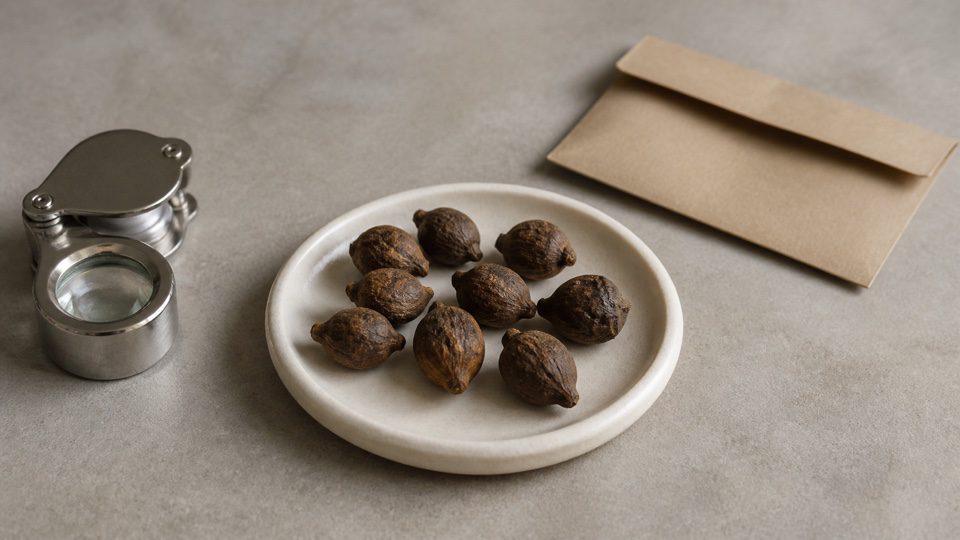
No reliable home visual test can prove that an unlabeled seed is an Aquilaria species. Verification begins with traceability. Ask for the following records before ordering:
- Accepted scientific name. “Agarwood seed” is incomplete. The invoice and packet should state a species such as Aquilaria malaccensis, not only a common name.
- Country and locality of origin. Separate where the parent stock grew, where the seed was collected, and where the seller operates.
- Seed-lot code. The code on the packet, invoice, photos, test results, and shipping documents must match.
- Collection and dispatch dates. Request day/month/year rather than “fresh.” Also ask how the lot was stored and how long transit is expected to take.
- Parent-stock and legal-acquisition record. A seller should be able to explain whether the source is a registered nursery, plantation, or other lawful stock.
- Current batch evidence. Ask for dated photos or video showing the lot code and packaging. Stock photography is not evidence of the shipped lot.
- Import/export support. Confirm who obtains the phytosanitary certificate, permits, declarations, labels, and routing required for the destination.
- Written remedy. The policy should cover non-shipment, document mismatch, wrong taxon, damaged seedlings, and seeds arriving outside the promised dispatch window.
Kew Science accepts Aquilaria malaccensis as a species in the family Thymelaeaceae and records its native range from Bangladesh through western and central Malesia. Use a current taxonomic source to check names because trade listings may use synonyms or misspellings.
What Are the Red Flags for Fake or Poor-Quality Listings?
Walk away when the seller promises a high-value future wood grade but cannot document the present seed or plant. Common warning signs include:
- Only “agarwood,” “oud,” “kyara,” “kynam,” or “super resin” appears—without a scientific name.
- A claim that a seed is guaranteed to produce kynam, a fixed oil yield, or a particular future selling price.
- No collection date, lot code, country of origin, or storage record.
- One certificate is shown but its holder, taxon, date, quantity, or lot does not match the offered goods.
- The seller offers to misdeclare seeds as gifts or to hide live plants in an ordinary parcel.
- Guaranteed germination without a stated test date, sample size, method, and remedy.
- Price is quoted only per kilogram with no seed count, lot date, net weight, or usable-condition standard.
- Pressure to pay by an irreversible method before documents are checked.
“Kynam” and “kyara” are high-value trade terms for unusual resinous agarwood material; they are not a recognized seed-certification class that can guarantee the result of a seedling. Resin formation depends on the living tree, time, injury or induction, microorganisms, environment, and later grading. See how agarwood forms in Aquilaria trees.
Can You Import Agarwood Seeds into the United States?
Possibly, but admissibility depends on the exact species, country of origin, material type, and current permit conditions. USDA APHIS states that most plants and seeds for planting require a PPQ 587 permit and that the U.S. buyer/importer is responsible for compliance. Only U.S. residents may apply for that import permit.
- Search the exact taxon, origin country, and planting material in the USDA Agricultural Commodity Import Requirements (ACIR) database.
- Apply through APHIS eFile for PPQ 587 or obtain confirmation that the item is exempt.
- Send the permit conditions and any required green-and-yellow shipping label to the seller before dispatch.
- Require an invoice or packing list with scientific name and quantity. Follow the permit’s rules for origin, recipient details, package description, and Plant Inspection Station routing.
- Confirm whether a phytosanitary certificate and protected-plant documents are required. Do not rely on a seller’s statement that “seeds always pass customs.”
APHIS’s Small Lots of Seed program has detailed conditions. The current page allows no more than 50 seeds of one taxon or 10 grams of that taxon per packet, with no more than 50 packets per shipment, only when all other eligibility conditions are met. The invoice must include the seller, scientific name, country of origin, and seed-lot code; each packet also needs specified labels. These limits do not by themselves make an Aquilaria shipment admissible—check ACIR and the issued permit.
Aquilaria and Gyrinops are regulated in CITES Appendix II under an annotation that generally excludes seeds and pollen from the listing’s scope. That does not remove U.S. plant-health controls, ESA considerations, state rules, or documentation requirements, and it does not mean rooted seedlings are exempt. Confirm the current CITES annotation and destination rules for the exact shipment. For wood, oil, live plants, and cross-border trade context, read the agarwood legality and CITES guide.
How Should You Compare Agarwood Seed or Seedling Prices?
Compare the total cost of a documented, admissible plant that survives establishment—not the cheapest packet or a speculative price per kilogram. Record the same fields for every quote: taxon, lot, collection date, quantity, plant age/size, documents, shipping, taxes, refund terms, and expected loss.
Landed cost per usable seed = (goods + documents + freight + payment fees + applicable import costs) ÷ usable seeds received
Cost per established plant = total acquisition and propagation cost ÷ seedlings alive after the defined hardening period
A kilogram listing can contain old, wet, mixed, or poorly counted seeds. Without a collection date, count, sample test, and batch identity, “price per kg” is not a useful comparison. The same principle applies to seedlings: height alone does not show root health, correct identity, or legal provenance.
Do not extend a seedling quote into a future agarwood-income promise. Standing trees, chips, powder, oil, and finished goods are different product forms with different evidence and markets. Use the agarwood price-comparison method for those materials.
What Should Be Confirmed Before You Pay?
- The scientific name is present on the quote, invoice, packet, and permit application.
- The origin, nursery/plantation source, collection or propagation date, and lot code agree.
- You have current images or video of the exact lot—not only a catalog image.
- The destination authority confirms admissibility for that taxon, origin, and material.
- The seller can supply every required phytosanitary, CITES, export, and shipping document.
- The routing and outer-package labels match the permit.
- The payment method, delivery window, inspection period, and refund triggers are written.
- No guaranteed resin grade, yield, germination rate, or investment return is part of the decision.
Frequently Asked Questions
Where is the best place to buy agarwood seeds?
The best source is a nursery or plantation that provides the scientific name, exact seed-lot code, collection date, origin, current batch evidence, and documents required by your destination. Prefer a domestic specialist nursery when comparable records are available because shorter transit and simpler import handling reduce risk.
How can I tell whether agarwood seeds are genuine?
You usually cannot prove species from appearance alone. Verify the chain of records: accepted scientific name, parent-stock or nursery source, country and locality, collection date, seed-lot code, matching invoice and packet labels, and current images of the exact batch. Laboratory identification may be appropriate for valuable or disputed lots.
Are agarwood seedlings better than seeds?
Seedlings let you inspect a living plant and avoid the germination stage, but they cost more to ship and may face stricter import and phytosanitary requirements. Seeds are compact but freshness and handling can determine value. Compare the landed cost per healthy established plant.
Do I need a permit to import agarwood seeds into the U.S.?
Most plants and seeds for planting require USDA APHIS PPQ 587, but the exact conditions depend on taxon, origin, treatment, quantity, and current restrictions. Check ACIR and obtain the permit or written exemption before the seller ships. State and protected-species rules may also apply.
Should agarwood seeds be priced per kilogram?
A kilogram quote is not useful unless it includes seed count, net condition, scientific name, collection date, lot code, sample-test method, and shipping terms. Compare landed cost per usable seed and, after propagation, cost per established seedling instead of assuming every gram has equal viability.
Can a seller guarantee kynam agarwood from seed?
No credible seed record can guarantee a future kynam or kyara grade. Those are trade terms for exceptional resinous material, not standardized seed cultivars. Tree biology, environment, injury or induction, time, processing, and later grading all affect the result.
Sources and Editorial Limitations
- USDA APHIS — How To Buy Plants and Seeds Online
- USDA APHIS — Seeds With Special Requirements and Prohibited Seeds
- USDA APHIS — How To Import Plants and Plant Products
- Royal Botanic Gardens, Kew — Aquilaria malaccensis
- CITES — agarwood taxa and annotation history
Editorial limitation: This is a verification and compliance framework, not a seller endorsement, legal opinion, import approval, viability certificate, appraisal, or cultivation-return forecast. Rules can change and may differ by state or destination. Confirm the exact shipment with the competent authorities before payment. Oudgo Editorial Team maintains the page under the public Editorial Policy; individual staff identities are not represented as public experts.
