
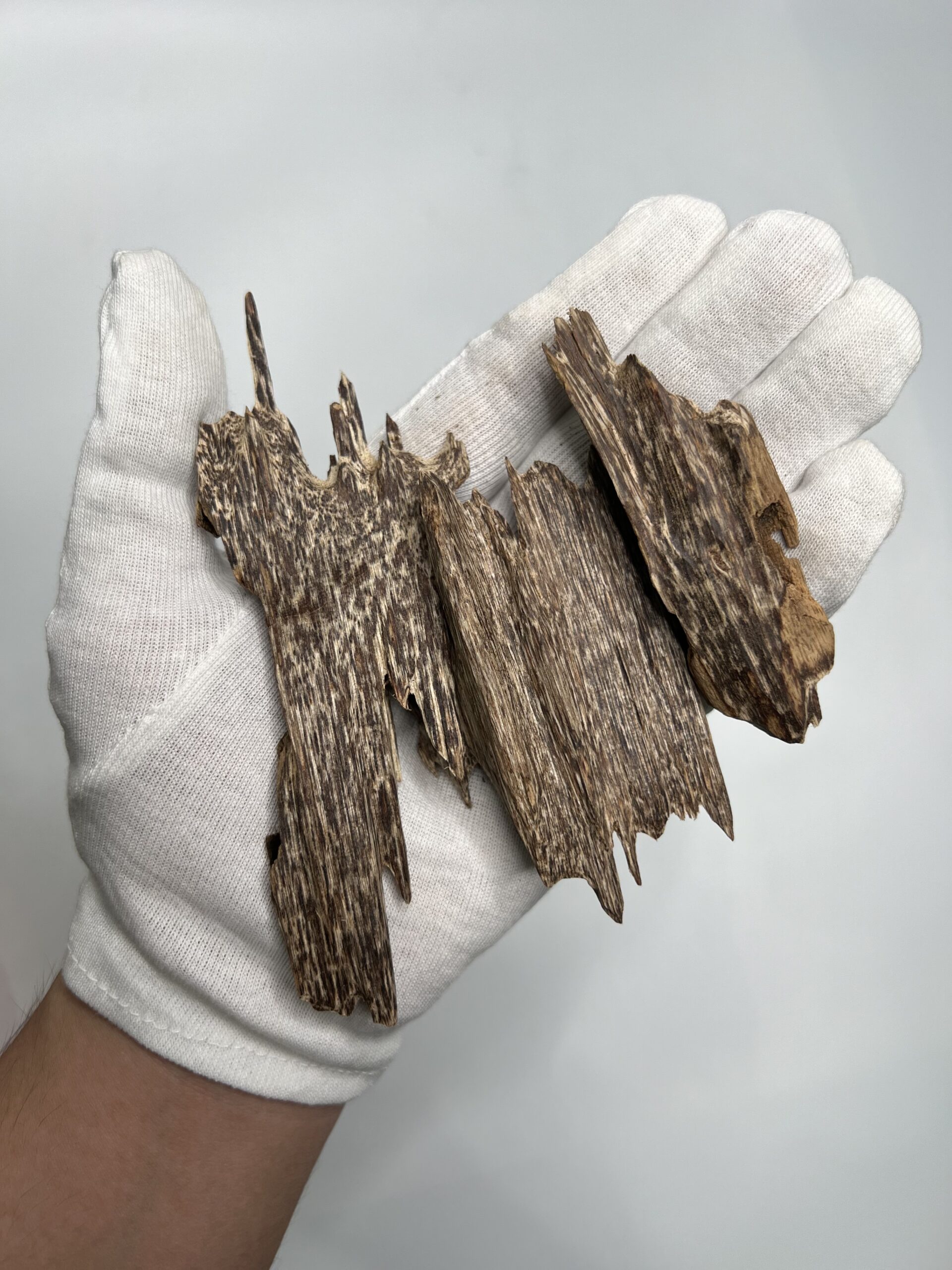
Agarwood Quality and Grading: Seven-Factor Framework
“Premium,” “super,” “double-super” and similar grade words can sound precise, but they are often seller-defined unless the criteria are stated. Agarwood quality is not a single signal. Colour, density, aroma, origin story and price can all be relevant, yet none can settle quality alone. A fair assessment combines the material’s physical character with the evidence that follows it and the purpose for which it is being bought.
This framework uses seven factors to make that comparison practical. It does not produce a universal score or replace a qualified assessment. It helps a buyer ask better questions, compare like with like and see where a seller’s claim is stronger than the information supplied.
Why agarwood cannot be graded on one signal
Agarwood varies within trees, across sources and after processing. A dark piece may have an attractive appearance, but colour can be affected by lighting, surface oxidation, finishing and treatment. A dense piece may be interesting, but density varies by shape, moisture and the part of wood tested. A strong aroma may be enjoyable, but it changes with storage, temperature and heating method.
Likewise, a prestigious origin label or high price does not independently establish quality. These signals can prompt more questions; they cannot replace the answers. A multi-factor approach protects buyers from paying for an imagined certainty and helps sellers describe material honestly.
Factor 1: species, origin and provenance evidence
Start with identity and source. What species or genus is stated? Is the claim based on grower records, a supplier statement, a prior owner’s description or a direct assessment? Does the record apply to the exact item or only to a general product category? Source information is valuable when its scope is clear.
Provenance can include a supplier history, batch identifier, invoice, current photographs and relevant documentation. It does not prove every quality attribute, but it helps a buyer understand where a claim came from. A modest, specific record is more useful than a dramatic regional name without a connection to the item.
Factor 2: resin distribution and density
Resin-associated material can be unevenly distributed. Visible streaks, grain, colour variation and density may help describe a piece, but they should not be converted into a numerical grade without a defined method. A dense outer surface does not tell you what lies inside every portion of the wood, and one small sample does not represent a whole batch.
Ask what has been observed and how. Is the description based on current photographs, a measured weight, a controlled comparison or a seller’s general impression? For a focused discussion of resin and its limits, see Agarwood Resin: Formation, Distribution and Quality Signals.
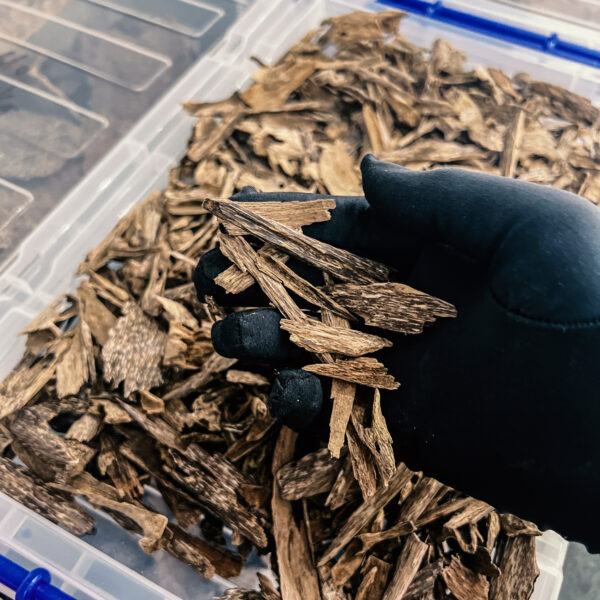
Factor 3: aroma under controlled heating
Aroma is central to agarwood, but it should be assessed in a repeatable way where possible. Record the format, amount used, heating method, temperature, room conditions and whether the item was burned or gently warmed. Notes such as sweet, woody, cool, resinous or smoky are personal observations; they become more useful when the preparation is stated.
Aroma can be affected by storage and post-harvest treatment. An intense first impression may not reveal longevity, complexity or composition. For this reason, scent should be combined with the other factors rather than used as a shortcut to authenticity or source.
Factor 4: condition, treatment and intended form
Condition changes value. Chips may have dust, moisture exposure, fractures or surface residue. Beads may have cracks, heavy polish, coatings or repairs. Oils may be pure, blended or fragranced. A buyer should know what form is offered and what has been done after harvest: cleaning, cutting, finishing, scenting, dyeing, stabilizing or blending.
Intended use matters too. A display piece may be valued for shape and workmanship; a chip for burning may be judged by how it performs under heat; a bracelet needs comfort and durable finishing. The same material can be excellent for one purpose and unsuitable for another. Grade language should never hide this distinction.
Factors 5–7: documentation, consistency and market context
Factor five is documentation: records should be current, item-specific where possible and clear about their limits. Factor six is consistency: does the listing, photograph, message and invoice tell the same story? A supplier who distinguishes fact from estimate creates more confidence than one who changes claims when asked ordinary questions.
Factor seven is market context: compare price, unit, retail channel, workmanship, delivery terms and return policy. A premium may be reasonable when it reflects an evidence package, careful selection or craftsmanship. It is less persuasive when it rests solely on a rare-sounding label. The Agarwood Price Guide helps normalize these comparisons.
Apply the seven-factor framework to buyer scenarios
| Scenario | Factors to emphasize | Useful next question |
|---|---|---|
| Chips for burning | Aroma, condition, form, weight and storage | How was the scent assessed and what is the net weight? |
| Bead bracelet | Material, finishing, workmanship and source evidence | Are coatings or repairs disclosed? |
| Oil | Composition, bottle size, source and batch records | Is it pure oil, a blend or a fragrance product? |
| Collector display piece | Provenance, condition, craftsmanship and legal context | Which records travel with this exact item? |
Use the table to identify what is missing. A seller does not need to prove every factor perfectly for every purchase, but a high price should be matched by a stronger description and evidence trail.

Where grading ends and seller claims begin
Grading ends where the evidence stops. A seller may describe a piece as premium within their own system, but they should say what that means: selection criteria, intended use, physical observations and the limits of documentation. Terms such as “rare,” “wild,” “old” or “highest grade” should be treated as claims requiring proportionate support.
A buyer does not need to reject every imperfect record. They need to price uncertainty honestly. For a close look at density claims, see Sinking Agarwood: What Density Can and Cannot Prove. The goal is a calm decision based on the material that can actually be shown.
How to make the framework repeatable
Use the same order for every item. First state the product form and intended use. Then capture the origin and provenance claim exactly as the seller presents it. Record physical observations—weight, dimensions, visible grain, condition and scent notes under a stated heating method. Finally, note treatment disclosure, documents, price and return terms. This sequence keeps a buyer from starting with a desired conclusion and selecting only the signs that support it.
Compare the information at the same level. Do not compare a retail bracelet’s total price with a raw chip’s price per gram. Do not compare a seller’s aroma note with a laboratory result. Do not treat a photograph taken in dramatic lighting as if it were a measurement of density. The framework works because each factor is kept in its appropriate place.
What a strong listing looks like
A strong listing names the form, weight and current condition. It describes source and species as records or seller statements rather than as guarantees. It shows current photographs and discloses finishing, blending or treatment. It explains the intended use and gives a reasonable return process. When a grade term is used, it identifies the criteria behind it.
A strong listing does not need to claim perfection. In fact, a sentence such as “supplier-stated plantation source; batch record available; no independent species analysis supplied” often inspires more confidence than a long list of unqualified superlatives. It gives the buyer a real evidence boundary.
Common grading mistakes
The first mistake is turning darkness into a score. Dark colour can be visually appealing and may be associated with resin-rich areas, but it is affected by many variables. The second is treating a sink test as an authentication test. It may relate to density in a particular object under particular conditions; it cannot prove origin, species, age or lack of treatment. The third is treating price as proof. High prices can reflect workmanship, scarcity, reputation or speculation as well as material quality.
The fourth mistake is forgetting condition. An old, admired piece may still have cracks, repairs, heavy finish or storage damage that affect its practical value. The fifth is ignoring purpose. A beautiful display piece and a fragrant burning chip should not be judged by the same priorities. These mistakes are easy to avoid once the questions are placed side by side.
How sellers can use the seven factors responsibly
Sellers can use the framework as a description template. State the known source information, physical observations and intended use. Disclose processing. Show current images. Link documents to their stated scope. Explain any grade vocabulary. Then invite buyers to ask what remains unknown. This improves clarity without forcing a seller to make a claim their information cannot support.
The result is a better market conversation. Customers learn why two items can legitimately differ in price; suppliers are rewarded for records and careful descriptions; and quality becomes a reasoned judgment rather than an adjective added to a label.
How to weigh the factors without inventing a formula
The framework is deliberately not a rigid points system. The weight of a factor depends on the purchase. A buyer of a small chip may prioritize aroma, condition and fair price. A buyer of a rare-name display piece may prioritize provenance, legal context and documentation. A buyer of oil may prioritize composition and source disclosure. Assigning the same numerical weight to every situation would create the appearance of precision without solving the underlying uncertainty.
Instead, identify the factor that could change your decision. If a product is expensive because it is claimed to be wild, provenance should carry more weight. If it is bought for burning, controlled aroma assessment and condition should carry more weight. If it is a wearable item, treatment and workmanship should carry more weight. This is a practical way to make the framework reflect the real choice.
Examples of a proportionate conclusion
“At this price, the aroma, current condition and clear weight are enough for a personal-use chip; the source claim is not central to my decision.” This is a valid conclusion. So is: “The collector premium depends on a rare origin claim, but the batch record does not follow the exact item, so I will not treat the claim as established.” The framework does not demand that every buyer seek every document. It asks each buyer to see what the evidence does and does not support.
Another useful conclusion may be: “The bracelet is well made and comfortable, but its source story is limited; I will value it as a finished wearable object rather than as a verified rare specimen.” This protects the buyer from overpaying while respecting the actual craftsmanship of the product.
Keep the record with the item
After purchase, retain the invoice, listing screenshots, photographs and any supplied records. Note the item’s weight and condition. If you later gift or resell it, pass the same description and limits forward. This is especially important where grade language contributed to the price. Accurate continuity gives the next owner a fair starting point and prevents a vague label from becoming more certain every time it changes hands.
The seven-factor framework is therefore not only a way to shop. It is a way to communicate value honestly: identify the material, describe what can be observed, preserve the evidence, and let the intended use determine what matters most.
Before accepting a prestige label
Pause for three questions. What exact attribute is the label meant to describe: aroma, appearance, source, rarity, workmanship or market reputation? What evidence supports that attribute for this item? What would make the claim less certain? If the seller can answer all three clearly, the label may be a useful shorthand. If not, treat it as a sales description and make a price decision without assuming an independent grade.
Prestige labels are most useful when they summarize disclosed criteria. They are least useful when they replace the criteria. This distinction is not hostile to sellers; it rewards those who do the work of recording source, condition and material facts rather than relying on a word whose meaning changes from one listing to the next.
The final check
Review the product one last time against the seven factors. If the strong points matter for your intended use and the weak points have been priced honestly, the purchase may be sensible. If a missing factor is central to the price, ask for more evidence or choose another item. Good grading is an informed decision, not a promise of certainty.
When the framework is used consistently, it turns a vague grade word into a conversation about material, evidence, purpose and fair value.
It gives both buyer and seller a shared, practical language for making claims clear and keeping expectations realistic throughout the transaction.
That clarity supports better choices, responsible sourcing, and durable trust over time.
Thoughtfully.
