
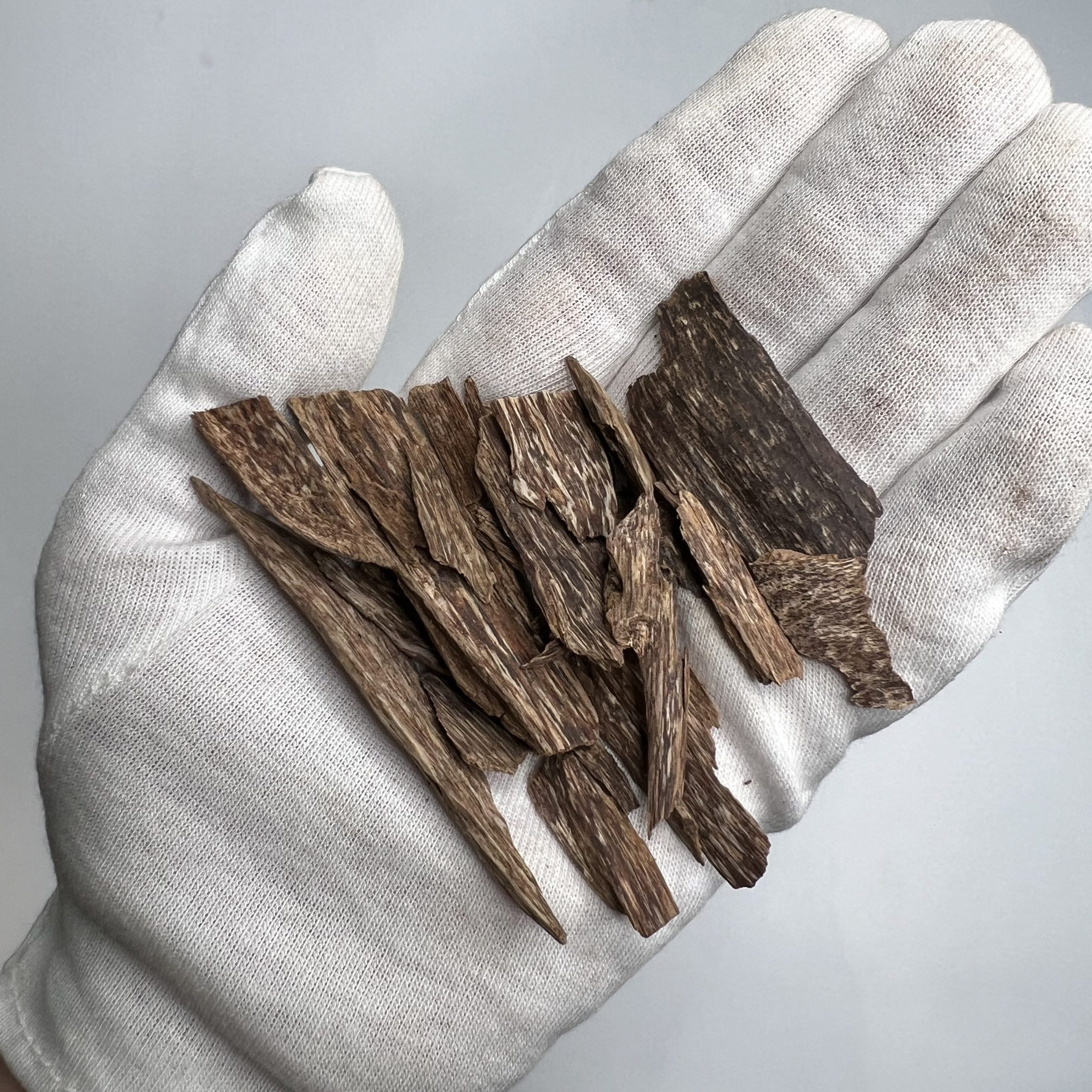
Agarwood Incense: Materials, Forms, Scent and Buying Guide
Agarwood incense is sold in several forms, from finished sticks to loose chips heated in a burner. They do not behave alike. The useful way to choose is to begin with the material, then match the form to your room, your equipment and how much smoke you are comfortable with.
Start small and use the form as intended. A stronger aroma is not proof of better material, and more smoke is rarely the better choice indoors.
What counts as agarwood incense
Agarwood is resinous wood associated with Aquilaria trees. In incense, it may appear as raw chips or powder, or as one aromatic component in a finished stick, cone or coil. The label “agarwood incense” alone does not reveal how much agarwood is present, whether the scent comes from wood, oil, added fragrance, or a blend, or how the product will burn.
That is why an honest description separates the material from the finished form. A bag of wood chips is not the same thing as a coated stick, and a stick called “oud” is not automatically made from a single botanical ingredient. Read the product description for the form, the stated ingredients and the intended heat method before drawing conclusions from the name.
Sticks, cones, powder and chips: forms and tradeoffs
Sticks are convenient because the combustible base and aromatic layer are already prepared. They are suitable for a short, supervised session with a holder that catches the full ash path. Cones offer a compact burn but can produce a more concentrated plume in a small room. Powders and chips invite more control over the amount used, but they require the right burner and more attention to heat.
Choose chips when you want to explore the material itself with indirect heat. Choose a stick or cone when you need a simple, consistent format and have a suitable holder. No form is universally superior: the best choice is the one that fits the space, the equipment and the level of smoke you are willing to manage.
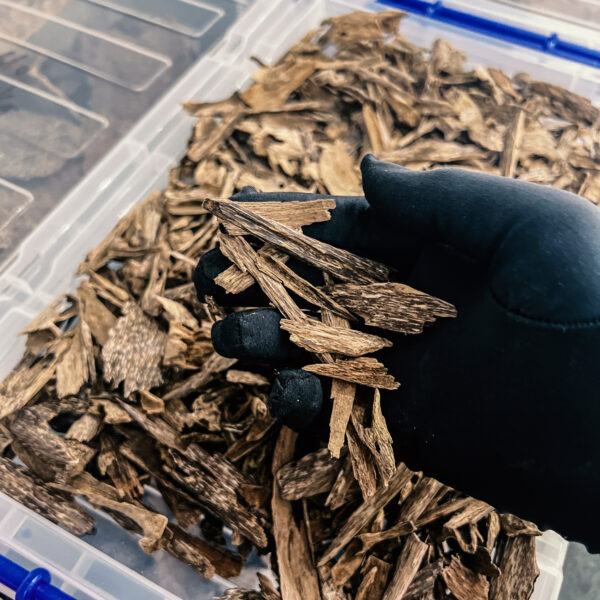
How agarwood material and concentration affect scent
Agarwood aroma develops with heat. A low, controlled temperature can reveal woody, resinous, sweet or earthy notes gradually; direct flame changes the experience by adding smoke from combustion. The result also depends on the particular material, its dryness, the amount used and the air in the room. Two pieces from the same seller may not smell identical.
Be cautious with dramatic promises such as “pure,” “wild,” “therapeutic” or “lasts all day” when they are not supported with detail. A pleasant scent is a personal response, not a laboratory test. Let the amount, temperature and setting stay consistent when comparing materials so you learn something useful from the difference.
Coreless, cored and blended incense compared
Cored sticks use a bamboo or similar central support; coreless sticks are formed from the aromatic mixture itself. Neither construction automatically signals quality. A core can affect burn length and ash shape, while a coreless stick may allow a different proportion of aromatic material. What matters to a reader is how cleanly the product burns, whether the holder fits it and whether the ingredients are explained.
Blended incense can be thoughtfully made, but a blend should be described as a blend. Ask whether the listed fragrance comes from agarwood material, an oil, other botanicals or unspecified perfume. Clear language gives you a better basis for choosing than a prestige label by itself.
Evidence buyers can request for origin and ingredients
Begin with simple questions: What form is this? Which ingredients are named? Is the agarwood claim about chips, powder, oil or an overall scent profile? Are there batch details, country-of-origin information or handling instructions? A seller may not disclose every manufacturing detail, but a clear description is more useful than an elaborate story without specifics.
For raw wood or higher-value agarwood, ask for documentation appropriate to the sale and jurisdiction. For a finished incense product, realistic evidence may be a transparent ingredient statement, intended-use guidance and a consistent product description. Photographs and aroma alone cannot independently prove species, origin or concentration.

How to choose by room, ritual and smoke tolerance
For a small or shared room, begin with the least material that serves the purpose. A short stick in a stable holder may be easier to supervise than a cone or charcoal session. If anyone in the space is sensitive to smoke or fragrance, a non-burning option is often the more considerate choice. Keep children, pets, textiles and food-preparation areas away from any lit material.
For a quiet, material-focused session, use a purpose-made electric burner or another low, controlled heat source only as its maker instructs. For a simple everyday ritual, a stick may be practical. In every case, stay with the burn, keep ventilation sensible and do not treat a stronger scent as a reason to add more material.
Price signals, claim limits and buyer red flags
Price can reflect scarcity, material grade, processing, packaging or a seller’s positioning. It cannot verify an origin claim on its own. Be cautious when a listing uses only superlatives, refuses to name the form or ingredients, promises health effects, or presents a photograph as proof of every claim attached to the product.
Better signs are modest, specific descriptions: a named form, clear use instructions, a statement of what is and is not known, and an approach to questions that does not turn uncertainty into a sales pitch. Buy a small amount first when you are exploring a new form or aroma profile.
Where this pillar sends readers next
If you are choosing a finished stick, continue with our guide to agarwood incense sticks. If you are weighing chips against sticks and cones, read this format comparison. For safe use with any burning format, keep a suitable holder and never leave a live ember unattended.
Questions readers ask
Is all oud incense made entirely from agarwood?
No. The term can describe raw agarwood material or a finished incense scented with agarwood or oud. Read the ingredients and product form.
Are chips better than sticks?
They serve different purposes. Chips suit controlled heating and material exploration; sticks are usually simpler for a short, supervised burn.
How much should I burn?
Begin with the smallest amount that fits the format and your space. More material means more smoke and more heat to supervise.
Use form as the first buying decision
Choose the format before choosing a story about origin. Sticks are practical for a familiar, contained session when the holder and ash path suit the product. Cones make a shorter, more concentrated session and need a stable heat-safe base. Powder is flexible but demands more care with heat and quantity. Chips are not simply another form of incense stick: they are heated rather than burned in the same way, so the burner, temperature and supervision matter. The same agarwood claim can behave very differently once it is combined with a binder, fragrance materials or a particular heating method.
Read the ingredient description with the form in mind. A manufacturer may describe agarwood powder, resinous wood, fragrance, binder, bamboo core or other materials. Clear wording allows a buyer to understand whether a stick is coreless, cored or blended; it does not require a seller to reveal a secret recipe. Vague phrases such as “pure oud scent” or “premium agarwood” are not a substitute for material, format and intended-use information. Compare the statement with the product you can actually see and smell.
Match the session to the space
Room size, ventilation, people nearby and the length of the session all matter. A large, strongly scented cone can be excessive in a small enclosed room; a fine stick may be a better choice only if it can be supervised and the smoke is tolerable for everyone present. If children, pets, sensitive people or an alarm-prone location make burning unsuitable, choose a non-burning method. The goal is not to use the most material. It is to create a controlled, comfortable session that can be stopped safely.
Use a short trial before buying a larger quantity. Test one product in the actual room, at a modest dose, with the correct holder. Note the opening, the character after several minutes, the lingering scent, the ash pattern and whether the product stayed lit as intended. If it is difficult to breathe comfortably, produces harsh smoke, leaves an unwanted residue or repeatedly triggers the alarm, stop using it there. A good incense choice is compatible with its setting, not merely impressive from the package.
Build evidence into the purchase
When comparing products, keep a small record: title, form, seller, ingredient wording, batch or lot reference where provided, price per unit, burn behaviour and your own scent notes. This turns scattered marketing language into a useful comparison. It also helps identify red flags: a claim of rarity without any material context, an origin claim that is never explained, an ingredient statement that changes between listings, or a product whose safety instructions do not fit how it is being sold.
Price is information, not proof. It may reflect material, labour, packaging, distribution and the maker’s position, but it does not certify agarwood percentage or origin. Likewise, a low-smoke claim does not eliminate fire risk, and a strong oud name does not prove a particular species. Ask a simple question before buying: what can this description genuinely support? If the answer is unclear, buy a small sample or choose a better-documented product.
Connect this choice to the next guide
For a fragrance-focused description of oud across different forms, see What Oud Smells Like. When sticks are the preferred format, use How to Choose Agarwood Incense Sticks. For a direct comparison of heat and burning formats, use Oud Chips vs Incense Sticks vs Cones. These narrower guides support the pillar by turning a broad category decision into a safe, specific next step.
Agarwood incense is most useful when its form, ingredients, scent expectations and use conditions are all considered together. Start with a well-described product, test it carefully in the real setting and let your written observations—not prestige words alone—guide the next purchase.
Read burn behaviour as a product signal
Burn behaviour is part of the product experience, but it should be interpreted carefully. A stick that burns too quickly, drops unusually hot ash or repeatedly goes out may reflect the format, humidity, holder angle, airflow, storage or formula. It is not evidence of purity by itself. Compare like with like: use the maker’s stated setup, keep the surface stable and change only one variable at a time. If a product cannot be used safely in the space available, the correct decision is not to force it to work.
Coreless and cored sticks illustrate why this matters. A bamboo core can provide structure and a predictable burn path; a coreless stick may offer a different ash footprint and material balance. Neither label establishes a universal quality ranking. The buyer should look for accurate ingredients, a holder that catches the ash, a size that fits the intended session and a scent that remains comfortable over time. A well-chosen format makes it easier to notice the actual aroma instead of troubleshooting the burn.
Keep buying claims proportionate
Agarwood is a meaningful material category, but a product description should not ask one word to prove everything. “Agarwood incense” can support a category claim; it does not automatically identify species, source, resin level, percentage in a blend or the absence of other fragrance materials. The strongest listings make the ordinary details easy to find: format, ingredient description, quantity, intended use, safety instructions and any batch information the maker can provide.
This is not a demand for laboratory analysis from every small maker. It is a practical buyer framework. Choose a product whose explanation is consistent with the price and the claim, begin with a sample where possible, and keep the evaluation grounded in the actual session. That approach protects both the reader and the maker: it leaves space for craftsmanship while avoiding promises that scent alone cannot verify.
Review the first sample before scaling up
Give a new incense time to reveal its whole session. Notice the condition when opened, the ease of lighting, the quality of the ash, the room’s response and the scent after the ember is out. Store the remainder correctly and repeat once before buying more. A second session often reveals whether the first impression came from the material, the environment or a changeable setup.
Use the record to choose a suitable form, not to turn a single product into a broad conclusion about every incense from an origin or price tier. The best next purchase is the one with clear information, safe compatibility with the room and a scent experience you can describe honestly.
