
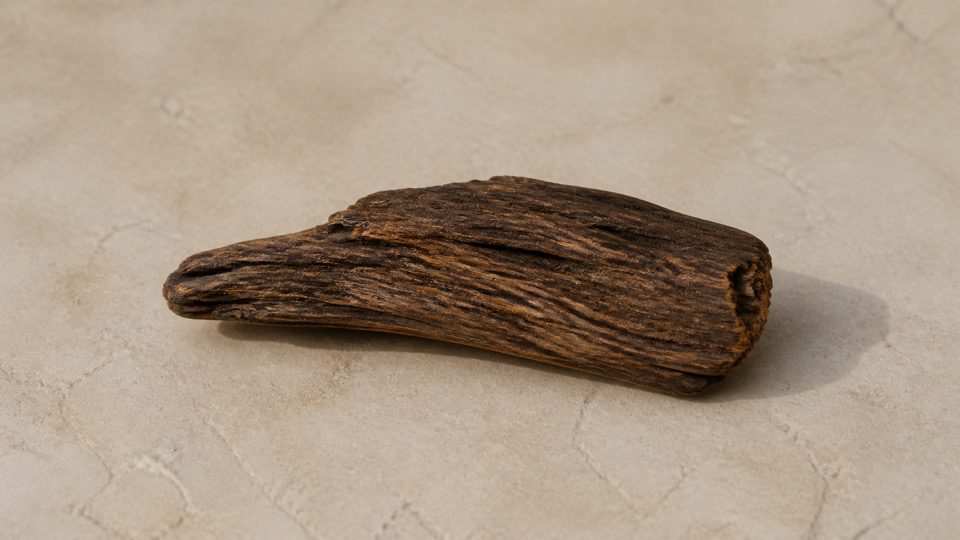
Agarwood is useful primarily as an aromatic material: it is smelled as raw wood, heated as chips, distilled into oud oil, made into incense, worn as beads and used in cultural or religious practices. It also has a long history in traditional medicine and promising laboratory research. However, current evidence does not establish agarwood incense, oil, wood or jewelry as a treatment for anxiety, insomnia, asthma, pain, inflammation, infection or other diseases.
Agarwood benefits: the evidence in 60 seconds
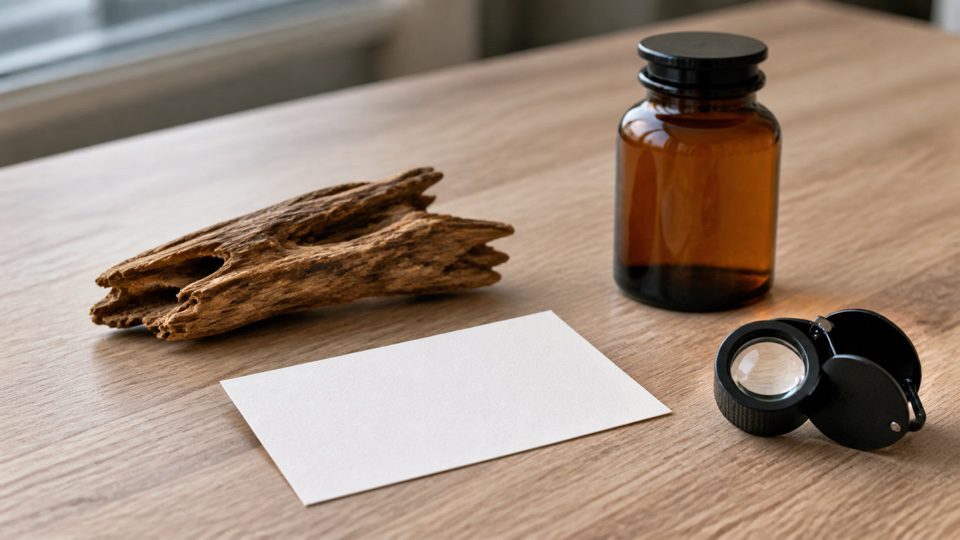
- Established uses: fragrance, incense, perfumery, craft, collecting and cultural or religious practice.
- Personal experience: people may find an aroma pleasant, grounding or suitable for a ritual, but this is subjective rather than a clinical outcome.
- Traditional medicine: historical use is real and worth documenting, but tradition alone does not prove modern safety or efficacy.
- Research: many reported pharmacological effects come from cells, isolated compounds or animal models—not human treatment trials.
- Safety: incense produces smoke and particulate matter; fragrance materials can irritate or trigger sensitivity in some users.
- Buying: a “health benefit” claim does not authenticate agarwood. Verify material, product form, batch, treatment and provenance separately.
What is agarwood good for?
Agarwood is best supported as a sensory and cultural material, not a self-treatment. Resin-enriched wood from susceptible Aquilaria and Gyrinops species can produce a complex aroma when smelled, gently heated or distilled. The appropriate use depends on the product form.
| Product form | Common evidence-aligned use | Important limitation |
|---|---|---|
| Raw chips or carved wood | Aroma evaluation, collecting, display or controlled heating | Tree species or dark color alone does not prove resin quality |
| Incense sticks or cones | Home fragrance, ceremony or personal ritual | Combustion creates smoke; “air purifying” and respiratory-health claims are not established |
| Oud or agarwood oil | Perfumery and fragrance use according to the product label | Composition, dilution and intended use vary; “natural” does not automatically mean safe |
| Bracelets and beads | Jewelry, tactile practice, cultural use or appreciation of a subtle wood aroma | Wearing wood has not been shown to treat disease or change the body’s “energy” |
| Traditional preparations | Historically documented practice within specific medical systems | Preparation, species, dose and supervision matter; do not copy a historical remedy as consumer medical advice |
For practical product-specific instructions, use the separate guide to using agarwood products. It routes chips, incense, oil and jewelry to the relevant method without presenting fragrance as medical care.
Are the health benefits of agarwood proven?
No broad health benefit is clinically proven for consumer agarwood products. Reviews report many chemical constituents and pharmacological findings, including work on inflammation, microbes and the central nervous system. Most of that evidence is preclinical: it evaluates extracts or isolated compounds in test systems or animals. It cannot be converted directly into a claim that burning chips, wearing beads or applying an unstandardized oil will treat a human condition.
A small human sleep study that evaluated agarwood aroma reported no significant differences in sleep variables, melatonin or body-temperature rhythm between experimental and comparison nights. By contrast, several frequently cited sedative, sleep, anxiety and serotonin studies used mice or rats. Those studies may justify further research, but they do not establish a consumer treatment.
| Evidence level | What it can show | What it cannot prove by itself |
|---|---|---|
| Historical or traditional record | A material was used within a documented practice | Modern clinical effectiveness, safe dose or suitability for every person |
| Chemical analysis | Which compounds are detectable in a particular sample | That the sample prevents or treats disease in a human |
| Cell or biochemical study | A possible mechanism under controlled conditions | Absorption, effective dose, benefit or safety in normal consumer use |
| Animal study | A biological effect and research hypothesis in that model | The same effect, dose or risk profile in humans |
| Controlled human study | Effects in the studied people, product, dose and protocol | A universal claim beyond the population and outcome tested |
| Regulatory authorization | A defined product met the applicable evidence and labeling requirements for an intended use | That every natural product with a similar name has the same authorization |
In the United States, FDA explains that fragrance or aromatherapy products marketed to treat or prevent disease—or to affect the body’s structure or function—are drugs. Statements that a product treats anxiety, depression, pain or sleep problems are not ordinary fragrance claims. Oudgo therefore does not treat laboratory findings as permission to market agarwood products as medicines.
Can agarwood aroma help with relaxation or sleep?
An aroma can be enjoyable and may support a personal wind-down routine through familiarity, preference and context. That is different from demonstrating a sedative, anxiolytic or sleep treatment. Individual response varies, and the strongest frequently cited agarwood findings are preclinical. The limited human sleep evidence cited above did not show significant changes in the measured sleep and biological-rhythm variables.
A careful description is: “The user may enjoy agarwood’s aroma during quiet time or a personal ritual.” Avoid stronger statements such as “reduces cortisol,” “treats insomnia,” “relieves depression” or “balances hormones” unless the exact product and intended use are supported by appropriate human evidence and regulatory status.
Does agarwood incense purify the air or support breathing?
No. Burning incense is a combustion activity, not an air-cleaning method. The U.S. Environmental Protection Agency identifies incense as an indoor particulate-matter source and advises proper ventilation. Fine particles can reach deep into the lungs, and particulate exposure can aggravate asthma and reduce lung function.
Use the smallest practical amount, provide ventilation, keep burning material away from flammable objects and stop if smoke or fragrance causes discomfort. People with asthma, respiratory conditions or fragrance sensitivity should be especially cautious and follow advice from their healthcare professional. Do not burn charcoal indoors; the EPA warns that combustion can also release harmful byproducts, including carbon monoxide.
For a lower-smoke aroma comparison and fire-safe setup, see how to heat agarwood chips with electric or charcoal methods. The method guide does not promise that heating eliminates emissions or creates a health benefit.
Is oud oil safe on skin or for aromatherapy?
Safety cannot be decided from the words “oud,” “agarwood,” “pure” or “natural.” A finished perfume, concentrated distillate, diluted cosmetic and fragrance compound may have different ingredients and intended uses. Follow the label for the exact product; do not assume a universal topical dilution or ingest an oil because it came from a plant.
FDA notes that plant-derived fragrance materials can be irritating, toxic or allergenic and that fragrance-sensitive users may experience skin or respiratory symptoms. Stop use if a rash, burning, wheezing or another unexpected reaction occurs and seek appropriate medical help. For product-selection terminology rather than treatment advice, continue to the oud oil and agarwood oil guide.
What are the spiritual benefits of agarwood?
“Spiritual benefit” describes belief, meaning or personal practice, not a clinical outcome. Agarwood has documented roles in religious ceremonies, incense traditions, hospitality and contemplative practices. A user may value the aroma as part of prayer, meditation or a cultural ritual. Oudgo does not claim that the material cleanses invisible energy, changes luck, guarantees focus or produces a measurable spiritual result.
The historical and faith-specific context belongs in the agarwood religion and rituals guide. Traditional therapeutic claims and their evidence limitations are covered separately in agarwood in traditional medicine.
Do claimed benefits prove agarwood is real?
No. Aroma descriptions, testimonials and wellness claims do not authenticate botanical identity or resinous wood. There is no single consumer test that proves every product form genuine. Water density, color, price and smell can provide observations, but each can be affected by moisture, construction, treatment, added fragrance and sample selection.
Use the real-vs-fake agarwood evidence guide for material verification, and the agarwood grading guide for quality and value. Authentication and quality are related but different: a genuine sample can still be low-resin or poorly processed.
Can you identify an agarwood tree by its benefits or smell?
No. Tree identification is botanical work and should use leaves, flowers, fruit, bark, accepted taxonomy and provenance—not a product claim or a scraped-bark smell. Even correct identification of an Aquilaria tree does not prove that resin-enriched agarwood is present. Resin formation is localized and variable.
Use the Aquilaria and Gyrinops distribution guide for species ranges and the agarwood formation guide for the difference between a susceptible tree and resinous wood. Do not cut, scrape or collect from a wild tree without lawful authorization.
What is agarwood called in English?
Agarwood is the clearest general English term for resin-enriched aromatic wood. Aloeswood and eaglewood are historical or regional English names. Gaharu is widely used in parts of Southeast Asia. Oud or oudh is used broadly in trade and perfumery and may refer to the wood or its aroma, while “oud oil” usually means a distilled or formulated fragrance product. A product page should state the material form instead of relying on a name alone.
How did Oudgo review agarwood benefit claims?
- We separated sensory, commercial, cultural, spiritual and medical meanings of “benefit.”
- We routed authenticity, grading, formation, oil and product-use questions to their dedicated canonical guides.
- We classified medical evidence as traditional, chemical, cell, animal, human or regulatory rather than presenting every study as equal.
- We checked whether cited human evidence measured the claimed outcome and whether findings were statistically significant.
- We removed disease-treatment, respiratory-support, air-purification and universal safety claims that exceeded the evidence.
- We added smoke and fragrance-sensitivity guidance from U.S. EPA and FDA sources.
Frequently asked questions
What is the main benefit of agarwood?
Its best-established benefit is sensory and cultural: agarwood provides a distinctive aroma for perfumery, incense, collecting and ritual use. Medical treatment claims require a much higher level of evidence than aroma preference or historical use.
Does agarwood have proven health benefits?
Not as a broad consumer health treatment. Research reports interesting chemical, cell and animal findings, but limited human evidence does not justify claims that agarwood products treat anxiety, insomnia, inflammation, pain, asthma, infection or other diseases.
Can agarwood incense help asthma or clean the air?
No. Incense smoke is an indoor particulate source and may aggravate asthma or fragrance sensitivity. Use ventilation and do not present burning incense as air purification or respiratory care.
Does wearing an agarwood bracelet improve health?
There is no reliable clinical evidence that wearing agarwood beads treats disease or changes a person’s physiology. A bracelet can be valued as jewelry, a tactile object, a cultural item or a source of subtle aroma.
Can agarwood oil treat anxiety or insomnia?
Animal studies are not proof of a human treatment, and a small human aroma study reported no significant changes in measured sleep variables. Use oud oil as labeled fragrance, not as a substitute for medical care.
Is natural agarwood automatically safe?
No. Smoke contains particles, fragrances can trigger sensitivity, and oils or formulations vary. Follow the exact product label, provide ventilation for incense, avoid unapproved ingestion and stop use if an adverse reaction occurs.
Sources and editorial limitations
- Hashim et al. — traditional use, phytochemistry, pharmacology and safety review
- Wang et al. — chemical constituents and pharmacological research review
- Yamamoto et al. — human aroma, sleep and biological-rhythm study
- Takemoto et al. — agarwood vapor study in mice
- U.S. FDA — aromatherapy claims and product regulation
- U.S. FDA — fragrance allergens and sensitivities
- U.S. EPA — sources of indoor particulate matter
Editorial limitation: This page is an evidence and consumer-safety review, not medical advice and not a clinical evaluation of Oudgo products. Products, extracts, oils and incense can differ substantially in species, chemistry, formulation and exposure. The absence of evidence is not proof that every effect is impossible; it means the claim should not be marketed as established. Reviewed by the Oudgo Editorial Team on August 12, 2026.
