
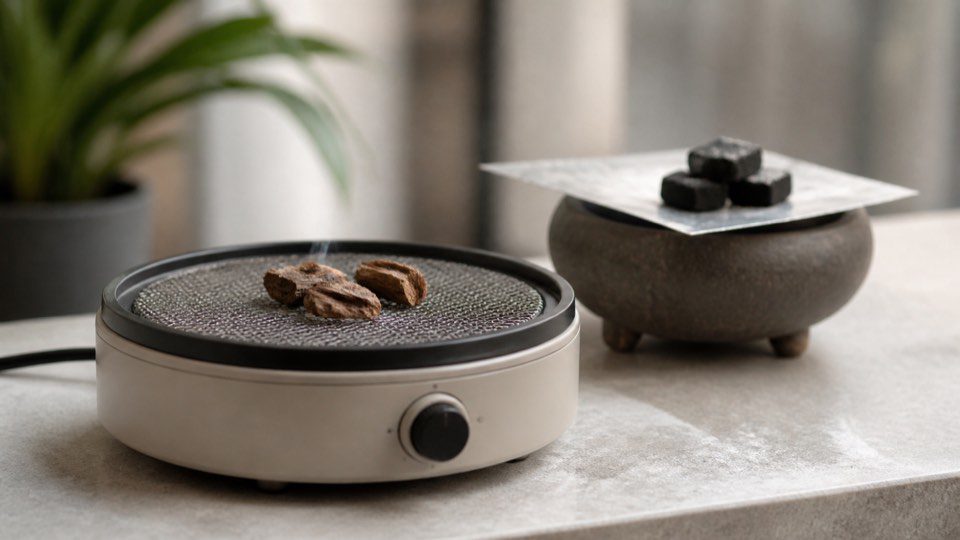
Quick answer: the most controllable way to use agarwood chips is to warm a very small piece on an adjustable electric incense burner, beginning at the lowest setting and increasing heat gradually until the wood becomes aromatic. For a stronger, smokier session, place a chip above fully lit charcoal with an ash or mica barrier. Do not hold oud wood in a direct flame, and always use ventilation and a stable, non-combustible burner.
Choose your method
- Electric heat: easier temperature control, slower scent development and less risk of immediately scorching a small chip.
- Charcoal: faster, hotter and usually smokier; use a heat barrier and closer supervision.
- Direct flame: not recommended. It can char the wood quickly, obscure its scent and increase fire risk.
This guide is for raw resinous wood sold as agarwood chips or oud chips. It is not a guide to lighting finished agarwood incense sticks and cones, which are formulated to smolder on their own.
What are agarwood chips?
Agarwood chips are pieces of resin-associated wood from agarwood-producing trees, principally species in the genera Aquilaria and Gyrinops. The amount and distribution of resinous material vary within a tree and between pieces, so two chips from the same lot can smell and heat differently. Agarwood and oud commonly refer to the same aromatic material in this context.
All species of Aquilaria and Gyrinops are included in CITES Appendix II. That does not prohibit every sale, but it means international trade is regulated. For a cross-border purchase, ask the seller what species or commercial source is known, where the material originated and what trade documentation applies to that shipment. Read more about how resinous agarwood forms.
Is an electric burner or charcoal better for agarwood chips?
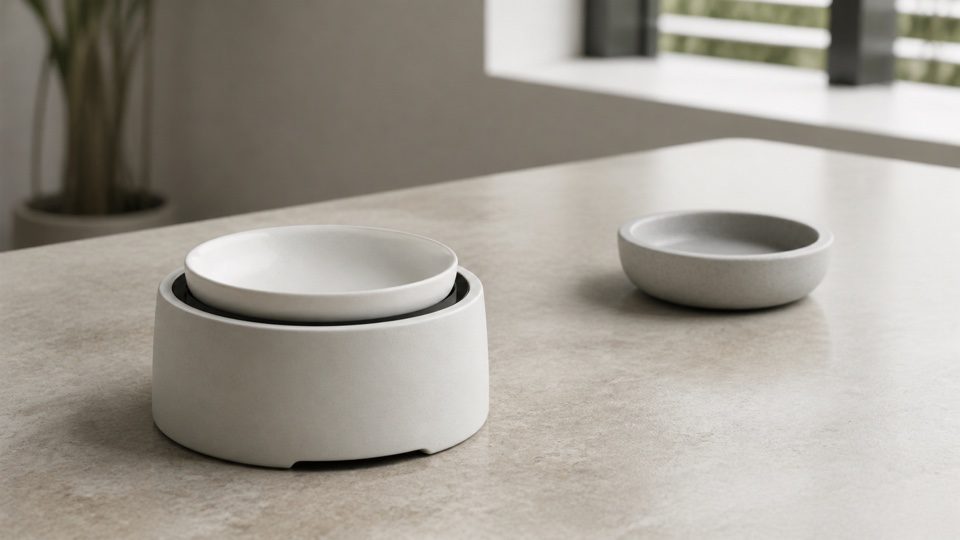
An electric burner is the better starting method when you want repeatable, gradual heating; charcoal is better when you deliberately want stronger heat and accept more smoke and handling. Neither method proves chip quality. The right choice depends on your burner, room, ventilation and the size and resin distribution of the sample.
| Factor | Adjustable electric burner | Charcoal with a barrier |
|---|---|---|
| Heat control | Increase in small steps; device settings vary | Heat changes as the charcoal develops and cools |
| Aroma development | Gradual; useful for following changes over time | Faster and more intense, with charcoal potentially affecting perception |
| Smoke | Can be limited when the chip is warmed below charring, but it is not emission-free | More likely when the wood is close to a hot coal |
| Best for | Beginners, small samples and repeatable comparison | Experienced users, short sessions and traditional presentation |
| Main risk | Hot surfaces, unsuitable voltage or leaving the device unattended | Open ignition, very hot charcoal, ash and rapid scorching |
How do you heat agarwood chips with an electric burner?
Place one small chip on the burner’s heat-safe cup or plate, start at the lowest setting and increase heat only after the aroma stabilizes. A single universal temperature is misleading because thermostat accuracy, sensor position, plate material, chip thickness and resin distribution differ between devices and samples.
- Check compatibility. Follow the manufacturer’s voltage, surface and material instructions. Not every wax warmer, oil burner or decorative holder is designed for wood chips.
- Prepare the area. Put the burner on a level, heat-resistant surface with clear space around it. Ventilate the room.
- Start small. Use one thin splinter or a rice-grain-sized fragment for the first pass. A smaller sample is easier to control and wastes less material.
- Use the lowest setting first. Allow time for the plate and chip to warm. Do not assume the dial number equals the actual wood temperature.
- Increase one step at a time. Wait between adjustments. Stop increasing when the aroma is clear; stronger heat is not automatically better.
- Turn or split the chip if needed. Uneven pieces may expose a fresh surface when turned. Use metal tongs and avoid touching the hot plate.
- End before heavy charring. Switch off and unplug the burner according to its instructions. Let the chip, plate and unit cool completely.
Browse electric incense burners only after checking the individual product’s voltage, temperature controls, cup material and stated compatibility with wood chips.
How do you burn agarwood chips on charcoal?
Ignite purpose-made incense charcoal in a fire-safe setting, wait until it is fully established, then place the agarwood above it rather than directly in the hottest centre. An ash bed or mica plate creates distance between wood and coal, slowing the transfer of heat.
- Use the correct equipment. Choose a stable charcoal-safe incense burner, insulating ash or sand where appropriate, metal tongs and incense charcoal intended for this use.
- Clear the area. Keep the burner away from paper, curtains, shelves, drafts, children and pets. Open a window or provide other ventilation.
- Light the charcoal safely. Follow its instructions and handle it only with tongs. Quick-light charcoal may spark during ignition.
- Wait for an even hot surface. Do not place wood on a charcoal tablet while it is still actively sparking or producing ignition odour.
- Add a barrier. Use an ash layer or a mica plate designed for incense practice. Begin with greater distance and reduce it only if more heat is needed.
- Add one small chip. Observe aroma and smoke. If it immediately produces harsh smoke or turns black, move it farther from the heat or remove it with tongs.
- Extinguish and cool responsibly. Treat charcoal and ash as hot long after visible glowing declines. Do not discard them until completely cold.
Activated charcoal for agarwood is a separate consumable from the wood itself. Review its current directions and pack information before use.
How can you avoid scorching oud chips?
Use less material, create more distance from the heat and make smaller adjustments. A useful session moves from faint woody notes to a clearer resinous aroma without immediately jumping to acrid smoke. Visible bubbling may occur in resin-rich areas, but it is not a universal grade test and does not justify adding more heat.
- Too little heat: the chip stays unchanged and produces little or no aroma after the burner has stabilized.
- Useful heat: the aroma becomes distinct while the piece darkens slowly and remains manageable.
- Too much heat: rapid blackening, flame, dense smoke or a sharp burnt smell overwhelms the wood’s other notes.
Scent descriptions are subjective. If you want to compare samples, keep the burner, sample size, room, warm-up time and notes consistent. The agarwood scent guide provides a repeatable vocabulary and comparison method.
How much agarwood should you use?
Begin with the smallest piece your equipment can hold safely, then add material only if the aroma is too faint after the heat has stabilized. Fixed gram recommendations can be wasteful because a thin resinous splinter and a thick low-resin piece do not behave alike. Record the sample weight when doing a formal comparison, but use heat response—not price or a seller’s grade label—as the practical adjustment signal.
How should you choose agarwood chips for heating?
Choose with a documented bundle of evidence: current lot photos, net weight, origin statement, form, treatment disclosure and a clear returns route. Dark colour, oiliness, density, a sinking claim or a strong cold smell cannot authenticate a chip alone.
| Ask the seller | Why it matters |
|---|---|
| Is the photographed lot the lot being sold? | Stock images cannot show the variation you will receive. |
| What is the net wood weight and typical piece-size range? | These are measurable and make offers easier to compare. |
| Is species or country of material origin documented? | Origin should be a provenance statement, not a universal quality grade. |
| Has colour, perfume, oil or other treatment been added? | Treatment can change appearance, cold aroma and heating behaviour. |
| What does “grade,” “sinking,” “kinam” or “kynam” mean for this lot? | These terms are not one universal, independently enforced retail standard. |
| What CITES or export documentation applies? | International movement of listed agarwood taxa is regulated. |
Use the real-versus-fake agarwood framework and the agarwood quality and grading guide before treating a marketing label as evidence. Then compare current chips in the Oudgo agarwood chips category.
Is heating agarwood chips safe indoors?
Heating or burning aromatic material is not risk-free: hot equipment can cause fire or burns, and combustion produces smoke and fine particles. Research on finished incense products has measured substantial particulate emissions, but those results should not be presented as a precise exposure estimate for every raw agarwood chip or electric-heating session. Use the evidence as a reason for ventilation, small amounts and avoiding deliberate smoke inhalation.
- Use a stable, non-combustible surface and equipment designed for the selected method.
- Keep at least a clear safety zone around hot equipment and away from anything that can burn.
- Never leave a live coal, hot plate or smoldering material unattended.
- Ventilate; stop if smoke causes eye irritation, coughing, headache or breathing discomfort.
- People with respiratory conditions should ask a qualified clinician about personal exposure concerns.
- Do not use chips as food, tea, medicine or skin treatment.
How should agarwood chips be stored?
Keep chips dry, dark and separated from strong household odours. Use a clean, well-closing container; label the lot and purchase date; avoid perfume, detergent, smoke and excessive humidity. Do not apply oil to “refresh” a chip because that changes both the material and its heating behaviour.
Agarwood chip FAQ
Should agarwood chips catch fire?
No. The goal is controlled warming or indirect heating. If a chip flames, remove the heat source safely; a direct flame can rapidly replace the resinous aroma with a burnt-wood smell.
Can you reuse an agarwood chip?
Sometimes. Let it cool, turn it and warm it again. Stop when it produces no useful aroma or is uniformly charred. Reuse depends on piece thickness and resin distribution.
What temperature should an electric oud burner use?
There is no trustworthy universal dial temperature for all burners and chips. Start at the device’s lowest wood-compatible setting and increase gradually; burner calibration and chip structure vary.
Do sinking agarwood chips always smell better?
No. Density can be one observation, but water behaviour is affected by size, moisture, structure and resin distribution. “Sinking” alone does not prove authenticity or predict personal scent preference.
Are agarwood chips the same as bakhoor?
Not necessarily. Agarwood chips are pieces of resin-associated wood. Bakhoor can refer to scented wood chips or compounded aromatic mixtures and may contain oils or other ingredients; check the product description.
Can a candle or wax warmer heat agarwood chips?
Only use equipment whose manufacturer states that it is suitable for wood chips or incense material. Decorative warmers may have unsuitable heat control, surfaces or clearances.
Sources and editorial method
This guide was prepared by the Oudgo Editorial Team from the visible equipment and product categories on Oudgo, official trade information and published emissions research. It does not claim that Oudgo completed an unpublished comparative laboratory test. Product compatibility, voltage, lot data and treatment disclosure must be checked on the current product page or with the seller.
- CITES and Timber: A Guide to CITES-listed Tree Species (2023) — lists Aquilaria and Gyrinops agarwood taxa in Appendix II.
- Jetter et al., Characterization of emissions from burning incense — measured particulate and gaseous emissions from 23 incense samples; it did not test every raw agarwood chip or electric burner.
- Characterizing PM2.5 emissions from incense burning in a California residence — a residential study of organic fine particulate emissions from burned incense.
- U.S. Fire Administration: Candle Fire Safety — open-flame principles used here for stable placement, clearance and supervision.
Related topics: this page replaces a mixed-intent article that also discussed growing trees, tea, general scent and tree identification. Those subjects now belong to the agarwood growing guide, agarwood varieties and tea overview, scent guide and what-is-agarwood pillar.
