
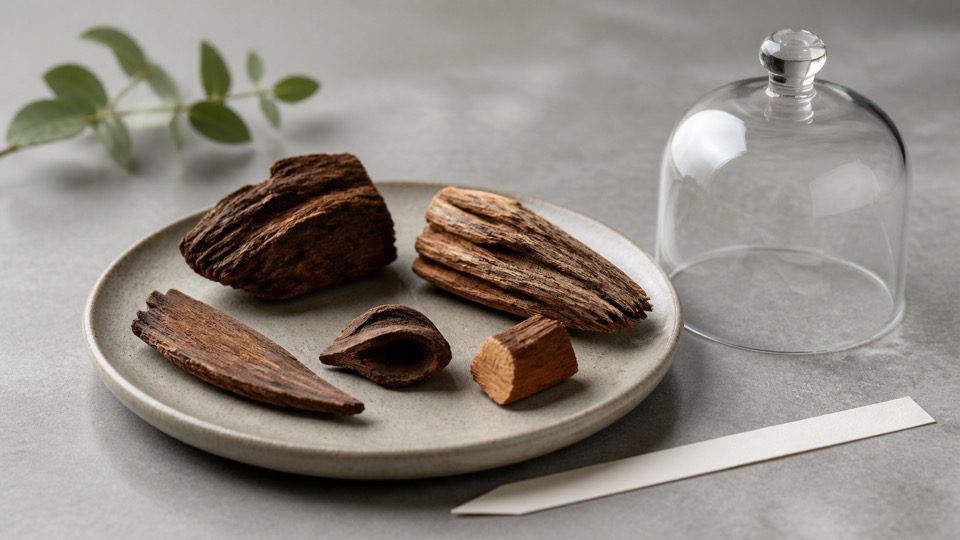
What does oud smell like? Oud—also called agarwood—usually smells woody, resinous and warm, but it is not a single fixed aroma. Depending on the wood, resin formation, processing and temperature, it may also smell sweet, balsamic, earthy, spicy or smoky, leathery, floral or mildly animalic. The aroma often changes while a chip is heated or an oil develops on skin.
This guide explains the vocabulary, the reasons oud varies and a repeatable way to compare samples without treating subjective scent impressions as proof of origin, grade or purity.
Short answer: genuine agarwood can move from dry wood and warm resin to sweet spice, earth, smoke and darker leather-like facets. Not every sample shows every note. Chips, incense and oud oil also smell different because heat, binders, extraction and dilution change what reaches your nose.
Agarwood scent at a glance
| Form | Typical first impression | What most affects it |
|---|---|---|
| Agarwood chips | Subtle when cold; woody, resinous and increasingly layered when heated | Resin distribution, sample size, moisture, burner and heat level |
| Agarwood incense | A more consistent room scent, often woody, sweet and smoky | Agarwood percentage, binder, bamboo core, base powder and added fragrance |
| Oud oil | Concentrated woody-resinous notes that can develop over hours | Raw material, fermentation or soaking, distillation, maturation and dilution |
Important: the descriptors above are a vocabulary, not a quality checklist. A clean, quiet sample may be valuable even if it is not smoky or animalic, and a powerful perfume-like scent does not prove high resin content.
Why does agarwood smell so complex?
Agarwood is resinous wood formed after an agarwood-producing tree responds to injury and other biological or environmental stress. The process changes the chemistry of affected wood rather than simply adding a surface fragrance. Our agarwood formation guide explains that transformation in detail.
A peer-reviewed review in Frontiers in Plant Science reported that more than 150 compounds had been identified across studied agarwood samples, with sesquiterpenoids, chromones and other volatile aromatic compounds among the important groups. This chemical diversity helps explain why “woody” alone is not enough to describe oud and why two pieces can develop differently under heat.
Heating matters as much as the material. A laboratory study found that agarotetrol, a chromone derivative, can generate lower-molecular-weight aromatic compounds when heated. Another headspace GC-MS study detected different chemical profiles in smoke from different agarwood samples. These results support a practical observation: scent can unfold rather than arrive all at once, and a cold sniff is not the same as a controlled heating session.
Common agarwood scent notes
People use familiar references to describe an unfamiliar material. The following terms can help you record what you perceive, but they are not universal promises.
- Woody: dry wood, polished wood or warm timber.
- Resinous or balsamic: warm, rounded and sometimes slightly sweet.
- Earthy: soil, roots, moss or a damp forest-floor impression.
- Spicy: peppery, clove-like or gently medicinal facets.
- Sweet: honeyed, vanilla-like or dried-fruit associations.
- Smoky or leathery: darker notes that may appear with stronger heat or in some oils.
- Floral or green: lighter lift around the deeper wood notes.
- Animalic: a musky or fermented impression found in some oils, not a requirement for genuine oud.
Why does one oud smell different from another?
Species and resin chemistry
Commercial agarwood comes from multiple agarwood-producing species. Species is only one variable: the amount and distribution of resin can differ within one tree, and chemical composition can differ between specimens. Scientific studies consistently identify variation rather than one universal chemical fingerprint for every market sample.
Formation and growing conditions
Injury, microbial communities, time and environmental conditions all influence resin development. Origin can be useful provenance information, but a country name by itself does not guarantee one exact scent. Compare the specific batch and seller evidence instead of relying on regional stereotypes.
Processing and product format
A raw chip, ground incense and distilled oil are not interchangeable scent references. Grinding increases surface area; an incense formula adds a binder or core; oil production selectively captures compounds and may include soaking, distillation and maturation. If a product contains added fragrance, that should be disclosed because it can dominate the natural material.
Heat and airflow
Too much heat can make smoke and char overwhelm delicate notes. Lower, controlled heat can make it easier to notice transitions, although the appropriate setting depends on the burner and sample. Never leave a burner unattended, keep it on a heat-resistant surface and ventilate the room.
Your own perception
Recent food, perfume, room fragrance, fatigue and expectation can change perception. Descriptions from sellers and reviewers are therefore useful references, not objective guarantees that every person will smell the same thing.
A repeatable agarwood scent-testing protocol
- Control the room. Use a ventilated space without perfume, cooking odors, candles or another incense.
- Record the sample. Note the product, stated species and origin, batch or SKU, format, sample weight if known and the burner used.
- Smell it cold. Record only what is detectable before heat. Do not score a quiet cold sample as automatically inferior.
- Start with a small amount and gentle heat. Follow the burner and product instructions. Avoid direct inhalation of smoke.
- Take notes in phases. Write the first impression, middle development and dry-down or room residue. Use neutral words before reading the seller’s scent description.
- Repeat under the same conditions. One session can be distorted by heat, airflow or nose fatigue. Compare only when the method is consistent.
- Separate preference from evidence. “I prefer this scent” is different from proving species, origin, resin content or purity.
This is a sensory comparison, not a laboratory authentication method. For purchase decisions, combine it with traceable product information and the checks in our real-versus-fake agarwood guide.
Does agarwood incense smell like oud oil?
They can share a woody-resinous family resemblance, but they should not be expected to smell identical. Incense includes combustion or heating, and its binder, base powder and bamboo core can affect the room scent. Oud oil is an extract whose profile depends heavily on raw material and production. For the most direct comparison, review the disclosed ingredients and compare products from a documented batch rather than assuming the format tells you the quality.
What is white agarwood?
Products marketed as “white agarwood” may refer to Aetoxylon sympetalum. It should not be treated as another name for an Aquilaria species. Kew’s Plants of the World Online recognizes Aetoxylon sympetalum as a separate species native to western Borneo. Sellers may describe its wood as woody, spicy or earthy, but those commercial scent descriptions should not be used to authenticate it. Check the botanical name on the listing.
Frequently asked questions
Are agarwood and oud the same scent?
In fragrance and trade contexts, “oud” commonly refers to agarwood or oil derived from resinous agarwood. A finished oud perfume may also combine natural oud, synthetic oud accords or both, so read the ingredient and product description.
Does agarwood always smell animalic?
No. Some oils have fermented, musky or leather-like facets, while other samples are cleaner, sweeter, greener or more wood-forward. Animalic strength is not a universal authenticity test.
Does agarwood smell like sandalwood?
Both are aromatic woods, but sandalwood is often described as creamy, soft and milky. Agarwood is typically more resinous and variable, with earthy, smoky, spicy or animalic directions possible. Blends can contain both.
Does darker agarwood always smell stronger?
No. Dark areas can suggest resin, but color can also be affected by moisture, aging, processing, lighting or treatment. Evaluate the actual sample and provenance; do not rely on color or a water test alone.
Does smelling or burning agarwood provide health benefits?
This guide does not make a medical claim. Traditional use and laboratory or animal research do not establish that burning incense treats stress, sleep problems, infection or respiratory disease in people. Any smoke can irritate sensitive users, so ventilate the room and stop if discomfort occurs.
Sources and further reading
- Naziz, Das & Sen: The Scent of Stress—Evidence From the Unique Fragrance of Agarwood
- Takamatsu & Ito: Agarotetrol as a source compound for aroma generated by heating agarwood
- Kao et al.: Chemical profiles of incense smoke ingredients from agarwood
- Zhang et al.: Environmental interactions and volatile compounds of agarwood oils
- Kew Science: Aetoxylon sympetalum taxonomic record
