
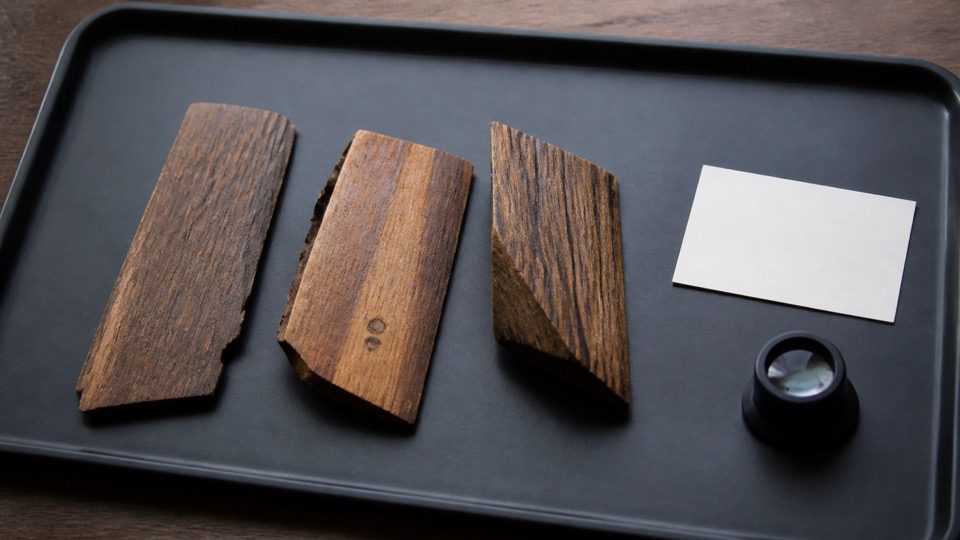
Drill holes describe an agarwood-induction method or a visible feature; they do not identify one universal product grade. Cultivators may wound an Aquilaria tree mechanically, introduce a biological inoculum, apply another inducer, or combine methods. The resulting resin distribution and chemical profile can vary, so “drilled,” “inoculated,” “cultivated” and “agarwood” should be documented as separate claims.
This page explains the method and the buyer evidence to request. For the wider formation process, see how agarwood forms. For use, see our agarwood heating guide.
What does drill-inoculated agarwood mean?
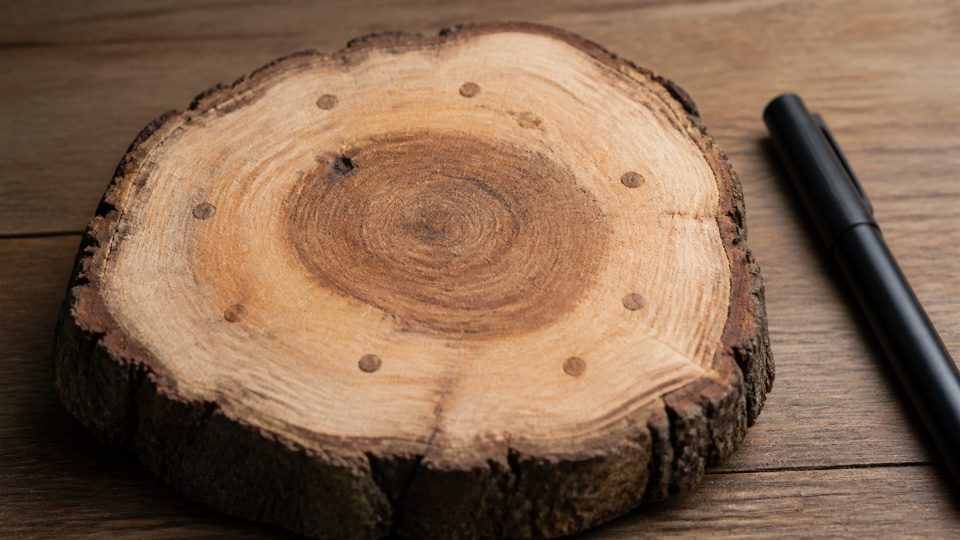
Physical injury can activate defense responses in an agarwood-producing tree. Some methods leave a hole open; others use that hole to deliver fungi, microorganisms, plant-response compounds or a combined treatment. Published studies group induction methods differently, but they consistently show that the method affects where resin develops and can affect chemical composition.
A visible drilled channel therefore does not disclose the whole process. Ask whether the method was mechanical only, biological, chemical or integrated; when treatment occurred; what tree species was claimed; and what part of the tree was harvested.
How do induction methods differ?
| Method label | What may happen | Buyer question | Do not assume |
|---|---|---|---|
| Mechanical wounding | Drilling, chiseling, nailing or another injury | Was anything introduced into the wound? | That every dark zone has the same resin content |
| Biological inoculation | Selected biological material is introduced after wounding | What organism or commercial process was used and how was it controlled? | That “natural inoculant” proves safety, quality or sustainability |
| Chemical or plant-response inducer | A formulated treatment is introduced to stimulate resin formation | Is the treatment disclosed and is the finished material tested for its intended use? | That cultivated means chemical-free |
| Integrated method | Physical injury is combined with one or more inducers | Which components, duration and harvest criteria applied? | That all integrated methods produce an equivalent result |
Is induced agarwood “real” agarwood?
“Real” is too broad unless the claim is defined. Research has identified resinous agarwood produced by several induction techniques, while also finding differences among chemical profiles. The responsible question is not simply natural versus artificial; it is whether the product identity, species/source statement, induction disclosure, composition and intended use are supported for the exact batch.
Do not call pale healthy wood agarwood merely because it came from an Aquilaria tree, and do not call every dark drilled piece high grade. Resin distribution can be localized and uneven.
What evidence should accompany an Oudgo or seller claim?
- Product name, format, dimensions or weight and current batch or lot reference.
- Claimed tree taxon and country or region of origin.
- Wild, cultivated or other source wording and the induction method disclosed.
- Supplier or producer record linking the finished material to that disclosure.
- Trade documents required for the taxon, product, origin and destination.
- Testing relevant to an objective composition, residue or performance claim.
We do not describe every drilled item as “certified,” “fully traceable,” “chemical-free,” “eco-friendly” or equal to wild material. Those statements require claim-specific evidence. A plantation statement may be relevant to source, but it does not automatically prove product quality, environmental impact or legal compliance for every transaction.
How should drill-hole pieces be evaluated for incense use?
Check that the item is actually sold for heating, not as a display sample, bead or craft material. Compare the listed weight, condition and odor before use. Begin with a small amount and low controllable heat; excessive temperature can create harsh smoke and obscure differences between resin-rich and resin-poor zones.
Use a stable noncombustible burner, provide ventilation, keep the setup away from combustible material, children and pets, and never leave heat or charcoal unattended. Stop if the item produces an unexpected chemical odor or visible residue inconsistent with its instructions.
What can appearance prove?
A channel, resin-darkened boundary, grain direction and cut surface can support description. They cannot establish the inducer, tree age, species, origin, purity, grade or safety alone. Color may also be affected by lighting, storage and treatment. Keep visual checks connected to records instead of turning one feature into a universal test.
Frequently asked questions
Are drill holes the same as ant nest agarwood?
No. A drilled hole is normally a deliberate cultivation feature. “Ant nest” is a trade description often associated with insect galleries. Appearance alone may not establish which process occurred.
Is induced agarwood always lower quality?
No universal ranking is justified. Method, tree, duration, resin distribution, finished form and the grading system all matter. Compare documented lots.
Does plantation-grown mean sustainable?
Not by itself. A sustainability claim needs a defined scope and evidence covering relevant environmental, legal and supply-chain factors.
Can drilling guarantee a consistent aroma?
No. Published work reports variation across methods and samples. A batch-specific sensory or chemical test is more relevant than the method name alone.
Sources and editorial method
- Agarwood induction: current developments and future perspectives
- Chemical profiles of cultivated agarwood induced by different techniques
- CITES PC27: agarwood production and trade terminology
- CITES timber identification guide
Updated by the Oudgo Editorial Team on 15 August 2026. We separated induction method, product identity, source, grade and sustainability. No current Oudgo batch test was invented.
