
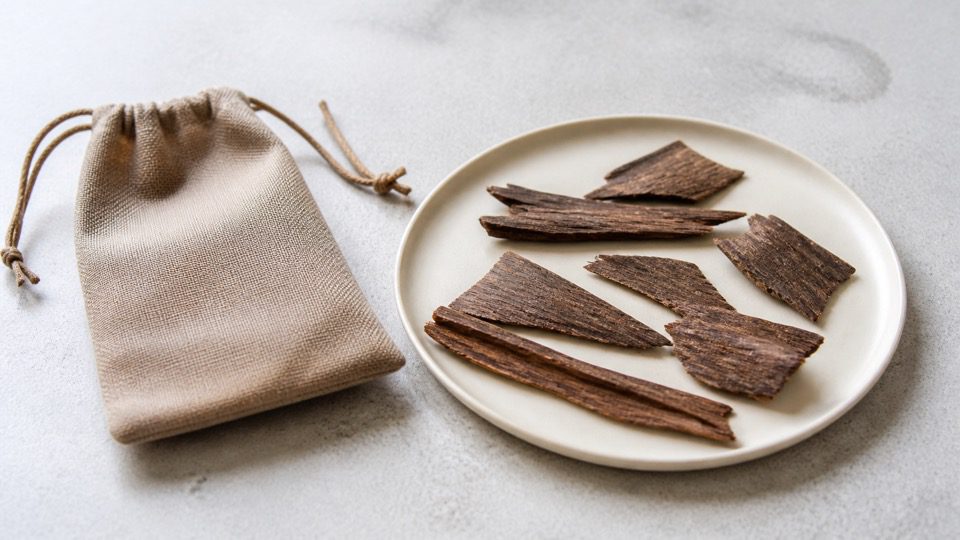
Flat agarwood is a cut form, not a universal grade. A seller may use “flat oud,” “agarwood sheet” or a similar name for thin pieces prepared for controlled heating, display or craft use. The shape can make portioning and surface inspection easier, but it does not by itself prove Vietnamese origin, species, resin content, formation method, purity or legal source.
Use this guide to compare the exact item you are offered. For general product selection, visit our agarwood chips category; for heating methods, see electric versus charcoal guidance.
What should a flat agarwood listing include?
| Listing field | Why it matters | Evidence boundary |
|---|---|---|
| Form and size | Thickness, length, width, weight and breakage affect handling | Thinness is not a grade or species test |
| Origin claim | Country or region may affect buyer intent and trade requirements | A product name needs a supplier/lot record; appearance cannot prove Vietnam |
| Source and formation | Wild, cultivated and induced claims are materially different | Cultivated does not automatically mean certified or chemical-free |
| Intended use | Heating, display and craft material need different instructions | Do not burn an item unless the listing identifies it for that use |
How are sheets different from chips?
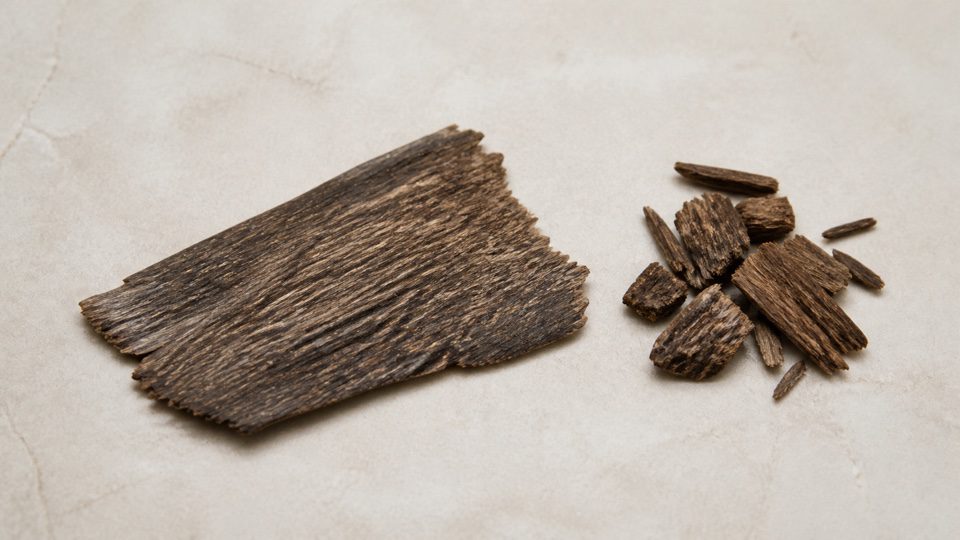
A sheet presents a broad, relatively thin surface. A chip is a broader category that can include irregular flakes, chunks or slivers. Equal weights may heat differently because thickness, surface area, resin distribution and airflow differ. There is no responsible universal thickness or burn time for every product sold under these names.
Flat pieces can make grain and resin-darkened zones easier to see, but one face is not the whole sample. Resin can be uneven within a piece. A darker sheet may smell different from a paler one, yet color alone does not establish origin, treatment or grade.
How should you heat flat agarwood?
- Confirm that the exact product is intended for heating.
- Start with a small portion and low controllable heat.
- Allow the material to warm before increasing temperature.
- Record aroma and visible response rather than chasing a fixed universal number.
- Stop when the aroma becomes harsh or the material chars faster than intended.
An electric burner offers repeatable temperature control and no open charcoal ember. Charcoal can supply stronger heat but requires an ash barrier, ventilation and careful fire management. Use a stable noncombustible surface and never leave either setup unattended.
How should you judge quality?
First define the grading system. Useful observations can include stated species/source, dimensions, weight, resin distribution, condition, treatment disclosure, aroma under a recorded method and batch-linked documents. Density or sink behavior may relate to resin distribution in some samples, but a home water test cannot prove every claim and may damage or contaminate thin material.
Do not accept “4A,” “premium,” “highest,” “wild” or “authentic Vietnamese” as self-explanatory. Ask who assigned the grade, the criteria, the comparator lot and what documentation supports origin and source.
What should support ethical or sustainable sourcing?
A source claim should state whether the material is wild, plantation-grown or otherwise produced and should connect to the exact lot. A sustainability claim needs a defined scope. CITES trade controls focus on listed taxa, specimens, source and international movement; CITES paperwork is not automatically a fragrance, purity or quality certificate.
How should flat agarwood be stored?
Keep it in a clean, dry, rigid container that protects thin edges from crushing. Retain the label, order record and batch documents. Store separate lots apart, away from direct sunlight, excessive heat, uncontrolled moisture and strong odors. If you see dampness, mold-like growth or an unfamiliar chemical odor, isolate the item and contact the seller before heating it.
Does flat oud provide relaxation or spiritual benefits?
People may use fragrant wood in personal or religious rituals, but Oudgo does not present a sheet format as treatment for stress, anxiety, sleep or another health condition. The U.S. FDA notes that claims to affect body function or treat a condition can change how an aromatherapy product is regulated. Personal preference should not be rewritten as a clinical result.
Frequently asked questions
Is flat oud always Vietnamese?
No. “Flat” describes form. A Vietnamese-origin claim must be stated and supported separately.
Can a sheet be reused?
It may be reheated only while it still produces the intended aroma and remains safe to handle under the product instructions. Do not promise a fixed number of sessions.
Does a jet-black sheet prove the highest grade?
No. Color is one observation and may be affected by resin, lighting, storage or treatment. Use a defined grading system and multiple evidence points.
Can I cut a sheet?
Only if the product is intended for portioning and you can do so safely with an appropriate tool. Thin pieces can split unpredictably; protect hands and surfaces.
Sources and editorial method
- CITES: glossary of agarwood products
- CITES/ITTO: agarwood resources, processing, products and regulatory practices
- Chemical profiles of agarwood induced by different techniques
- U.S. FDA: aromatherapy and intended use
Updated by the Oudgo Editorial Team on 15 August 2026. We define flat oud as a product form and do not infer origin, grade, sustainability, medical effect or batch composition from shape alone.
