

An agarwood tree is not one single species. The name usually refers to trees in the genera Aquilaria and Gyrinops that can develop resin-rich wood called agarwood. Kew currently accepts 21 Aquilaria species and nine Gyrinops species. They are flowering plants in the family Thymelaeaceae and order Malvales—not monocots.
| Quick fact | Evidence-based answer |
|---|---|
| Plant group | Flowering plants (angiosperms), order Malvales, family Thymelaeaceae |
| Main agarwood-producing genera | Aquilaria and Gyrinops |
| Accepted species in Kew POWO | 21 Aquilaria; nine Gyrinops as checked August 13, 2026 |
| Tree versus product | The living tree is not automatically agarwood; agarwood is resin-enriched wood formed in part of a responsive tree |
| Can a photo prove species? | Usually not by itself; provenance, reproductive material, a botanical key, voucher specimen or DNA evidence may be needed |
| Trade status | Aquilaria spp. and Gyrinops spp. are listed in CITES Appendix II with Annotation #14 |
This page covers tree biology, classification and identification limits. For the defense response that produces resinous wood, read how agarwood forms after injury and biological response. For the material itself, start with what agarwood is and how it differs from oud oil.
What is an agarwood tree?
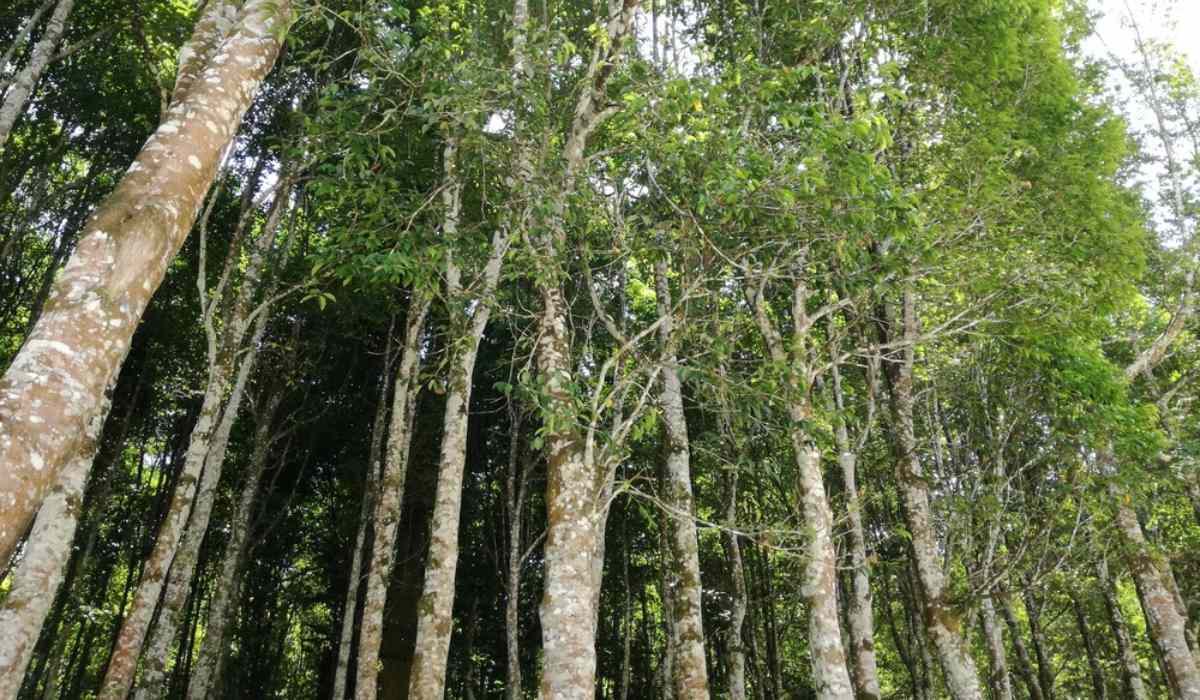
“Agarwood tree” is a functional trade term for certain trees capable of producing agarwood, not a single botanical name. The best-known genus is Aquilaria; Gyrinops also includes agarwood-producing taxa. Both are accepted genera in Thymelaeaceae, although molecular studies show that relationships within tribe Aquilarieae are more complex than a simple visual split between the two.
A healthy trunk is normally dominated by pale, non-resinous wood. Injury and the tree’s subsequent biochemical and biological responses can change localized tissue, producing the aromatic, resin-enriched material traded as agarwood. Therefore, species identity, tree origin, resin formation and final product grade are separate questions.
How are agarwood trees classified?
Aquilaria and Gyrinops are eudicot flowering-plant genera in the order Malvales and family Thymelaeaceae. Older page copy incorrectly labelled them monocots. Kew’s current backbone gives this hierarchy:
| Rank | Classification | Practical meaning |
|---|---|---|
| Kingdom | Plantae | Plants |
| Phylum | Streptophyta | Land plants and close relatives in Kew’s hierarchy |
| Class / subclass | Equisetopsida / Magnoliidae | Flowering-plant lineage; not a monocot classification |
| Order | Malvales | The order also includes several other woody flowering-plant families |
| Family | Thymelaeaceae | The family containing Aquilaria and Gyrinops |
| Tribe | Aquilarieae | A research grouping used for the two closely related genera |
| Genus | Aquilaria or Gyrinops | The genus alone does not establish the exact source species of a finished product |
Kew accepts Aquilaria as a genus with 21 species, native overall from Assam and southern China to New Guinea. Kew accepts Gyrinops as a genus with nine species, native from Sri Lanka to New Guinea. Accepted names and counts can change with taxonomic revision, so this page records its check date rather than presenting a permanent total.
Which Aquilaria species are commonly discussed?
Four frequently discussed accepted species are A. malaccensis, A. crassna, A. sinensis and A. filaria, but they do not share one identical native range. Country of sale or processing must not be treated as proof of botanical origin.
| Accepted species | Native range summarized from Kew POWO | Evidence boundary |
|---|---|---|
| Aquilaria malaccensis | Bangladesh to western and central Malesia, including Assam, Bangladesh, Borneo, East Himalaya, Malaya, Myanmar, Philippines, Sumatra, Thailand and Vietnam | A broad natural range does not prove the origin of a particular chip, oil or bead |
| Aquilaria crassna | Indochina: Cambodia, Laos, Myanmar, Thailand and Vietnam | “Vietnamese origin” can be compatible with this range, but needs batch evidence |
| Aquilaria sinensis | Southeastern China and Hainan; recorded by Kew as introduced in Vietnam | Native, introduced and cultivated ranges are different concepts |
| Aquilaria filaria | Eastern Philippines to western New Guinea, including Maluku, New Guinea and the Philippines | Wet-tropical ecology cannot be generalized to every Aquilaria species |
Use the dedicated agarwood distribution guide for a fuller native-versus-cultivated range comparison.
What biological characteristics can help identify an agarwood tree?
Habit, bark, leaves, venation, flowers, fruit and seeds can narrow an identification, but they should be assessed together and against a species-level botanical key. Many Aquilaria species look similar, and a single leaf or internet photograph can support only a tentative identification.
| Character | What to record | What it cannot prove alone |
|---|---|---|
| Whole-tree habit | Tree or shrub form, trunk, branching and verified scale | Exact species, age or resin content |
| Bark and wood | Bark texture/color, wounds and whether sampled wood is pale or resin-enriched | Species or product grade from darkness alone |
| Leaves | Arrangement, blade dimensions, apex/base, margin, petiole, lateral veins and underside hairs | Species when only a generic “glossy leaf” description is available |
| Flowers | Position, floral parts, color, hair and collection date | Agarwood formation or quality |
| Fruit and seed | Capsule form, valves, seed attachment and mature measurements | Commercial provenance without a collection record |
| Location | Coordinates, habitat and whether wild, introduced or cultivated | Native status or species identity by country alone |
A reliable record should include photographs with scale, collection locality, date and reproductive structures where possible. A botanist can compare these with a flora or herbarium voucher. If the material is processed or morphology overlaps, molecular testing may be needed.
Can leaves or wood color identify the species?
No. Leaf and wood appearance are screening observations, not stand-alone species tests. Environment, tree age, injury, processing and image conditions can change what a buyer sees. Resin enrichment can darken part of the wood, but dark color does not prove an Aquilaria species, origin, legality or quality grade.
When is DNA barcoding useful?
DNA barcoding can provide stronger species evidence than appearance alone, especially for wood chips, blocks and other processed material. A peer-reviewed study tested eight loci across seven Aquilaria species and found that the trnL–trnF + ITS2 combination produced useful species resolution in its reference set and blind product samples. This does not make one marker universal: results depend on sample quality, the loci used and a verified reference library.
Later plastome studies have explored additional highly variable regions. The practical lesson for buyers is conservative: a seller’s species claim should be treated as disclosure unless it is linked to a traceable botanical record or a suitable lab report. Read the real-versus-fake agarwood evidence checks for product-level verification.
Does every agarwood tree contain agarwood?
No. A tree’s botanical identity does not mean that every part of its trunk contains commercially useful resin-rich wood. Agarwood formation is localized and variable. Wounding can initiate defense responses, while microbial communities and tree physiology may influence the process; research does not support a universal “one fungus creates agarwood” formula.
Artificial inoculation methods also differ in injury pattern, inoculum, tree condition and evaluation period. The resulting presence, extent and chemistry of resinous tissue must be assessed rather than assumed. See the formation and inoculation evidence guide.
Where do agarwood-producing trees grow?
The combined native range of Aquilaria spans South and Southeast Asia into New Guinea, while individual species occupy narrower and different ranges. Some species are associated primarily with wet tropical biomes; A. sinensis is recorded by Kew mainly in a subtropical biome. Cultivation outside a native range does not make that place the species’ native origin.
For a planted tree, record the nursery, seed or parent-tree source, species identification method and planting site. For international movement, check the product form, source and destination rules rather than assuming plantation origin removes all requirements.
What does CITES Appendix II mean for agarwood trees?
Appendix II regulates international trade; it is not a statement that every specimen is illegal or that all species have the same extinction-risk category. The 2023 CITES timber guide lists Aquilaria spp. and Gyrinops spp. in Appendix II with Annotation #14, which defines the covered parts and derivatives and specific exemptions.
Legal checks should identify species or declared taxon, source (wild or artificially propagated), product form, country of export/re-export and destination. Read the dated CITES and U.S. legality guide before importing plants, wood or oil.
How should an agarwood tree be identified?
Use a chain of evidence, escalating from documentation and morphology to expert or molecular confirmation when the decision matters.
- Define the question. Decide whether you need genus, species, geographic origin, resin presence or commercial grade; these are not interchangeable.
- Record provenance. Keep supplier/nursery, parent or seed source, coordinates, cultivation status, date and lot or specimen identifier.
- Photograph diagnostic material. Include habit, bark, both leaf surfaces, flowers, mature fruit and seeds with a scale.
- Use a species-level botanical reference. Compare the complete character set and current accepted name, not a generic social-media photo.
- Retain a voucher where appropriate. A qualified botanist or herbarium can document the identification.
- Escalate processed or high-value material. Consider a suitable DNA method or other lab evidence with transparent reference samples and limitations.
How is tree identification different from agarwood grading?
Tree identification answers “what taxon is this?”; grading asks about the properties and evidence of a particular resinous material or product. Species and origin can affect expectations, but neither automatically proves resin content, scent preference, purity, legal provenance or price. Use the agarwood quality and grading framework for product evaluation and the types and identification guide for trade terminology.
Frequently asked questions
Is an agarwood tree the same as an oud tree?
Usually, yes in everyday trade language. “Oud tree” commonly refers to an agarwood-producing Aquilaria or Gyrinops tree. Oud more precisely refers to agarwood or its aromatic products, while the living plant should be identified botanically.
Are agarwood trees monocots?
No. Kew classifies Aquilaria and Gyrinops in the order Malvales and family Thymelaeaceae. They are eudicot flowering plants, not monocots.
How many Aquilaria species are there?
Kew Plants of the World Online accepted 21 species when this page was checked on August 13, 2026. Counts can change as names and relationships are revised, so use a current taxonomic source.
Can every Aquilaria tree produce agarwood?
The genus includes agarwood-producing species, but a living tree does not automatically contain a useful amount of resin-rich wood. Formation is localized and varies with injury, tree response, time and other biological factors.
Can I identify an agarwood tree from its leaves?
Leaves can narrow the possibilities, but similar morphology makes leaf-only identification unreliable. Flowers, fruit, location, provenance, a botanical key and sometimes DNA evidence are needed for a defensible species claim.
Are all agarwood trees endangered?
Do not apply one conservation category to every species. Species-level risk assessments differ and can change. International trade in Aquilaria and Gyrinops is covered by CITES Appendix II with Annotation #14, which is separate from an IUCN risk category.
Editorial method and limitations
Last substantive review: August 13, 2026. Oudgo Editorial Team compared current Kew taxonomic records, CITES listings and peer-reviewed phylogeny/DNA-barcode studies. We did not physically voucher or DNA-test the trees shown in legacy site images; captions therefore distinguish the media label from independent species proof. This page provides botanical and trade education, not a permit decision or laboratory identification.
Sources
- Royal Botanic Gardens, Kew — Aquilaria accepted genus, classification, range and species list
- Royal Botanic Gardens, Kew — Gyrinops accepted genus, classification, range and species list
- Kew POWO — Aquilaria malaccensis
- Kew POWO — Aquilaria crassna
- Kew POWO — Aquilaria sinensis
- Kew POWO — Aquilaria filaria
- CITES — CITES and Timber 2023 guide, Aquilaria/Gyrinops listing and Annotation #14
- Lee et al. — genome size, molecular phylogeny and evolutionary history of Aquilarieae
- Lee et al. — DNA barcoding of Aquilaria and market-product species authentication
- Hishamuddin et al. — plastome regions and DNA-barcoding applications for agarwood products
- Ding et al. — chromosome-level genome and documented morphology of Aquilaria sinensis
